
How LUMS Decides Admission 2027: Merit Explained
LUMS does not publish a merit formula or any weightage. It lists six things it evaluates, from your academic record and admission test to an interview if you are called. Here is what each one means, how a decision is reached, and where financial aid and NOP fit in.
By ParhaiKrlo Team · Published 29 Sept 2026 · 7 min read
Updated: 29 September 2026
Students ask for the "LUMS aggregate formula" the same way they ask for MDCAT merit: so many percent for marks, so many for the test. LUMS doesn't work like that, and it says so in its own way. This page sets out what LUMS actually says it evaluates, how an application moves from submission to a decision, and what LUMS does not publish.
Quick answer: is there a LUMS merit formula?
No published one. LUMS lists the things it evaluates but gives no weightage, no aggregate formula and no cutoff. Its own answer to "what criteria does the school use?" is that decisions are "based on a holistic assessment of each applicant's academic achievements, test results, and overall profile."
Any "LUMS aggregate" formula you see online is someone's guess, not LUMS's.
What LUMS looks at
On every undergraduate programme page, LUMS lists six criteria it evaluates eligible applicants on. Here is what it says about each.
1. Academic background. Your Matric/O Level and intermediate/A Level record. You first have to meet the minimum marks for your school, which our LUMS eligibility criteria post covers. LUMS says private candidates are evaluated on their grades the same way as regular students.
2. Performance in the admission test. One of the SAT, ACT or LCAT. Law applicants also need the Law Admission Test (LAT).
3. Online application submission. The application form itself, submitted by the deadline. LUMS processes applications "based on the information provided" in the form, so what you write there is what gets evaluated.
4. Supporting documents and fee payment. Scanned documents and the processing fee, both by the deadline. LUMS will not consider incomplete applications. You also need at least two teacher evaluations, submitted directly by teachers from your current or last institution. LUMS doesn't accept recommendations from school or college counsellors.
5. Application review. Shortlisted applications are reviewed by a committee. LUMS asks applicants to "provide complete information regarding their academic achievements and extracurricular activities" and to "tell LUMS about their success stories."
6. Interview (if called). LUMS says some candidates may be called for an interview. More on this below.
LUMS also says there are no quotas, and that all applicants, "regardless of citizenship", are held to the same standards and criteria.
How the pieces fit together
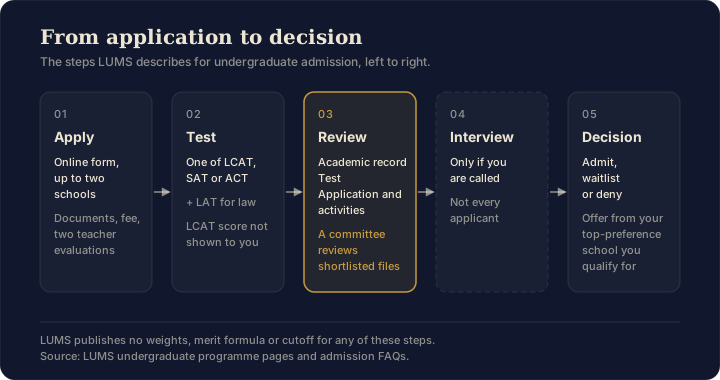
This is the path an application takes, as LUMS describes it:
- You apply through the online portal, choosing up to two schools and listing your major preferences.
- You complete the file: documents, fee, teacher evaluations and, if you want aid, the financial aid application. LUMS says your application is evaluated only once all of these are in.
- You sit the admission test, or send your SAT/ACT scores.
- Each school selects its own students. LUMS says applicants "are selected on the basis of the programme requirements of that particular school."
- Shortlisted applications go to a committee for review. LUMS says some candidates may be called for an interview.
- You get a decision. Some applicants are admitted, some are waitlisted, and the rest are denied. LUMS says acceptances are offered between April and July, so friends can hear at different times.
Two details change how you should fill in the form. First, if you qualify for more than one school, LUMS sends you an offer from your highest-preference school that you qualify for, so order your preferences carefully. Second, you are admitted to a school, not a major. The exceptions are the BA-LL.B at SAHSOL and a specialist stream some students are offered at SBASSE. At MGSHSS you are admitted to either the Humanities and Social Sciences stream or the Economics stream, and LUMS says transfers between them are not possible except in exceptional circumstances.
The waitlist is real. If seats open up after the first round of offers, waitlisted students are offered places in a second round. LUMS says its decisions are final, and it can't give feedback on unsuccessful applications.
Test score: LCAT vs SAT/ACT
LUMS treats the three tests as alternatives. You need one of them. It doesn't say anywhere that one is preferred over another in selection.
What differs is what LUMS sees and what you see:
- SAT/ACT: you must report every attempt, and LUMS uses your best score from a single attempt. There's no minimum SAT or ACT score.
- LCAT: your score isn't disclosed to you, and it's valid for one academic year.
If you take the LCAT and also have SAT or ACT scores, LUMS encourages you to submit those as well. For what LUMS does and doesn't say about LCAT scoring, see LCAT passing marks.
Law (SAHSOL): the LAT is required on top of the SAT, ACT or LCAT. LUMS says it's a requirement set by the Supreme Court of Pakistan for admission to the five-year LL.B. It doesn't say how the LAT is weighed against your other test.
Interviews (and what about essays?)
Interviews. Each school's page (SDSB, MGSHSS, SBASSE and SAHSOL) says the same thing: "Some candidates may be called for an interview." So interviews aren't for everyone, and LUMS doesn't publish who gets called or how an interview is scored. If you're called, it's part of the evaluation.
Essays. LUMS doesn't list an admissions essay or personal statement on its public admission pages. What it does ask for is a complete application form, including your academic achievements, extracurricular activities and "success stories", plus two teacher evaluations.
Financial aid and NOP: do they affect admission?
Financial aid. LUMS doesn't describe its undergraduate admissions as "need-blind", and it doesn't say directly whether applying for aid affects your admission decision. What it does say: you can only open the aid application after submitting your admission application and paying the fee, and aid is assessed on "academic performance, demonstrated financial need, available resources, and university policies." The National Outreach Programme FAQ describes the order for regular applicants who apply for aid: "If you get admission in LUMS, your case will be reviewed by the Financial Aid Committee." If aid matters to you, apply for it on time. Missing the aid deadline makes you ineligible for aid assessment that year.
National Outreach Programme (NOP). NOP is a fully funded, need-based scholarship, not a separate or easier route in. On admissions, LUMS says:
- NOP candidates "have to fulfill the same academic criteria as other students applying through regular stream". In LUMS's words, it "does not compromise on merit."
- NOP students apply for admission "along with other regular students" and take the admission test.
- There's no annual, provincial or city quota. Candidates who meet the NOP criteria "and qualify on LUMS merit" are offered admission with the scholarship.
NOP starts early: LUMS says students apply to its Summer Coaching Session in their first year of intermediate or A Levels. See nop.lums.edu.pk for its own eligibility rules.
What actually strengthens your application
Everything here comes straight from what LUMS says it evaluates:
- Clear the minimum with room to spare. The minimum only lets you apply. LUMS's figures for its undergraduate Class of 2029/30 show an average FSc/ICS score of 88%, an average Matric score of 93% and an average SAT of 1380. These are averages for one class, not cutoffs, but they show the level of the pool.
- Prepare properly for your one test. It's one of the six criteria, and for the LCAT you won't see your score, so practice tests are your only feedback.
- Fill in the activities and achievements sections completely. LUMS asks you to substantiate your application with them.
- Pick teachers who know your work for the two evaluations, and make sure they submit on time.
- Order your school preferences deliberately. Your offer comes from your highest-preference school that you qualify for.
- Submit everything by the deadlines. Incomplete or late files aren't evaluated at all.
Frequently Asked Questions
Does LUMS have a merit formula?
No published one. LUMS lists six things it evaluates: academic background, performance in the admission test, the online application, supporting documents and fee, application review, and an interview if called. It gives no weightage or aggregate formula, and says decisions are based on a holistic assessment of each applicant's academic achievements, test results and overall profile.
Is LCAT more important than FSc marks?
LUMS does not say. Your academic background and your admission test are two of the six criteria it lists, and it publishes no weights for any of them. You must first meet the minimum marks for your school, and LUMS's figures for its Class of 2029/30 show an average FSc/ICS score of 88%, so both your marks and your test matter.
Does everyone get an interview at LUMS?
No. Each school's programme page (SDSB, MGSHSS, SBASSE and SAHSOL) says some candidates may be called for an interview. LUMS does not publish who is called or how the interview is scored.
Does applying for financial aid affect LUMS admission?
LUMS does not describe its undergraduate admissions as need-blind and does not say directly either way. Its National Outreach Programme FAQ says that for regular applicants who apply for aid, if you get admission, your case is then reviewed by the Financial Aid Committee. NOP candidates must meet the same academic criteria as everyone else.
Is SAT treated the same as LCAT at LUMS?
LUMS accepts the SAT, ACT or LCAT as alternatives and does not say that one is preferred in selection. For the SAT and ACT you report every attempt and LUMS uses your best single attempt, with no minimum score. LCAT scores are not disclosed to applicants and are valid for one academic year.
Next steps
LUMS won't give you a formula, but it does tell you what it evaluates. The parts you control most are your test preparation and a complete, careful application.
- LUMS eligibility criteria 2027: the minimum marks for each school.
- LCAT 2027 dates and deadlines: what LUMS has announced for the Fall 2027 cycle.
- LCAT passing marks: what LUMS says about scoring and cutoffs.
- LUMS preparation hub: everything LCAT in one place.
- Full-length LCAT mocks: timed practice with instant scoring and a subject-by-subject breakdown.
We will update this page if LUMS publishes anything new about how it selects students.