
LCAT Math & Verbal Sections Explained (2027)
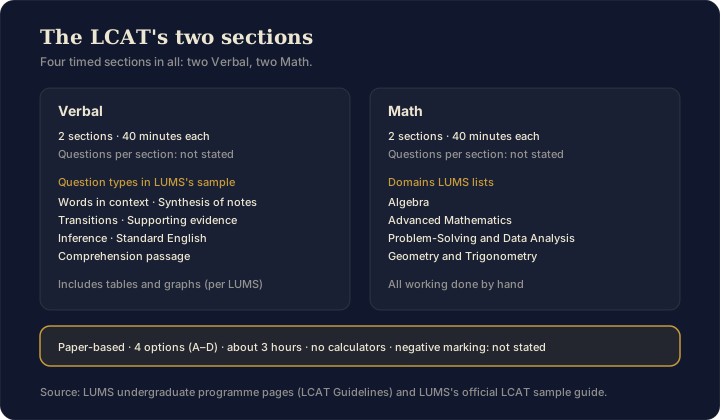
The LCAT has four sections: two Verbal and two Math, 40 minutes each, on paper and with no calculator. Here is what each section tests, the question types LUMS's own sample shows, four worked examples, and how to approach each section on test day.
By ParhaiKrlo Team · Published 29 Sept 2026 · 8 min read
Updated: 29 September 2026
Our LCAT preparation guide covers the format, the eight content domains and study plans. This post goes one level deeper: what the questions in each section actually look like, how to work through them, and the mistakes that cost marks. Every fact about the test comes from LUMS's programme pages or its official LCAT sample guide.
Quick answer: what's in the LCAT?
- Two kinds of section only: Verbal and Math. LUMS lists 4 sections: two Verbal and two Math.
- 40 minutes per section. LUMS gives the total as "approximately 3 hours".
- Paper-based multiple choice with four options (A–D). You fill in circles on an answer sheet.
- No calculators in any part of the test.
- Not published: the number of questions per section and whether there is negative marking.
LCAT at a glance
| Section | Questions | Time | What it tests |
|---|---|---|---|
| Verbal (2 sections) | Not stated by LUMS | 40 minutes each | Reading and writing: Craft and Structure, Information and Ideas, Standard English Conventions, Expression of Ideas |
| Math (2 sections) | Not stated by LUMS | 40 minutes each | Algebra, Advanced Mathematics, Problem-Solving and Data Analysis, Geometry and Trigonometry |
LUMS calls the LCAT "similar to the SAT, though it may differ in terms of duration and format", and its sample guide recommends SAT practice material. It doesn't list any other section, such as analytical or logical reasoning. If a site tells you there's a reasoning section, or quotes a question count, that isn't from LUMS.
The Math section
LUMS's guide names the ground directly: algebra, linear equations, logarithms, inequalities, data interpretation, ratios, percentages, quadratic and exponential functions, and geometry and trigonometry, "particularly understanding area and volume." It adds that the list is a guideline: not every topic is guaranteed to appear, and the test isn't limited to them.
The Math questions in LUMS's official sample are short and self-contained. They are:
- Word problems with a model. A situation, a simple equation, and a question about what the equation means.
- Direct calculations. A length, an area, a term of a sequence, a percentage change.
- Properties rather than values. Things like the sum of a quadratic's roots or the sign of a trig ratio, which have a fast route if you know the property.
None of them needs long algebra, but every one has to be done by hand. Here are two examples of the kind of question to expect, from our own LUMS sample papers.
Example 1: percentages (Problem-Solving and Data Analysis)
An item's price is reduced by 25% and then increased by 40% of the reduced price. Compared with the original price, the final price is
A) 5% higher B) 5% lower C) unchanged D) 15% higher
Answer: A. Percentage changes multiply; they don't add. Take the original price as 100. A 25% cut gives 75. A 40% rise on 75 is 30, giving 105. That's 5% higher than 100. Option D is the trap: 40 − 25 = 15 only works if both percentages apply to the same base, and here they don't.
Example 2: quadratics (Advanced Mathematics)
How many real solutions does the equation x² + 8x + 17 = 0 have?
A) Two distinct real solutions B) Exactly one real solution C) Infinitely many real solutions D) No real solutions
Answer: D. You don't need to solve it, only to check the discriminant: b² − 4ac = 64 − 68 = −4. A negative discriminant means no real solutions. A quick check: x² + 8x + 17 = (x + 4)² + 1, which is always at least 1, so it can never equal 0.
The Verbal section
LUMS describes the Verbal sections as combining reading and writing. Its official sample shows these question types:
- Words in context. A sentence with a blank; choose the word whose meaning fits the logic of the sentence, not just one that sounds right.
- Synthesis. A student's notes in bullet points; choose the statement that combines them for a stated purpose.
- Transitions. Two sentences; choose the linking word that shows how they relate.
- Supporting evidence. A short description of a book or claim; choose what would best support it.
- Inference. A short text; work out what the author thinks, from the wording.
- Standard English. Complete a sentence so it's grammatically correct, often at a sentence boundary.
- A comprehension passage followed by several questions on its summary, details and trends. In LUMS's sample, the passage is full of figures.
That last point matters. LUMS's "Information and Ideas" domain explicitly includes "informational graphics such as tables and graphs", so expect numbers in the Verbal section too. The official directions ask you to choose the answer "based on the passage", not on what you already know about the topic.
Example 3: transitions (Expression of Ideas)
The 2005 earthquake destroyed most unreinforced stone buildings in the Kaghan valley's lower settlements. ____ traditional timber-laced stone buildings in the same settlements, built with flexible joints, largely survived the shaking. Which transition best completes the text?
A) Consequently, B) In short, C) Similarly, D) By contrast,
Answer: D. Name the relationship before you look at the options. The first sentence says one kind of building was destroyed; the second says another kind survived. That is a contrast. "Consequently" would mean the survival was caused by the destruction. "Similarly" would mean both groups fared alike. "In short" would mean the second sentence summarises the first. Only "By contrast" fits.
Example 4: sentence boundaries (Standard English Conventions)
The ski lift was upgraded in 2016 ____ breakdowns have still occurred during peak season in three subsequent winters. Which choice completes the text so that it conforms to the conventions of Standard English?
A) , B) , however C) and which D) ; nevertheless,
Answer: D. Both halves are complete sentences, so they need a proper boundary between them. A comma alone (A) is a comma splice. "However" after a comma (B) is still a comma splice, because "however" isn't a conjunction. "And which" (C) leaves the second half with no clear grammatical link. A semicolon followed by "nevertheless," (D) joins two independent clauses correctly and signals the contrast.
How to approach each section
Pace by section, not by the whole test. Each section is 40 minutes. LUMS doesn't publish how many questions a section has, so you can't work out a per-question time in advance. When a section starts, count its questions and set yourself a halfway checkpoint at 20 minutes.
Don't let one question eat your time. If a question isn't moving after a real attempt, note its number and move on. Come back to it if time allows. LUMS doesn't publish rules on rough work, so follow the invigilator's instructions on where you may write.
Guessing. LUMS doesn't say whether the LCAT has negative marking. Read the instructions printed on your paper and follow them. If wrong answers cost nothing, don't leave a blank. If they are penalised, guess only when you can rule out options.
Math without a calculator. Keep numbers as fractions for as long as possible. Use properties (discriminants, sums of roots, special right triangles) instead of long calculation. When the options are far apart, estimate and eliminate.
Verbal: answer from the text. Before you look at the options, decide what kind of answer you need: a contrast, a cause, a summary, a complete sentence. Then pick the option that matches, and check it against the passage, not against your general knowledge.
Fill in the answer sheet carefully. It's a paper test with an answer sheet. Every few questions, check that your circle is on the right question number. One skipped line can shift a whole run of answers.
Common mistakes
- Practising with a calculator. LUMS says calculators aren't allowed. Practice that uses one doesn't carry over to test day.
- Treating Verbal as a vocabulary list. Words-in-context questions test which word the sentence's logic needs, not whether you know a dictionary meaning.
- Thinking charts are Math-only. Tables and graphs are part of LUMS's Verbal domain.
- Trusting unofficial numbers. LUMS publishes no question count, cutoff or negative-marking rule. Anyone who quotes one is guessing. See LCAT passing marks for what LUMS does and doesn't say about scoring.
- Adding percentage changes. As Example 1 shows, successive percentages multiply.
- Answer-sheet slips. A correct answer in the wrong circle scores nothing.
Frequently Asked Questions
How many sections are in LCAT?
Four: two Verbal and two Math. LUMS gives each section 40 minutes and describes the total test as approximately 3 hours. LUMS does not list any other section, such as analytical reasoning, and it does not publish how many questions each section has.
Is there negative marking in LCAT?
LUMS does not say on its public pages or in its official sample guide whether the LCAT has negative marking. Read the instructions printed on your test paper and follow them: if wrong answers cost nothing, do not leave blanks; if they are penalised, guess only when you can rule out options.
Can I use a calculator in LCAT?
No. LUMS states that calculators are not allowed during any part of the test, and its sample guide tells applicants to practise accuracy in manual calculations. Do all your Math practice by hand.
What topics come in LCAT Math?
LUMS lists four domains: Algebra, Advanced Mathematics, Problem-Solving and Data Analysis, and Geometry and Trigonometry. Its guide names algebra, linear equations, logarithms, inequalities, data interpretation, ratios, percentages, quadratic and exponential functions, and area and volume, and says the list is a guideline rather than a guarantee of what will appear.
How do I prepare for LCAT Verbal?
Practise the question types in LUMS's sample: words in context, synthesis of notes, transitions, supporting evidence, inference, Standard English sentence completion and a comprehension passage. Expect tables and figures in Verbal too, answer from the text rather than general knowledge, and time yourself at 40 minutes per section.
Practise both sections
The quickest way to find out which question types slow you down is to sit timed sections under test conditions, then review every mistake by type.
- Full-length LCAT mocks: timed Verbal and Math practice with instant results and explanations.
- LUMS preparation hub: all our LCAT practice in one place.
- LCAT preparation guide: domains and 30, 60 and 90-day study plans.
- LCAT 2027 dates and deadlines: what LUMS has announced so far.
- How LUMS decides admission: where the test fits in the decision.
We will update this page if LUMS changes the test format or publishes new details.