
MDCAT Biology Chapter-wise Weightage 2027 — 16 Years of Past Paper Data
Biology is 45% of the current MDCAT pattern, but only the 2025 paper has ever tested it that heavily. We analyzed 1,270 real Biology MCQs across all available papers (2008–2025) to find which chapters actually carry the weight for MDCAT 2027.
By ParhaiKrlo Team · Published 8 Sept 2026 · Updated 10 Oct 2026 · 8 min read
Biology is 45% of the current MDCAT pattern — 81 of 180 MCQs, the single biggest chunk of the paper. That was the split in MDCAT 2025 and MDCAT 2026, and PMDC hasn't announced any change for MDCAT 2027, so it's the number to prepare against. Every prep site quotes that number. Almost none of them tell you which Biology topics actually rack up the marks, because doing that requires real test data, not just a copy of the syllabus PDF.
We have that data. ParhaiKrlo's database holds 3,364 verified, topic-tagged past-paper MCQs spanning all 16 available MDCAT/pre-MDCAT papers from 2008 to 2025 (2020–2021 have no papers). 1,270 of those are Biology, each one tagged down to the exact subtopic. So instead of guessing which chapters matter most, we counted.
The headline finding: until 2025, no past paper in that archive tested Biology at anywhere close to 45%. The old UHS papers (2008–2019) ran Biology at 31–41% of the paper, and the 2022–2024 PMDC papers at about 34%. The 2025 paper was the first to hit 81 of 180, and MDCAT 2026 kept that split. That gap matters for how you plan your prep, and we'll get into what it means below. First, the official numbers, then what the papers actually show, topic by topic.
The official PMDC Biology weightage
Per the MDCAT 2027 syllabus guide, which follows the 180-MCQ pattern used in 2025 and 2026, Biology is the largest single subject on the paper:
| Subject | MCQs | Weightage |
|---|---|---|
| Biology | 81 | 45% |
| Chemistry | 45 | 25% |
| Physics | 36 | 20% |
| English | 9 | 5% |
| Logical Reasoning | 9 | 5% |
| Total | 180 | 100% |
PMDC's official curriculum breaks Biology into 16 units — Acellular Life, Bioenergetics, Biological Molecules, Cell Structure & Function, Coordination & Control, Enzymes, Evolution, Reproduction, Support & Movement, Inheritance, Circulation, Immunity, Respiration, Digestion, Homeostasis, and Biotechnology. That list tells you what's examinable. It doesn't tell you what actually gets examined most — for that, you need years of real papers, not a syllabus document. See the full Biology syllabus for the complete topic tree with subtopics.
What 16 years of past papers actually show
We pulled every active, topic-tagged Biology MCQ from every past paper on ParhaiKrlo (2008–2019 and 2022–2025 — 2020–2021 have no available papers) and counted them by topic. 1,270 questions, cleanly tagged, zero untagged stragglers.
| Topic | Past-paper MCQs | % of Biology | Priority |
|---|---|---|---|
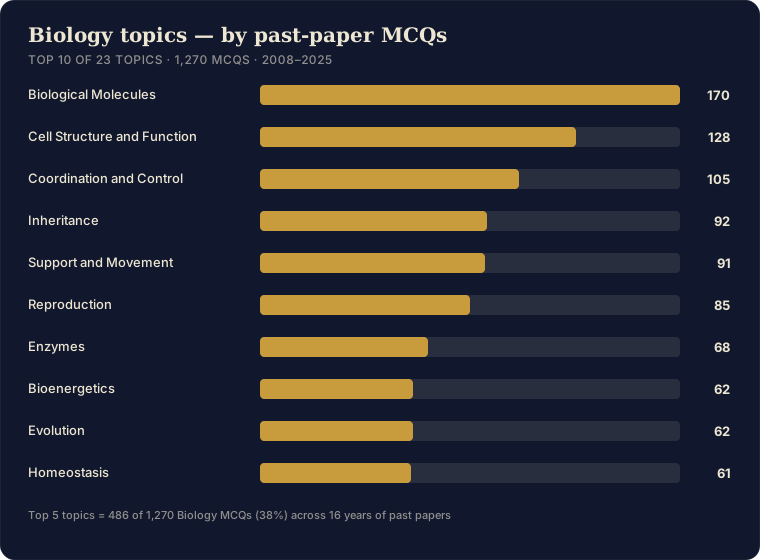
| Biological Molecules | 170 | 13.4% | High |
| Cell Structure and Function | 128 | 10.1% | High |
| Coordination and Control | 105 | 8.3% | High |
| Inheritance | 92 | 7.2% | High |
| Support and Movement | 91 | 7.2% | High |
| Reproduction | 85 | 6.7% | Medium |
| Enzymes | 68 | 5.4% | Medium |
| Bioenergetics | 62 | 4.9% | Medium |
| Evolution | 62 | 4.9% | Medium |
| Homeostasis | 61 | 4.8% | Medium |
| Immunity | 49 | 3.9% | Medium |
| Acellular Life | 47 | 3.7% | Medium |
| Digestion | 47 | 3.7% | Medium |
| Circulation | 45 | 3.5% | Medium |
| Diversity of Life | 40 | 3.1% | Medium |
| Biotechnology | 31 | 2.4% | Low |
| Respiration | 26 | 2.0% | Low |
| Ecology | 20 | 1.6% | Low |
| Kingdom Plantae | 16 | 1.3% | Low |
| Cell Division | 9 | 0.7% | Low |
| Genetic Engineering | 7 | 0.6% | Low |
| Photosynthesis | 6 | 0.5% | Low |
| Growth and Development | 3 | 0.2% | Low |
The top 5 topics — Biological Molecules, Cell Structure and Function, Coordination and Control, Inheritance, and Support and Movement — account for 486 of 1,270 Biology MCQs, or 38% of every Biology question ever asked in a tagged past paper. That's a real, verifiable concentration, not a rough guess.
A couple of things worth calling out. First, this data mostly confirms what we said in our MDCAT syllabus guide about "highest-yield units" — four of the five topics we listed there match exactly. The one correction: we'd named Homeostasis as the fifth-highest-yield unit. The actual past-paper count puts Support and Movement ahead of it — 91 MCQs versus 61. Homeostasis is still solidly mid-table (4.8%), just not top-5.
Second, and more important: Biology's overall share of the archive sits well below today's 45%. Pre-2020 papers ran 38.1% Biology, and 2022–2024 papers ran about 34%. Only the 2025 paper matches the current split. In plain terms: if you're calibrating "how much Biology to expect" off past papers, every paper before 2025 undersells how Biology-heavy the current MDCAT is. Treat the 45%/81-MCQ target as the real number to prep against, and treat the topic proportions below as the reliable part of this data — they're what tells you where inside Biology the 81 marks are most likely to land.
The 5 highest-weight Biology topics (deep dive)
Biological Molecules — 170 MCQs (13.4%)
The single highest-yield Biology topic in 16 years of papers. Covers water's biological properties, carbohydrates, proteins, lipids, nucleic acids (DNA/RNA structure, Watson-Crick model), and genes. This is dense, testable content — structural details (bonds, functional groups, base pairing) are easy to turn into MCQs, which is likely why it dominates. See the Biological Molecules syllabus page for the full subtopic breakdown.
Cell Structure and Function — 128 MCQs (10.1%)
Animal vs. plant cell differences, prokaryotic vs. eukaryotic cells, organelle structure and function (nucleus, endoplasmic reticulum, Golgi apparatus, mitochondria), and chromosome structure. Foundational content that shows up across nearly every past paper we have. Full topic tree: Cell Structure and Function.
Coordination and Control — 105 MCQs (8.3%)
Receptors, neurons, nerve impulse transmission, reflex arcs, and brain structure/function. Consistently one of the most-tested physiology topics, likely because it overlaps heavily with clinically relevant content examiners like to probe. Details: Coordination and Control.
Inheritance — 92 MCQs (7.2%)
Mendel's laws, gene linkage, crossing over, and X-linked recessive conditions like hemophilia. Genetics questions are a past-paper staple — ratio and cross problems are easy to write as MCQs and easy to repeat with different numbers year to year. Full breakdown: Inheritance.
Support and Movement — 91 MCQs (7.2%)
Cartilage, bone, the three muscle types (smooth, cardiac, skeletal), joints, and conditions like arthritis. This is the topic our own earlier syllabus guide under-ranked — the past-paper data shows it's essentially tied with Inheritance for 4th place, not a second-tier topic. Full breakdown: Support and Movement.
Topics tested less than you'd expect
A handful of PMDC-listed units show up far less often than their place in the official 16-unit syllabus might suggest. Growth and Development is the clearest case: just 3 MCQs across all 16 years of tagged data, or 0.2% of every Biology question ever asked. Photosynthesis (6 MCQs, 0.5%), Genetic Engineering (7 MCQs, 0.6%), and Cell Division (9 MCQs, 0.7%) round out the bottom of the table.
None of these have zero questions, and none should be skipped outright — a topic that appears even once every couple of papers is still a topic PMDC considers examinable, and it can still show up on your specific paper. But if you're deciding where to spend a limited number of remaining revision hours, these four are the ones to deprioritize relative to their syllabus billing. They read as "full units" on paper; in 16 years of actual MDCAT history, they've barely moved the needle.
How to use this data to plan your Biology prep
-
Front-load the top 5. Biological Molecules, Cell Structure and Function, Coordination and Control, Inheritance, and Support and Movement make up 38% of every Biology MCQ ever tagged in our past-paper archive. If your revision time is limited, these five topics should get roughly proportionate priority over the other eighteen.
-
Don't skip the low-weightage topics entirely. Growth and Development, Photosynthesis, Genetic Engineering, and Cell Division are low-frequency, not zero-frequency. A student who covers them picks up 1–2 free marks over one who skipped them assuming "it never comes." Give them a single pass, not zero passes.
-
Calibrate to 45%, not to what older papers show. Since papers before 2025 (31–41% Biology) undersell the 45% share used in 2025 and 2026, don't let your practice-paper score convince you Biology matters less than it does. Weight your actual study time toward the official 81-MCQ target, and use the topic-level table above — not the overall subject share — as your guide to where inside Biology those marks concentrate.
-
Check your own gaps against the syllabus tree. Use /syllabus/biology to see every topic and subtopic broken down, and identify which ones you haven't touched yet — especially inside the top-5 topics, where a single missed subtopic can cost more marks than an entire low-weightage unit.
-
Practice by topic, not chronologically. Working through papers year by year is useful for exam-day pacing, but it mixes high- and low-yield content together. Use /practice to drill a single Biology topic at a time, and pull real past-paper questions filtered by the topics that matter most before your final revision pass.
Frequently Asked Questions
What is the total weightage of Biology in MDCAT 2027?
PMDC hasn't announced a change for 2027, so expect 81 out of 180 MCQs — 45% of the paper, the split used in MDCAT 2025 and 2026 and the largest single subject. This is higher than the 34% Biology carried in the 2022–2024 PMDC-era papers (68/200).
Which Biology topic has the most MCQs in past papers?
Biological Molecules, with 170 MCQs across 16 years of tagged past papers — 13.4% of every Biology question ever asked, ahead of Cell Structure and Function (128) and Coordination and Control (105).
Should I skip low-weightage Biology topics?
No. Topics like Growth and Development (0.2%) or Photosynthesis (0.5%) still appear on papers, just rarely. Covering them briefly is worth 1–2 free marks; spend the bulk of your time on the top-5 topics instead.
Does past-paper data match the official 45% Biology weightage?
Only the 2025 paper does. Papers from 2008 to 2019 tested Biology at 31–41%, and the 2022–2024 papers at about 34%, below today's 45%. Use the 45% figure to plan your overall study time, and the topic-level breakdown in this post to plan where inside Biology to focus.
Where can I practice MCQs for a specific Biology topic?
Use the practice page filtered by topic, or visit a topic's page under the Biology syllabus for subtopic-specific past-paper questions with explanations.