
MDCAT 2027 Syllabus — PMDC Weightage, Chapters & Paper Pattern
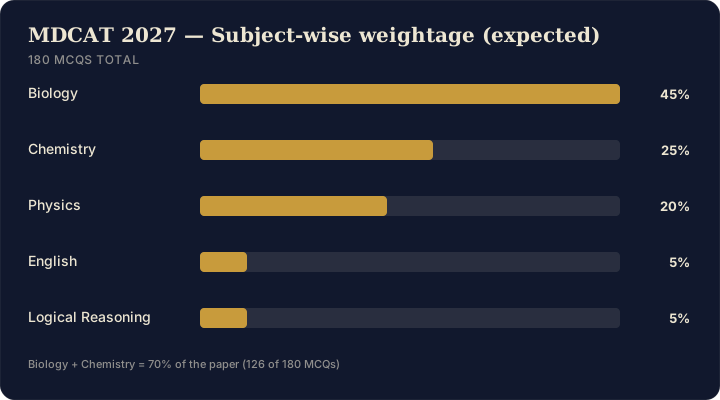
The MDCAT 2027 syllabus as it stands: PMDC's 180-MCQ pattern used in 2025 and 2026 (Biology 45%, Chemistry 25%, Physics 20%, English 5%, Logical Reasoning 5%), every chapter, and what PMDC hasn't announced yet.
By ParhaiKrlo Team · Published 30 Aug 2026 · Updated 10 Oct 2026 · 9 min read
If you're preparing for MDCAT 2027, the first thing you need to know is exactly what's on the exam. Not what your coaching center says. Not what an old blog claims. The official syllabus is set by PMDC (Pakistan Medical & Dental Council) and applies uniformly across all provinces — Punjab, Sindh, KPK, and Balochistan.
Has PMDC announced the MDCAT 2027 syllabus? Not yet. As of October 2026, PMDC hasn't published a separate 2027 curriculum, pattern or date. The current syllabus is the PMDC 2025 Curriculum, and it was used unchanged for both MDCAT 2025 and MDCAT 2026. Both papers had the same 180-MCQ pattern, so that's the pattern to prepare for. We'll update this page when PMDC announces anything for 2027.
MDCAT 2027 at a glance
- Total questions: 180 MCQs (the pattern used in 2025 and 2026)
- Total marks: 180 (each MCQ = 1 mark)
- Duration: 3 hours (180 minutes)
- Format: Paper-based, OMR sheet
- Negative marking: None in 2025 or 2026 — attempt every question
- Exam date: Not announced yet. MDCAT 2026 was held on Sunday, 20 September 2026, after being moved from 16 August, so don't plan around a fixed month.
- Passing marks: For MDCAT 2026 these were 55% (99/180) for medical and 50% (90/180) for dental. PMDC confirms the bars each year.
- Difficulty split: 15% easy, 70% moderate, 15% difficult (per the PMDC curriculum)
Subject-wise weightage
| Subject | MCQs | Weightage |
|---|---|---|
| Biology | 81 | 45% |
| Chemistry | 45 | 25% |
| Physics | 36 | 20% |
| English | 9 | 5% |
| Logical Reasoning | 9 | 5% |
| Total | 180 | 100% |
The math is clear: Biology and Chemistry together are 70% of the paper (126 MCQs out of 180). Get these two subjects right and you've secured most of your score. Physics is another 20%. English and Logical Reasoning are only 18 marks combined — worth preparing, but not worth over-investing time in.
Biology — 81 MCQs (45%)
Biology is the single biggest subject on MDCAT. Master it and you're nearly halfway to passing. The PMDC syllabus covers 16 units:
- Acellular Life — Viruses, AIDS and HIV
- Bioenergetics — Cellular respiration of proteins, fats, glucose
- Biological Molecules — Water, carbohydrates, proteins, lipids, RNA, conjugated molecules, DNA structure (Watson-Crick), genes
- Cell Structure & Function — Animal vs plant cells, prokaryotic vs eukaryotic, organelles (nucleus, ER, Golgi, mitochondria), chromosomes
- Coordination & Control — Receptors, neurons, nerve impulse, reflex arc, brain structure and function
- Enzymes — Characteristics, mechanism, factors affecting rate, inhibitors
- Evolution — Origin of life, Lamarckism, Darwinism (natural selection)
- Reproduction — Male and female reproductive systems, menstrual cycle, sexually transmitted diseases
- Support & Movement — Cartilage, bone, muscles (smooth, cardiac, skeletal), joints, arthritis
- Inheritance — Mendel's laws, gene linkage, crossing over, X-linked recessive (hemophilia)
- Circulation — Human heart, cardiac cycle, blood vessels, lymphatic system
- Immunity — Specific defense mechanisms
- Respiration — Respiratory system, gas exchange, effect of smoking
- Digestion — Digestive system parts and functions
- Homeostasis — Kidney structure and function, glomerular filtration, thermoregulation, excretion
- Biotechnology — Vaccines, disease diagnosis (DNA/RNA probes, monoclonal antibodies), treatment products
Highest-yield units: Biological Molecules, Cell Structure, Coordination & Control, Inheritance, Homeostasis. These consistently produce the largest number of questions. For the exact past-paper MCQ counts behind this list (and one correction — Support & Movement edges out Homeostasis for 5th place), see MDCAT Biology Chapter-wise Weightage.
Chemistry — 45 MCQs (25%)
Chemistry breaks into three sub-branches. The PMDC syllabus covers 20 units:
Physical Chemistry:
- Fundamentals of Chemistry — Moles, Avogadro's number, limiting reactants, yield calculations
- Atomic Structure — Proton, Planck's quantum theory, quantum numbers, orbital shapes, hydrogen spectrum, electronic configuration
- Gases — Kinetic molecular theory, STP, Boyle's/Charles's laws, absolute zero, ideal gas equation, real vs ideal gases
- Liquids — Properties, evaporation, boiling point, vapor pressure, hydrogen bonding, anomalous behavior of water
- Solids — Crystalline solids, ionic vs molecular crystals, crystal lattice, lattice energy
- Chemical Equilibrium — Le Chatelier's principle, solubility products, common ion effect, buffers, Haber's process
- Reaction Kinetics — Rate of reaction, factors, order of reaction, activation energy, rate constant
- Thermochemistry — Exothermic/endothermic, internal energy, first law, Hess's law, enthalpy
- Electrochemistry — Redox reactions, oxidation/reduction, balancing, standard hydrogen electrode
Inorganic Chemistry:
- Chemical Bonding — VSEPR theory, sigma/pi bonds, hybridization, dipole moment, bond energy
- s- and p-Block Elements — Trends, block classification, Group I/II/IV reactions
- Transition Elements — Electronic structure of d-block elements
Organic Chemistry:
- Fundamentals of Organic Chemistry — Definition, classification, functional groups, isomerism
- Hydrocarbons — Alkanes (free radical mechanism), alkenes, benzene (resonance, electrophilic substitution, nitration, sulphonation, halogenation, Friedel-Crafts), alkynes
- Alkyl Halides — Nomenclature, structure, substitution vs elimination mechanisms
- Alcohols & Phenols — Nomenclature, reactivity, ether/ester preparation, phenol chemistry
- Aldehydes & Ketones — Preparation, nucleophilic addition, reduction, oxidation
- Carboxylic Acids — Preparation, reactivity, conversion to acyl halides, anhydrides, esters
- Macromolecules — Protein classification, importance, enzymes as biocatalysts
- Industrial Chemistry — Adhesives, dyes, polymers (addition and condensation)
Highest-yield units: Chemical Bonding, Atomic Structure, Chemical Equilibrium, Hydrocarbons (especially benzene chemistry).
Physics — 36 MCQs (20%)
Physics is where students lose the most marks. Concepts matter more than formulas. The PMDC syllabus covers 16 units:
- Vectors and Equilibrium — Vector addition (rectangular components), scalar product, vector product
- Force and Motion — Displacement, velocity, acceleration, projectile motion (horizontal/vertical components, maximum height, range, time of flight, launch angle), Newton's laws, momentum, collisions
- Work and Energy — Work, kinetic and potential energy, absolute potential energy, power, work-energy theorem, efficiency
- Rotational and Circular Motion — Angular displacement, revolution, radian, angular velocity, relations between linear and angular quantities
- Fluid Dynamics — Terminal velocity, fluid drag, streamline vs turbulent flow, equation of continuity, Bernoulli's equation (with blood physics application)
- Waves — Wave motion, progressive waves, wave speed, transverse vs longitudinal, speed of sound (Newton's formula, Laplace's correction), superposition, interference, stationary waves, organ pipes, SHM
- Thermodynamics — Thermal equilibrium, molar specific heat, work in thermodynamic systems, first law, Cp − Cv = R
- Electrostatics — Coulomb's law, electric field, field intensity (point charge, infinite sheet), electric potential, capacitor charging/discharging
- Current Electricity — Steady current, Ohm's law, resistivity and temperature, internal resistance, maximum power transfer
- Electromagnetism — Magnetic flux density, magnetic flux, motion of charged particle in magnetic field
- Electromagnetic Induction — Faraday's law, Lenz's law, transformer (step-up and step-down)
- Alternating Current — Phase of AC, AC through resistor/capacitor/inductor, EM spectrum
- Electronics — Rectification (half and full wave), PN junction, forward/reverse biasing
- Dawn of Modern Physics — Photon model of light
- Atomic Spectra — Line spectra
- Nuclear Physics — Atomic nucleus composition, spontaneous decay, half-life, biological and medical uses of radiation
Highest-yield units: Force and Motion, Waves, Electrostatics, Current Electricity, Electromagnetic Induction.
English — 9 MCQs (5%)
Only 9 questions but easy marks if your grammar is solid. Focus areas from the PMDC syllabus:
- Reading and Thinking Skills — Scanning for short answers, deducing meaning from context, figurative language
- Formal and Lexical Aspects — Synonyms (with shades for irony/parody/satire), pronoun-antecedent agreement, tenses, infinitives and infinitive phrases, gerunds and gerund phrases, adverb positions, prepositions, transitional devices, punctuation, sentence classes, active/passive voice, direct/indirect speech
- Writing Skills — Proofreading, faulty sentence structure, subject-verb agreement, spelling errors
Strategy: Read one MDCAT English past paper per day for two weeks. Pattern recognition matters more than memorizing grammar rules.
Logical Reasoning — 9 MCQs (5%)
The newest section and the easiest to prepare. PMDC syllabus covers 6 themes:
- Critical Thinking — Separating truth from falsehood, evaluating beliefs with logic
- Letter and Symbol Series — Sequential orders based on arithmetic operations, geometrical progressions, letter/symbol rules
- Logical Deductions — Structured reasoning from short passages to accurate conclusions
- Logical Problems — Puzzle-solving with deductive reasoning
- Course of Action — Choosing correct administrative steps or follow-ups based on statements
- Cause and Effect — Identifying causal relationships between events
Strategy: Solve 10 LR questions daily for two weeks. Don't over-invest — 9 marks isn't worth 40 hours.
How to use this syllabus for your prep
1. Weight your study time by exam weightage. Biology is 45% of the exam, so it should be roughly 45% of your study hours. Most students spend disproportionate time on Physics because it feels "harder" and neglect Biology because it feels "easier" — that's a scoring mistake.
2. Start with high-yield units. In Biology: Biological Molecules, Cell Structure, Inheritance, Homeostasis. In Chemistry: Chemical Bonding, Atomic Structure, Benzene chemistry. In Physics: Force and Motion, Electrostatics, Current Electricity. These consistently produce the most questions year after year.
3. Practice with real MDCAT past papers. No textbook matches the value of solving actual UHS past papers. Questions repeat concepts and often even patterns. Every past paper you solve teaches you what MDCAT actually asks vs what your book covers.
4. Track your weak topics. Don't re-read chapters you already understand. Identify subtopics where you consistently miss questions and drill those.
5. Time yourself from day one. MDCAT gives you exactly 1 minute per question. If you can't hit that pace by exam day, no amount of knowledge will save you.
6. No negative marking — attempt every question. Even for questions you don't know, take an educated guess. You have nothing to lose.
Frequently Asked Questions
When is MDCAT 2027?
PMDC hasn't announced the MDCAT 2027 date yet. MDCAT 2026 was held on Sunday, 20 September 2026, after being moved from 16 August, so don't plan around a fixed month.
What are the passing marks for MDCAT 2027?
PMDC confirms the bars each year. For MDCAT 2026 they were 55% (99 out of 180) for medical and 50% (90 out of 180) for dental. The paper was 180 MCQs, each worth 1 mark, with no negative marking.
Is there negative marking in MDCAT?
There was no negative marking in MDCAT 2025 or MDCAT 2026, so you should attempt every question. Even for questions you don't know, take an educated guess, since you have nothing to lose by leaving nothing blank.
What is the MDCAT 2027 subject-wise weightage?
PMDC hasn't announced a change, so expect the split used in 2025 and 2026. Out of 180 MCQs: Biology is 81 MCQs (45%), Chemistry is 45 MCQs (25%), Physics is 36 MCQs (20%), English is 9 MCQs (5%), and Logical Reasoning is 9 MCQs (5%). Biology and Chemistry together make up 70% of the paper.
Has the MDCAT syllabus changed for 2027?
Not as of October 2026. PMDC hasn't published a separate 2027 syllabus. The current one is the official PMDC MDCAT 2025 Curriculum (dated 26 May 2025), which was used unchanged for MDCAT 2026. We'll update this guide if PMDC announces changes.
Start practicing today
You now know what MDCAT 2027 is expected to test. The next step is practice. If you're retaking after MDCAT 2026, our MDCAT 2027 plan for repeaters breaks the year into phases.
We have every MDCAT past paper from 2008 to 2025, with verified answer keys and explanations on every question. Two full papers and one sectional are free — no signup wall.
Take a free full-length mock →
Explore the full syllabus with topic-tagged questions →
Verified against the official PMDC MDCAT 2025 Curriculum PDF (dated 26 May 2025), which PMDC applied unchanged to MDCAT 2026. PMDC hadn't announced a 2027 syllabus or pattern when we checked on 8 October 2026. Last updated: October 2026.