
MDCAT Past Papers 2008–2025 — Complete Year-Wise Guide (Free Practice)
Every MDCAT past paper from 2008 to 2025, organised year by year. Every answer is checked against the official key — and against the science — and we say so wherever they disagree. Includes tips on how to use past papers without burning them out too early.
By ParhaiKrlo Team · Published 5 Sept 2026 · Updated 10 Oct 2026 · 6 min read
If you're preparing for MDCAT, past papers are the single highest-ROI resource you have. Not textbooks, not YouTube lectures, not Rs. 15,000 academies — past papers. UHS and PMDC recycle question patterns, favourite topics, and even exact concepts year after year. A student who has seriously worked through 10+ past papers walks into the exam hall with a huge information advantage.
This guide lists every MDCAT past paper we have on ParhaiKrlo, organised by year, with what makes each one worth your time.
Why past papers matter more than any other resource
MDCAT is a pattern exam. The concepts examinable are fixed by the PMDC national curriculum (see our complete syllabus guide), and every year around 60–70% of questions test the same core topics — genetics ratios in biology, stoichiometry in chemistry, kinematics and electromagnetism in physics. Past papers show you exactly which sub-topics UHS actually asks about, at what difficulty, and in what wording style.
Textbook practice makes you know the syllabus. Past papers make you ready for the exam.
Full year-wise breakdown
Every paper below has been transcribed and tagged by topic and sub-topic, and every answer checked against the official key — and against the science. If a question was defective or had no valid option in the original paper, we've left it out rather than guess an answer.
| Year | MCQs on ParhaiKrlo | Subjects | Notes |
|---|---|---|---|
| 2008 | 216 | Bio 69 / Chem 58 / Phys 60 / Eng 29 | Older UHS format, no Logical Reasoning section |
| 2009 | 213 | Bio 66 / Chem 58 / Phys 59 / Eng 30 | Similar structure to 2008 |
| 2010 | 219 | Bio 70 / Chem 60 / Phys 59 / Eng 30 | Solid coverage of biology fundamentals |
| 2011 | 220 | Bio 88 / Chem 58 / Phys 44 / Eng 30 | |
| 2012 | 219 | Bio 87 / Chem 58 / Phys 44 / Eng 30 | |
| 2013 | 218 | Bio 88 / Chem 58 / Phys 44 / Eng 28 | |
| 2014 | 214 | Bio 88 / Chem 55 / Phys 42 / Eng 29 | Strong genetics and stoichiometry emphasis |
| 2015 | 218 | Bio 87 / Chem 57 / Phys 44 / Eng 30 | Heavier diagram-based physics |
| 2016 | 216 | Bio 87 / Chem 58 / Phys 42 / Eng 29 | |
| 2017 | 216 | Bio 88 / Chem 54 / Phys 44 / Eng 30 | Official UHS Paper Code |
| 2018 | 219 | Bio 88 / Chem 58 / Phys 43 / Eng 30 | Official UHS Paper Code C |
| 2019 | 200 | Bio 80 / Chem 60 / Phys 40 / Eng 20 | Official UHS Paper Code A, last UHS-era paper |
| 2022 | 200 | Bio 68 / Chem 54 / Phys 54 / Eng 18 / LR 6 | First PMDC-era paper, Logical Reasoning introduced |
| 2023 | 195 | Bio 66 / Chem 54 / Phys 53 / Eng 16 / LR 6 | |
| 2024 | 197 | Bio 66 / Chem 53 / Phys 54 / Eng 18 / LR 6 | Last 200-MCQ paper |
| 2025 | 180 | Bio 81 / Chem 45 / Phys 36 / Eng 9 / LR 9 | Most recent paper in our archive; same 180-MCQ split as MDCAT 2026, and the pattern to expect for MDCAT 2027 |
Where a year shows fewer MCQs than the paper printed, the missing questions could not be recovered or had no valid answer; each paper's own note on ParhaiKrlo says which ones and why.
A note on trust: every answer here was checked against the official UHS/PMDC key — and against the science. Where the two disagree, we mark the answer the science supports, and that question's explanation says so and why (how we mark papers). Where the original source had a defective question (missing options, ambiguous phrasing, unresolved diagrams), we've switched it off rather than fabricating an answer, and the paper's note names it.
Three eras of MDCAT — what changed and why it matters
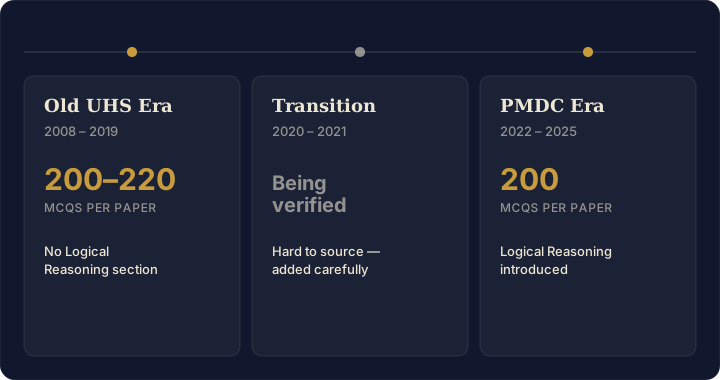
Old UHS era (2008–2019). Papers were 200–220 MCQs across Biology, Chemistry, Physics, and English. Biology carried the heaviest weight (usually 80–88 MCQs), no Logical Reasoning section existed, and paper codes were published officially. These papers are great for depth practice — the biology and chemistry conceptual coverage is very close to what PMDC still tests today.
Transition (2020–2021). Papers from this window are hard to source in reliable form and are being added carefully after verification. Don't panic if you don't see them yet.
PMDC era (2022–2025). New national body, new weightage, and a Logical Reasoning section was introduced starting with the very first PMDC-era paper in 2022. Papers ran 200 MCQs from 2022 to 2024; 2025 dropped to 180, the format MDCAT 2026 kept. PMDC hasn't announced any change for MDCAT 2027, so prepare for 180. This is the format you'll sit in your own exam, so weight your practice accordingly: at least half your past-paper work should be from 2022 onwards.
How to actually use past papers (without burning them out)
Most students make the same mistake: they solve every past paper in the first two weeks of preparation, get an average score, panic, and have nothing fresh left for the final month. Don't do that.
Phase 1 — sub-topic drilling (first 6–8 weeks). Filter past-paper questions by sub-topic and practice small sets — 20 genetics questions across all years in one sitting, then 20 stoichiometry questions, and so on. You're building recognition of what UHS actually asks, not scoring.
Phase 2 — full papers, untimed (weeks 8–12). Sit one full paper, no timer, open-book allowed for concepts you get stuck on. Goal: understand every question, not race.
Phase 3 — full papers, timed (final 4–6 weeks). Now you sit papers strictly timed in mock conditions, at the real exam's pace of a minute a question — the current pattern is 180 MCQs in three hours. Save your 3 most recent papers (2023, 2024, 2025) for this phase — those are your most accurate simulators.
After every paper, keep a mistake log. Not a mental note — an actual list of which sub-topic, why you got it wrong, and one line of correction. This is where past papers convert from a nice-to-have to a score jump.
Frequently Asked Questions
Are MDCAT past papers enough to prepare?
Past papers are the single highest-ROI resource for MDCAT prep — more useful than textbooks, YouTube lectures, or expensive academies. But they work best paired with the syllabus, not alone: textbook practice makes you know the syllabus, while past papers make you ready for the exam. Use both together rather than relying on past papers by themselves.
How many MDCAT past papers should I solve before the exam?
At least 10+ past papers — a student who has seriously worked through that many walks into the exam hall with a real information advantage. Weight your practice toward the PMDC-era papers (2022 onward), since that's the current format you'll actually sit, and save your three most recent papers (2023, 2024, 2025) for timed practice closer to exam day.
Where can I find MDCAT 2020 and 2021 past papers?
Papers from the 2020–2021 transition window are hard to source in reliable form and are being added carefully after verification, so they're not listed yet. Don't panic if you don't see them — the old UHS-era papers (2008–2019) and the current PMDC-era papers (2022–2025) still give you the depth and format practice you need.
Do MDCAT questions repeat every year?
Not the exact questions, but the patterns do. UHS and PMDC recycle question patterns, favourite topics, and even exact concepts year after year — around 60–70% of questions each year test the same core topics, like genetics ratios in biology, stoichiometry in chemistry, and kinematics and electromagnetism in physics. That's why past papers show you exactly which sub-topics UHS actually asks about, at what difficulty and wording style.
Should I solve past papers timed or untimed?
Both, in that order. In the middle of your prep (weeks 8–12), sit full papers untimed, open-book allowed for concepts you get stuck on, so the goal is understanding every question rather than racing. In your final 4–6 weeks, switch to strictly timed papers under 3.5 hours in mock conditions, using your most recent papers as the most accurate simulators.
What to do next
- Browse the full past papers library — start with a 2024 or 2025 paper to see what current MDCAT actually looks like
- Read the MDCAT 2027 Syllabus Guide if you haven't mapped what's actually examinable
- When you're ready for exam-condition practice, try a full-length mock test — same 180-MCQ weightage, same three-hour timer
Every question on ParhaiKrlo has an AI explanation available too — if you get something wrong, you can pull up why the correct answer works and where the concept comes from in the syllabus, without waiting for a tutor or googling.
Start with one paper. Untimed. Just to see where you stand.