
FAST Aggregate Formula 2027: How NU Merit Is Calculated
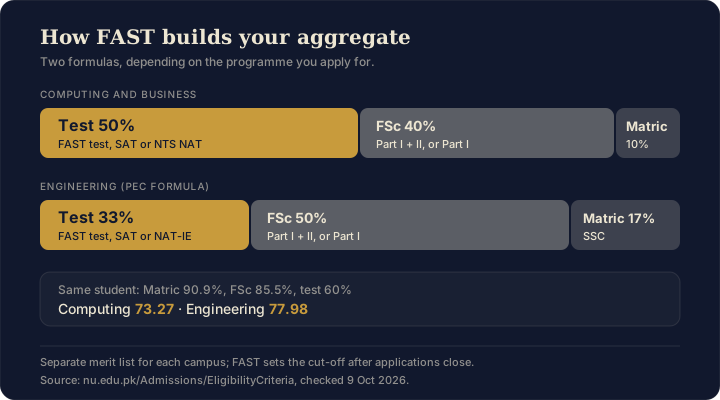
FAST-NUCES ranks Computing and Business applicants on 50% admission test, 40% FSc and 10% Matric, and Engineering applicants on 33%, 50% and 17%. Here is the formula with worked examples, what each mark is worth, how campus merit lists work and how to set a realistic test target.
By ParhaiKrlo Team · Published 9 Oct 2026 · 6 min read
Your FAST-NUCES merit isn't your test score alone. FAST combines your admission test, FSc and Matric into one aggregate, and the weights depend on which programme you apply for. Getting this right tells you how much your test really matters and what score to aim for.
The formulas below are from FAST's Eligibility Criteria page and its 2025 prospectus, checked on 9 October 2026.
Quick answer: the FAST merit formula
- Computing (CS, Software Engineering, AI, Data Science, Cyber Security): 50% test, 40% FSc, 10% Matric.
- Business (BBA, Accounting & Finance, Business Analytics, FinTech): 50% test, 40% FSc, 10% Matric.
- Engineering (Civil, Electrical, Computer): 33% test, 50% FSc, 17% Matric, as recommended by the Pakistan Engineering Council.
- The test can be FAST's own admission test, the SAT or NTS NAT. You pick one.
- Merit lists are made separately for each campus, and FAST sets the cut-off after applications close.
The formula in detail
Turn each part into a percentage first, then apply the weights.
Computing and Business:
Aggregate = (Test % × 0.50) + (FSc % × 0.40) + (Matric % × 0.10)
Engineering:
Aggregate = (Test % × 0.33) + (FSc % × 0.50) + (Matric % × 0.17)
Which FSc marks count
FAST uses whichever of these is available when it compiles the merit list:
- Your FSc Part I and II marks together, or
- Your FSc Part I marks alone, if your Part II result isn't out yet, or
- The percentage on your IBCC equivalence certificate for A Level or, failing that, O Level.
Many applicants are still waiting for Part II results at merit time, so for them Part I is the FSc share. If your Part I was weak, the test has to make up more ground.
Worked example
Take a student with 1000/1100 in Matric (90.91%) and 470/550 in FSc Part I (85.45%). Here is their aggregate at three test results:
| Test score | Computing / Business aggregate | Engineering aggregate |
|---|---|---|
| 50% | 68.27 | 74.68 |
| 60% | 73.27 | 77.98 |
| 70% | 78.27 | 81.28 |
For example, at 60% on the test: Computing is (60 × 0.50) + (85.45 × 0.40) + (90.91 × 0.10) = 30.00 + 34.18 + 9.09 = 73.27.
Two things stand out:
- The same student scores higher on the Engineering formula, because it leans on FSc and Matric, where most applicants score better than on the test. That's why you can't compare a Computing cut-off with an Engineering one.
- For Computing, every 10% on the test moves your aggregate by 5 points. For Engineering it moves it by 3.3.
What each mark is worth
| One percentage point in... | Computing / Business | Engineering |
|---|---|---|
| Admission test | 0.50 aggregate points | 0.33 points |
| FSc | 0.40 points | 0.50 points |
| Matric | 0.10 points | 0.17 points |
FAST doesn't publish the test's total marks. If the paper is marked out of 120, as prep sites report, one test mark is worth about 0.42 aggregate points for Computing and 0.28 for Engineering.
There's one more thing your raw score depends on: negative marking. A wrong answer doesn't just score zero, it takes marks away. Skipping questions you can't narrow down protects your test percentage, and through it your aggregate.
The test score you need
Rearranging the formula gives the test percentage needed for a target aggregate:
- Computing / Business: Test % = (Target − 0.40 × FSc % − 0.10 × Matric %) ÷ 0.50
- Engineering: Test % = (Target − 0.50 × FSc % − 0.17 × Matric %) ÷ 0.33
Here's what that gives for three students:
| Matric / FSc | Target 65 (Computing) | Target 70 (Computing) | Target 75 (Computing) | Target 70 (Engineering) |
|---|---|---|---|---|
| 95% / 92% | 37.4% | 47.4% | 57.4% | 23.8% |
| 90% / 85% | 44.0% | 54.0% | 64.0% | 37.0% |
| 80% / 75% | 54.0% | 64.0% | 74.0% | 57.3% |
The pattern: every 10% you're behind in FSc costs you about 8% more on the test for Computing. Strong academics buy you room on test day, but they can't replace a good test score.
These targets are examples, not FAST cut-offs. You can try your own marks in the FAST aggregate calculator, which has a "test score I need" mode for exactly this.
How FAST's merit lists work
- Each campus has its own merit list. FAST runs one admission test at all six campuses (Islamabad, Lahore, Karachi, Peshawar, Chiniot-Faisalabad and Multan), but it ranks applicants separately for each one. The same aggregate can get you into one campus and not another.
- The cut-off is set after the fact. FAST's Eligibility Criteria page says merit cut-off marks are "determined by the University". It doesn't publish a target in advance.
- Cut-offs move every year with the number of applicants and seats, and they differ by programme.
- You can apply to more than one campus for an extra Rs. 500 each, which gives you more than one list to appear on.
Why we don't quote closing merits
You'll find closing merit figures for FAST campuses on other sites. FAST doesn't publish an official table of them, and they change every year, so we don't repeat them here. If you want a target, use last session's list for your exact programme and campus, add a margin, and treat it as a rough guide rather than a promise.
Minimum marks to be considered
Before merit matters, you have to be eligible:
| Programme group | Matric | FSc | FSc subjects |
|---|---|---|---|
| Computing | 60% | 50% | Mathematics (pre-medical with additional Maths can apply) |
| Engineering | 60% | 60% | Pre-Engineering or ICS (Physics, Maths, Computer Science) |
| Business | 60% | 50% | None specified |
FAST checks every document at admission. If you're admitted while awaiting a result and then fall below the minimum, the admission is cancelled.
Frequently Asked Questions
How is the FAST aggregate calculated?
For Computing and Business programmes, FAST uses 50% admission test, 40% FSc and 10% Matric. For Engineering it uses 33% test, 50% FSc and 17% Matric. Convert each to a percentage, multiply by its weight and add them up.
Does FAST use FSc Part I or full FSc marks?
Whichever is available when the merit list is compiled: Part I and II together, or Part I alone if your Part II result isn't out. A and O Level students use their IBCC equivalence percentage.
What test score do I need for a 70% aggregate at FAST?
It depends on your academics. For Computing, with 90% in Matric and 85% in FSc you need about 54% on the test. With 80% and 75% you need about 64%. Our FAST aggregate calculator works it out for your own marks.
Is FAST merit the same for every campus?
No. FAST prepares a separate merit list for each campus, and the cut-off is set by the university after applications close. It moves every year and differs by programme.
What are the minimum marks for FAST?
60% in Matric for every programme. In FSc, 50% for Computing and Business and 60% for Engineering. Computing needs Mathematics in FSc; Engineering needs Pre-Engineering or ICS.
Put the formula to work
- FAST aggregate calculator: your aggregate, or the test score you need, on FAST's formula.
- FAST entry test pattern and syllabus: where the test marks come from.
- FAST-NU past papers: seven full-length papers prepared by ParhaiKrlo on the BS CS/Engineering pattern, with every answer explained. FAST doesn't release its own papers.
- FAST test vs SAT vs NAT: which test to send for the test share.
The weights here are from FAST's Eligibility Criteria page, checked on 9 October 2026. Confirm them when FAST opens its 2027 admissions.