
FAST Entry Test Pattern and Syllabus 2027: Sections, Weightage and Marking
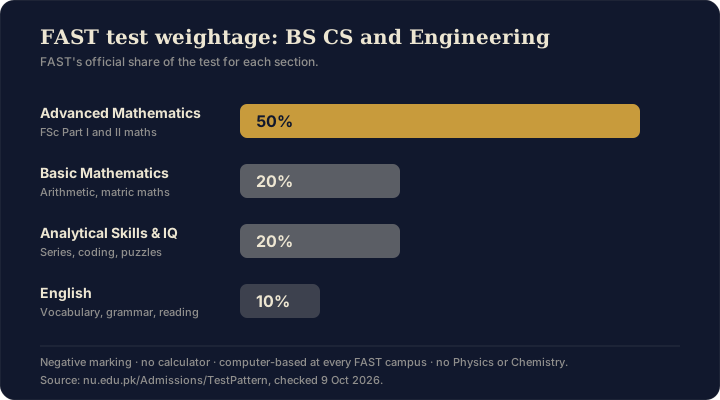
FAST weights its BS Computer Science and Engineering admission test Advanced Mathematics 50%, Basic Mathematics 20%, Analytical Skills & IQ 20% and English 10%, with negative marking and no calculator. Here is how the computer-based test runs, what changed for 2026, and the topics in every section.
By ParhaiKrlo Team · Published 9 Oct 2026 · 6 min read
The FAST-NUCES admission test (the "NU test") decides entry to BS Computer Science, Software Engineering, AI, Data Science, Cyber Security and Engineering at every FAST campus. It is half of your merit for Computing programmes and a third of it for Engineering, and you only get one attempt. So it pays to know exactly what's on it.
The weights and rules below are FAST's own, from its Test Pattern page, How to Apply page and 2025 prospectus, checked on 9 October 2026. Where a figure comes from prep sites rather than FAST, we say so.
Quick answer: the FAST test pattern
- Sections (BS CS/Engineering): Advanced Mathematics 50%, Basic Mathematics 20%, Analytical Skills & IQ 20%, English 10%.
- Format: computer-based, at every FAST campus.
- Negative marking: yes. FAST says so on its Test Pattern page but doesn't publish the deduction per wrong answer.
- Calculator: not allowed.
- Length: FAST doesn't publish it for the BS test. Prep sites consistently report 120 MCQs in 120 minutes.
- No Physics or Chemistry. Unlike NUST NET or ECAT, FAST's Computing/Engineering test is maths, reasoning and English only.
Official weightage
FAST publishes the share of the test each section carries, not the number of questions. These are the current figures for the two undergraduate tests:
| Section | BS (CS / Engineering) | BBA and BS (A&F, Business Analytics, FinTech) |
|---|---|---|
| Advanced Mathematics | 50% | Not tested |
| Basic Mathematics | 20% | 50% |
| Analytical Skills & IQ | 20% | 25% |
| English | 10% | 10% |
| Essay Writing | Not tested | 15% |
The rest of this guide is about the BS CS/Engineering test.
What changed for 2026
FAST's 2025 prospectus listed the BS (Computing)/(Engineering) test as Advanced Math 50%, Basic Math 30% and Analytical Skills & IQ 20%, with no English section. The current Test Pattern page adds English at 10% and cuts Basic Math to 20%. If you're using older guides or older practice papers, check that they include English.
How many questions per section?
FAST doesn't say. Prep sites report the paper as 120 MCQs: 50 Advanced Math, 20 Basic Math, 20 IQ and 30 English. Our own FAST-pattern papers follow that split.
Look closely at those numbers, though. If English really has 30 questions but carries only 10% of the test, each English question is worth far less than a maths question. Either way, FAST's weights are the official part: English is a tenth of your score, and Advanced Math is half.
How the test runs
This is how FAST describes its online admission test (How to Apply page and prospectus):
- Each candidate gets a different paper, and the sections appear in random order.
- Each section has its own timer. Time you save in one section doesn't carry forward to the next.
- Within a section you can move back and forth and change any answer. Changes are only possible in the section you're in.
- You need basic mouse and keyboard skills. There's no paper version.
- Bring only your admit card. Latecomers aren't allowed in.
The section timers change how you pace yourself. On a paper test you might rush English to save time for maths. On FAST's test that saved time is simply lost, so use each section's full time on that section.
What each section asks
FAST lists no chapters. The topics below follow the FSc and Matric courses, organised as we tag them in our FAST-pattern papers. Each links to a topic page with practice MCQs.
Advanced Mathematics (50%)
This is FSc Part I and II mathematics, and it decides your test. Expect questions on:
- Calculus: Functions and Limits, Differentiation, Integration
- Algebra: Quadratic Equations, Sequences and Series, Matrices and Determinants, Complex Numbers, Partial Fractions, Mathematical Induction and Binomial Theorem, Permutations, Combinations and Probability
- Geometry and trigonometry: Trigonometry, Analytic Geometry, Conic Sections, Vectors
- Other FSc chapters: Sets, Functions and Groups, Linear Inequalities and Linear Programming
With no calculator, the questions reward method over arithmetic: knowing a derivative rule or a series formula cold, then simplifying cleanly.
Basic Mathematics (20%)
Matric-level maths and everyday arithmetic, done quickly and without a calculator: Percentages, Ratio and Proportion, Averages, Speed, Time and Work, Commercial Arithmetic, Geometry and Mensuration, Basic Algebra and Arithmetic and Number Properties.
These are the marks strong FSc students lose through careless working. Practise mental arithmetic and checking your answer against the options.
Analytical Skills & IQ (20%)
Reasoning questions that don't depend on any textbook: number and letter Series, Coding and Decoding, Analogies and Classification, Arrangements and Puzzles (seating, ordering, blood relations) and Logical Reasoning.
IQ improves faster with practice than any other section, because the question types repeat. Learn the common patterns and you'll recognise them on the day.
English (10%)
Vocabulary (synonyms, antonyms), Sentence Completion, Grammar and Usage and Reading Comprehension.
English is worth the least, so it shouldn't take much of your preparation time. A steady habit of reading and vocabulary work over a few months is enough for most students.
Negative marking: when to skip
FAST deducts marks for wrong answers but doesn't publish how many. That means a blind guess has a real cost. A sensible rule:
- If you can't rule out any option, skip it.
- If you can rule out two of the four options, take the guess. Your odds are then good enough to be worth the risk under most penalty schemes.
Practise this on timed papers so it becomes a habit before test day.
Frequently Asked Questions
What is the FAST entry test pattern for BS Computer Science?
FAST weights the BS CS/Engineering test Advanced Mathematics 50%, Basic Mathematics 20%, Analytical Skills & IQ 20% and English 10%. It is computer-based, with negative marking and no calculator.
How many MCQs are in the FAST test?
FAST doesn't publish the number. Prep sites report 120 MCQs in 120 minutes: 50 Advanced Math, 20 Basic Math, 20 IQ and 30 English. FAST's official figures are the section weights.
Is there Physics in the FAST entry test?
No. FAST's test for BS Computing and Engineering programmes covers mathematics, analytical skills and IQ, and English. There is no Physics or Chemistry section.
Does the FAST test have negative marking?
Yes. FAST's Test Pattern page says there is negative marking, but it doesn't publish the deduction per wrong answer. Skip questions you can't narrow down at all.
Did the FAST test pattern change recently?
Yes. FAST's 2025 prospectus listed Advanced Math 50%, Basic Math 30% and IQ 20% with no English. The current Test Pattern page adds English at 10% and cuts Basic Math to 20%.
How to use this pattern in your preparation
- Put about half your time into Advanced Math, since it's half the marks. Start with the FSc chapters you find weakest.
- Do short daily sets of Basic Math and IQ. Both reward speed, and speed comes from repetition.
- Keep English light but regular: a little vocabulary and one reading passage a day.
- Sit full-length timed papers in the last month, with the section timers in mind.
Our resources follow the BS CS/Engineering pattern:
- FAST-NU past papers: seven full-length papers with every answer explained. FAST doesn't release its own papers; ours are prepared by ParhaiKrlo on the current pattern.
- FAST-NU mock tests: timed, full-length mocks.
- FAST-NU syllabus: every topic in all four sections, with practice MCQs.
- FAST entry test 2027 dates and registration: when to apply and what it costs.
- FAST aggregate formula: how your test score becomes your merit.
FAST can change its test pattern from one cycle to the next, as it did for 2026. Check the Test Pattern page when the 2027 admissions open.