
MDCAT 2027 Preparation for Repeaters: A Month-by-Month Plan
Retaking MDCAT isn't about studying more of the same. It's about finding exactly where you lost marks in 2026 and fixing that. Here's a month-by-month plan from now until MDCAT 2027.
By ParhaiKrlo Team · Published 7 Oct 2026 · 7 min read
Updated: 7 October 2026
If MDCAT 2026 didn't go the way you wanted, you're not starting from zero. You've already seen the real paper, you know the syllabus, and you know how three hours in the hall feels. A repeat year works when you use that experience well.
Most repeaters who don't improve make the same mistake: they study everything again from the start, the same way as last time. This plan does something different. It starts by finding exactly where your marks went, then spends the year fixing that.
Quick answer
- MDCAT 2027's date isn't announced yet. MDCAT 2026 was held on 20 September after being moved from 16 August, so plan for a test around August or September 2027 and adjust when PMDC announces it.
- Expect the same pattern unless PMDC changes it: 180 MCQs in 3 hours. Biology 81, Chemistry 45, Physics 36, English 9 and Logical Reasoning 9. There's no negative marking.
- Start with a diagnosis, not a textbook. In October, sit one full mock and sort every mistake by cause.
- Spend November to March rebuilding, in proportion to weightage and to your own weak spots.
- From April, practise under exam conditions, building up to two full timed mocks a week by the summer.
- Your 2026 score doesn't disappear. UHS accepted MDCAT 2023, 2024 or 2025 results for 2025-26 admissions, and KMU is accepting 2024, 2025 or 2026 results this year. Check how your province treats multiple results before you count on it.
First, decide if a repeat year is right for you
A retake costs a year. It's worth it when:
- You were close. A few more marks would have put you in a realistic merit range. Use our MDCAT merit calculator to see how many marks you'd need.
- You know why you fell short. Weak topics, poor timing or exam nerves can all be fixed with a plan.
- You can study full time, or nearly full time, for most of the year.
- Your family is on board with the time and the cost.
It's a harder call if you were far from merit and don't know why, or if you'd be just as happy in BDS, DPT, Pharm-D or another health degree you could start this year. Our post on whether an entry test retake is worth it goes through the decision in more detail.
The paper you're preparing for
| Subject | MCQs | Share |
|---|---|---|
| Biology | 81 | 45% |
| Chemistry | 45 | 25% |
| Physics | 36 | 20% |
| English | 9 | 5% |
| Logical Reasoning | 9 | 5% |
| Total | 180 | 3 hours |
That's one minute per question. Biology and Chemistry together are 126 of the 180 marks, so they should get most of your hours. PMDC sets the syllabus each year, so check the 2027 syllabus when it's published. Our MDCAT syllabus and weightage guide covers the current one.
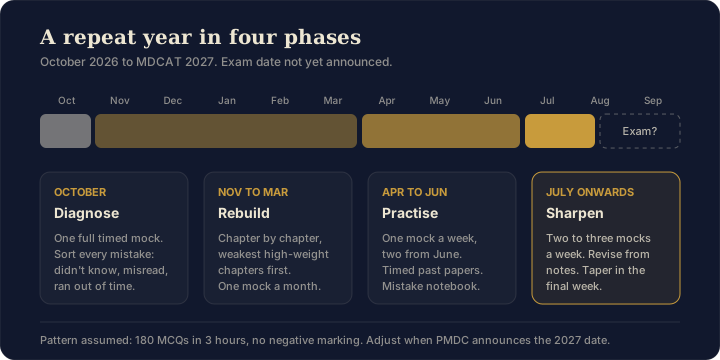
The plan, month by month
October 2026: diagnose
Don't open a textbook yet. This month is for finding out exactly where your 2026 marks went.
- Sit one full, timed mock under real conditions: 180 questions, 3 hours, no phone. Use a full-length MDCAT mock or a recent past paper.
- Sort every wrong or skipped answer into three piles:
- Didn't know it. A content gap. Fix it in the rebuild phase.
- Knew it, but got it wrong. Misreading, careless errors or confusing two similar facts. Fix it with practice and review.
- Ran out of time. A speed problem. Fix it with timed sets.
- Count each pile by subject and chapter. That list is your plan for the year.
- Set a target score. Work backwards from the aggregate you need, using your FSc and Matric marks.
Also sort out your routine. Pick fixed study hours, decide whether you'll join an academy or study alone, and gather your books: the FSc textbooks the syllabus is based on, plus past papers.
November 2026 to March 2027: rebuild
This is the longest phase. Its job is to close your content gaps properly.
- Go chapter by chapter, starting with your weakest high-weightage chapters. In Biology, that usually means the big physiology and genetics chapters. Our Biology chapter-wise weightage shows which chapters past papers test most.
- For each chapter: read the textbook, make short notes, then solve past-paper MCQs on that chapter only. Questions are written from the textbook, so learn it line by line.
- Split your time by weightage. Roughly 45% Biology, 25% Chemistry and 20% Physics, with the rest on English and Logical Reasoning. Shift it towards whichever subject your October diagnosis flagged.
- Do 20 to 30 timed MCQs every day from chapters you've already finished, so nothing goes cold.
- Sit one full mock a month to track progress.
A realistic weekly target is two to three chapters, depending on size. By the end of March you should have covered the whole syllabus once, properly.
April to June 2027: practise under exam conditions
Now the focus moves from learning to scoring.
- Sit one full timed mock a week, then two a week from June.
- Review every mock the same day or the next. Put each mistake back into one of the three piles, and fix it.
- Solve past papers year by year, timed. MDCAT past papers from 2008 to 2025 show you how topics are tested and how the paper has changed.
- Keep a mistake notebook. Write down every fact you got wrong and why. Read it every week.
- Do a second, faster pass of the syllabus alongside the mocks, focusing on high-yield chapters.
July to the exam: sharpen
- Two to three full mocks a week, at the same time of day as the real test.
- Revise from your notes and mistake notebook, not from the full textbook.
- Practise English and Logical Reasoning briefly every day. They're only 18 marks together, but they're quick to improve.
- Final week: taper off. Our final-week revision plan for MDCAT 2026 shows how to structure the last eight days, and the same approach works for 2027.
A sample study day
| Time | What to do |
|---|---|
| Morning (3 hours) | New chapter: textbook reading and notes |
| Midday (1.5 hours) | Past-paper MCQs on that chapter, timed |
| Afternoon (2 hours) | Second subject: chapter work or revision |
| Evening (1 hour) | 20 to 30 mixed MCQs from finished chapters, plus English or LR |
| Before bed (15 minutes) | Read your mistake notebook |
That's about seven and a half hours. Take one lighter day a week. Burning out in March helps nobody.
Mistakes repeaters make
- Restarting from page one. You already know a lot. Spend your time on what you got wrong.
- Taking mocks without reviewing them. A mock you don't review costs three hours and teaches you nothing.
- Studying only the subjects you like. If Physics scares you, it'll cost you marks until you face it.
- Starting slowly. October to March feels like a long time. It isn't.
- Ignoring timing until the end. One minute per question needs practice from the start.
- Changing books and academies constantly. Pick your sources in October and stick with them.
- Isolating yourself. A repeat year is hard. Keep in touch with friends and family, and take breaks.
Keep an eye on admissions too
While you prepare, follow this year's admissions. If your 2026 score is valid for more than one session, you may still have options this year, or extra options next year. Read our guides to the MBBS admission process and private medical college fees.
Frequently Asked Questions
When is MDCAT 2027?
The date isn't announced yet. MDCAT 2026 was held on 20 September after being moved from 16 August, so plan for a test around August or September 2027 and adjust your plan when PMDC announces the date.
Is my MDCAT 2026 score still valid if I retake in 2027?
Results stay valid for more than one session. UHS accepted MDCAT 2023, 2024 or 2025 results for 2025-26 admissions, and KMU is accepting 2024, 2025 or 2026 results this year. Check how your province treats multiple results before you count on it.
How should a repeater start MDCAT 2027 preparation?
Start with a diagnosis, not a textbook. In October, sit one full timed mock and sort every wrong or skipped answer into three piles: didn't know it, knew it but got it wrong, and ran out of time. Count each pile by subject and chapter. That list is your plan for the year.
How many hours a day should I study for an MDCAT retake?
Our sample day comes to about seven and a half hours: three hours on a new chapter, an hour and a half of past-paper MCQs on it, two hours on a second subject, an hour of mixed MCQs plus English or Logical Reasoning, and 15 minutes with your mistake notebook. Take one lighter day a week.
How many mocks should I take before MDCAT 2027?
Take one a month while you rebuild (November to March), one a week from April, two a week from June, and two to three a week from July. Review every mock the same day or the next. A mock you don't review costs three hours and teaches you nothing.
Next steps
- Full-length MDCAT mocks: start your October diagnosis.
- MDCAT past papers, 2008 to 2025: practise chapter by chapter.
- MDCAT merit calculator: set a target score.
The paper pattern is PMDC's 180-MCQ format used for MDCAT 2026. The MDCAT 2026 date change is from PMDC's announcement. Score validity is from UHS's 2025-26 MBBS admission notice and KMU's 2026-27 admission page, both checked on 7 October 2026. PMDC announces the MDCAT 2027 date and syllabus separately, so check them when they're released.