
NUST Closing Merit and Merit Positions Explained
NUST publishes closing merit as merit positions, not percentages. Here's what a merit position is, why closing positions move from list to list and year to year, and how to use them to judge your chances and order your preferences.
By ParhaiKrlo Team · Published 3 Oct 2026 · 5 min read
Updated: 3 October 2026
Every summer, NUST students compare numbers like "my merit position is 1,450" and "Computer Science closed at 600 last year." These numbers are easy to misread. A merit position isn't a percentage, and a closing merit isn't a cutoff you can aim at.
This guide explains what NUST's merit positions mean, how closing merit works across merit lists, and how to use last year's numbers without being misled by them.
Quick answer
- Your merit position is your rank among all candidates in a discipline, worked out from your aggregate. Position 1 is the highest aggregate.
- A closing merit position is the rank of the last candidate offered a seat in a programme, in a particular merit list.
- Closing positions move down from list to list as selected candidates drop out and seats free up.
- NUST says closing positions "vary every year" and don't guarantee admission. They're a guide for ordering your preferences, not a cutoff.
- NUST doesn't publish a cutoff aggregate percentage. Aggregate figures you see online are third-party estimates.
From aggregate to merit position
NUST first works out your aggregate. For NET-basis admission it's:
- NET: 75%
- HSSC (or Part I): 15%
- SSC: 10%
Our aggregate guide works through the formula with examples.
NUST then ranks every candidate in a discipline by aggregate, highest first. Your place in that ranking is your merit position. NUST generates merit lists, tentatively, in the last week of July, after the final NET series. You can search your merit position and selection status on the NUST admissions portal using your registration number.
Merit is worked out within each discipline (Engineering, Computing, Business Studies and so on), using the NET that discipline accepts.
What a closing merit position means
Each programme has a fixed number of seats. NUST goes down the merit order and offers each candidate their highest preference that still has a seat. When a programme's seats are filled, the rank of the last person offered a seat is that programme's closing merit position for that list.
So if a programme "closed at 600" in a list, the candidate ranked 600th was the last one offered that programme. Some candidates above 600 went to a higher preference instead.
A closing position is not a minimum score. It depends on how many seats the programme has, how many higher-ranked candidates preferred it, and who accepted.
Why closing positions move down
NUST offers seats over several merit lists. After each list:
- Some selected candidates don't pay their admission dues in time. NUST says they're no longer considered in that discipline's selection process.
- Some candidates move up to a higher preference, freeing their old seat.
- Some choose another university and never take up their seat.
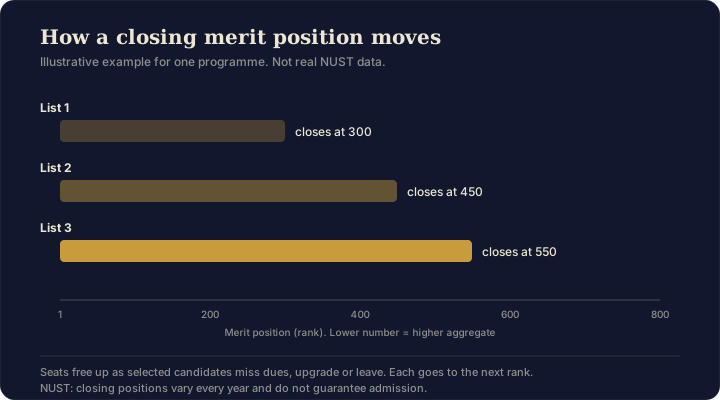
Each freed seat goes to the next candidate in merit order. So a programme's closing position in the second or third list is usually lower (a bigger number) than in the first. Candidates who just missed out in the first list can still be selected later.
Upgrades are automatic if you've paid your dues. If you want to keep your current programme and stop moving, NUST has a "Freezing the UG programme" form.
Why closing positions change every year
NUST publishes last session's closing merit positions as guidance on its admissions portal. It also says they "do not guarantee admission" and that merit positions "vary every year." That's because:
- The number of candidates changes. More applicants push every rank down.
- Seats change. A programme that adds seats closes at a lower position.
- Preferences shift. A programme that becomes popular, like AI or Data Science, fills with higher-ranked candidates.
- NET performance changes. A harder or easier year shifts everyone's aggregate.
Use last year's closing positions to judge whether a programme is a reach, a match or a safe choice. Don't treat them as a guarantee.
A worked example
This example is illustrative, not real NUST data:
| Merit list | Programme A closing position | Programme B closing position |
|---|---|---|
| List 1 | 300 | 900 |
| List 2 | 450 | 1,300 |
| List 3 | 550 | 1,600 |
Say your merit position is 1,200, and you listed A first and B second:
- List 1: you're below both closing positions, so you're not selected yet.
- List 2: Programme B closes at 1,300, so you're offered B. Pay your dues on time to stay in the process.
- List 3: Programme A still closes above your position at 550, so you stay in B.
If you'd left B off your preferences, you wouldn't have been offered it at all. NUST says candidates can't be considered for a programme they didn't choose.
Using closing merit to order your preferences
- List programmes in the order you actually want them. NUST offers you your highest preference that your merit position reaches. Putting a programme lower doesn't improve your chances of getting it.
- Include realistic options. If every preference is a reach, you may not be offered anything.
- Only list programmes you'd accept. NUST warns that choosing programmes you don't want can lead to "unnecessary fee payments and complications."
- Know the change rules. After merit lists are generated, NUST gives 1 to 2 days to edit preferences within each discipline. During selection you can apply to change preferences once, using NUST's form.
What about aggregate cutoffs?
NUST publishes closing merit as positions, not aggregate percentages. Aggregate "cutoffs" on calculator and coaching websites are estimates, built by matching positions to reported aggregates. They can be useful as a rough target. For example, some sites put SEECS Computer Science at roughly 80 to 82%. But they're not NUST figures, so treat them with care.
A better plan: aim for the highest NET score you can, since NET carries 75% of your aggregate.
Frequently Asked Questions
What is a merit position at NUST?
It's your rank among all candidates in a discipline, worked out from your aggregate: 75% NET, 15% HSSC and 10% SSC. Position 1 has the highest aggregate. You can search your merit position on the NUST admissions portal with your registration number.
What does closing merit position mean?
It's the rank of the last candidate offered a seat in a programme in a particular merit list. It isn't a minimum score: it depends on the programme's seats, how many higher-ranked candidates preferred it, and who accepted.
Why does the closing merit change in later lists?
Seats free up when selected candidates don't pay their dues in time, move up to a higher preference, or go elsewhere. Each freed seat goes to the next candidate in merit order, so closing positions usually move down in later lists.
Does last year's closing merit guarantee admission?
No. NUST says its published closing merit positions do not guarantee admission and are only a reference for ordering your preferences, because merit positions vary every year with applicants, seats and preferences.
Does NUST publish a cutoff aggregate percentage?
No. NUST publishes closing merit as positions, not aggregate percentages. Aggregate cutoffs on calculator and coaching websites are third-party estimates, so treat them as rough targets only.
Next steps
- NUST aggregate calculation: the formula and the NET score you need.
- Which NET series to take: how to use multiple attempts, since only your best score counts.
- NUST NET papers: eight full NET-pattern papers to push your NET score up.
The merit rules above are from NUST's Merit Generation Criteria, Procedure of Admission, Undergraduate Selection Process and closing merit pages, checked on 3 October 2026. Check ugadmissions.nust.edu.pk for the current session's lists.