
NUST Aggregate 2027: How Merit Is Calculated and the NET Score You Need
NUST ranks NET candidates on 75% NET, 15% FSc (Part-I if you're still in second year) and 10% Matric. Every NET mark is worth 0.375 aggregate points, more than 2% of FSc. Here is the official formula, worked examples, and the NET score you need for each target aggregate.
By ParhaiKrlo Team · Published 2 Oct 2026 · Updated 3 Oct 2026 · 6 min read
Updated: 1 October 2026
Your NUST admission comes down to one number: your aggregate. NUST ranks every NET candidate by it and offers seats in that order, following each candidate's programme preferences. Three quarters of it comes from a single three-hour test.
This guide explains NUST's official merit formula, works through real examples, and shows the NET score you need for the aggregate you're aiming at. The formula is from NUST's Merit Generation Criteria page, checked on 1 October 2026.
Quick answer: the NUST merit formula
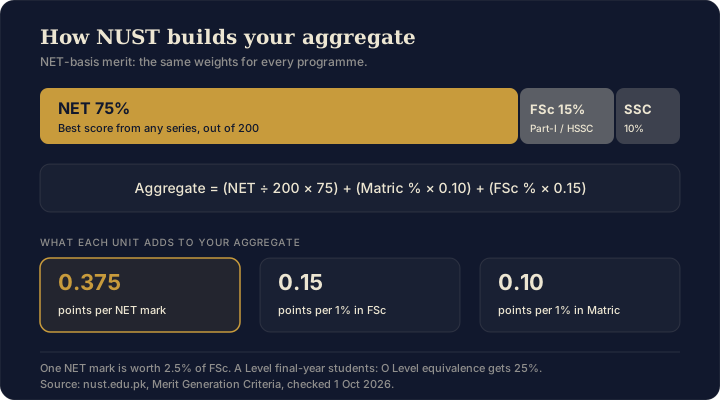
- NET: 75%
- HSSC / FSc: 15% (Part-I marks if you're still in second year)
- SSC / Matric: 10%
Aggregate = (NET marks ÷ 200 × 75) + (Matric % × 0.10) + (FSc % × 0.15)
The weights are the same for every NET-basis programme: Engineering, Computing, Business, Architecture and the rest. Only the NET paper you sit changes.
The formula in detail
| Component | Weight | What NUST uses |
|---|---|---|
| NUST Entry Test (NET) | 75% | Your best NET score from any series in the current cycle |
| SSC / O Level / equivalent | 10% | Matric percentage, or your IBCC O Level equivalence |
| HSSC Part-I / HSSC / A Level / equivalent / DAE | 15% | FSc Part-I if you're still in second year, otherwise your HSSC or IBCC equivalence |
Some details that change the numbers:
- Best score only. If you sit NET in Series 1 and Series 3, NUST picks the higher score automatically. A bad attempt never pulls you down.
- FSc Part-I counts, not the full result, if you apply while still in second year. NUST's FAQ says your Part-I marks are used for merit. You still need 60% in the complete FSc when you join.
- A Level students in their final year: NUST gives 25% weight to your O Level equivalence marks. That covers both the Matric 10% and the FSc 15%, since there is no HSSC result yet. Use the marks on your IBCC certificate, not your own conversion. NUST warns that self-calculated marks can affect your merit and lead to cancellation.
- Gap year or repeater? NUST says there's no penalty in merit generation.
Worked example
Say your Matric is 1000/1100 (90.91%), FSc Part-I is 470/550 (85.45%), and you score 140/200 in NET.
| Component | Calculation | Points |
|---|---|---|
| NET | 140 ÷ 200 × 75 | 52.50 |
| Matric | 90.91 × 0.10 | 9.09 |
| FSc Part-I | 85.45 × 0.15 | 12.82 |
| Aggregate | 74.41% |
Now say the same student scores 160 instead of 140. The aggregate jumps to 81.91%. Twenty extra NET marks added 7.5 points, more than their whole Matric contribution.
Why NET decides your merit
Look at what each mark is worth:
- 1 NET mark = 0.375 aggregate points
- 1% in FSc = 0.15 points
- 1% in Matric = 0.10 points
One NET mark is worth 2.5% of FSc. Ten extra correct MCQs (3.75 points) would take a 25-point jump in your FSc percentage to match.
By October of second year, your Matric is final and your Part-I marks are fixed. NET is the only part you can still change, and you get up to four attempts at it. That's why the best preparation time goes to NET.
What NET score do you need?
Rearranging the formula gives the NET score you need for a target aggregate:
NET needed = (target − Matric % × 0.10 − FSc % × 0.15) ÷ 75 × 200
| Your academics | For 70% | For 75% | For 80% | For 82% |
|---|---|---|---|---|
| Matric 80%, FSc 75% | 136 | 149 | 162 | 168 |
| Matric 90%, FSc 85% | 129 | 142 | 156 | 161 |
| Matric 95%, FSc 92% | 125 | 138 | 152 | 157 |
NET scores are out of 200, rounded up. The bottom row shows how much strong academics help: about 11 NET marks less for the same aggregate than the top row.
What aggregate is competitive?
NUST doesn't announce a cutoff in advance. Closing merit depends on how many people apply, how they score, and how many selected students take their seats. The main things to know:
- NUST posts last session's closing merit on its website as guidance, and offers seats in merit order across several lists. Candidates move up as others decline.
- Closing merits differ a lot by programme and campus. SEECS Computer Science, Software Engineering and AI in Islamabad are among the hardest. Calculator sites that track past merit lists put them at roughly 80 to 82%. Those are third-party estimates, not NUST figures. Use them as a rough target, not a promise.
- Pick your programme preferences carefully. NUST only considers you for programmes you list, in the order you list them. After a merit list, you can change preferences once, using NUST's form. Our guide to closing merit and merit positions explains how to read last year's lists.
A sensible plan: pick a realistic target aggregate for your first-choice programme, find your required NET score in the table above, and add a 5 to 10 mark buffer.
Merit lists and selection
NUST generates merit lists tentatively in the last week of July, after the final NET series. Selected candidates see a provisional selection letter and fee invoice on the admissions portal.
- Pay admission dues on time. If you miss the deadline, you drop out of that discipline's selection process.
- Upgrades are automatic. If you've paid, you stay in line for a higher preference as seats free up. If you want to keep your current seat, submit NUST's "Freezing the UG programme" form.
- Selection usually closes about two weeks after classes start at the H-12 campus.
ACT/SAT basis uses the same weights
If you apply on ACT or SAT for a national seat, NUST uses the same split: 75% ACT/SAT, 10% SSC and 15% HSSC. For international seats it's 100% ACT/SAT. You still need at least 60% in SSC and HSSC.
Frequently Asked Questions
How is the NUST aggregate calculated?
NUST's merit for NET-basis admission is 75% NET, 15% HSSC (FSc Part-I if you are still in second year) and 10% SSC. As a formula: NET marks divided by 200 times 75, plus Matric percentage times 0.10, plus FSc percentage times 0.15.
Does NUST use FSc Part-I or full FSc marks for merit?
If you apply while in second year, NUST uses your FSc Part-I marks for merit generation. You still need at least 60% in your complete FSc result when you join NUST.
How is the aggregate calculated for A Level students?
O and A Level candidates in their final A Level year get 25% weight on their O Level equivalence marks from IBCC, in place of the separate 10% and 15%. Use the marks on the IBCC certificate, not self-calculated ones.
What NET score do I need for an 80% aggregate?
It depends on your academics. With 90% in Matric and 85% in FSc Part-I, you need about 156 out of 200. With 80% and 75% you need about 162, and with 95% and 92% about 152. Each NET mark is worth 0.375 aggregate points.
Does NUST penalise gap-year students?
No. NUST's admission FAQ says gap-year and repeater candidates are treated as normal candidates, with no penalty in merit generation.
Raise the 75%
- NUST NET papers: eight full NUST NET past papers prepared by ParhaiKrlo on the NET-Engineering pattern, 200 MCQs each, with every answer explained. NUST doesn't publish its own papers.
- NET 2027 pattern and syllabus: where your 200 marks come from.
- NET-2027 registration and dates: all four series, so you can plan more than one attempt.
- NUST NET preparation hub: topic-wise practice in Maths, Physics and English.
The formula above is from NUST's Merit Generation Criteria and its undergraduate admission FAQs, checked on 1 October 2026. NUST can change its policy for any cycle, so confirm there before you rely on these numbers.