
NUST NET English: Question Types and How to Score 35+ Out of 40
English is 40 of the 200 NET-Engineering MCQs and the quickest section to finish. NUST says it follows the SAT pattern. Here is every question type with a worked example, the common traps, and a plan to get 35 or more.
By ParhaiKrlo Team · Published 2 Oct 2026 · Updated 3 Oct 2026 · 7 min read
Updated: 2 October 2026
Most NET preparation goes into Mathematics, and that makes sense: it's half the paper. But English is 20% of NET-Engineering, about 40 MCQs, and it's the section where a few weeks of steady work moves your score the most. There are no long calculations, the question types repeat, and a good English score can make up for a few hard Maths questions.
This guide covers what NUST says about the English section, every question type with an example, and a plan to score 35 or more out of 40.
Quick answer
- Weight: English is 20% of NET-Engineering and NET-Applied Sciences, and 50% of the Business, Social Sciences and Natural Sciences NETs
- Pattern: NUST says its English paper follows the SAT pattern
- Question types: synonyms, antonyms, analogies, sentence completion, error identification, sentence correction and reading comprehension
- Biggest area: vocabulary. It's about half the English questions in our NET-pattern papers
- Time: aim for 30 to 40 seconds a question, so English takes about 25 minutes and leaves extra time for Maths
What NUST says about NET English
NUST's admission FAQ says NET questions are MCQs with four options, based on SSC and HSSC studies, and that "the paper of English is on the pattern of SAT exam." NUST doesn't publish a list of English topics or a word list.
"SAT pattern" in practice means:
- Vocabulary is tested in context, not just as isolated definitions
- Passages test understanding: main idea, inference, the author's purpose
- Grammar is tested through finding and fixing errors, not naming rules
The question types, with examples
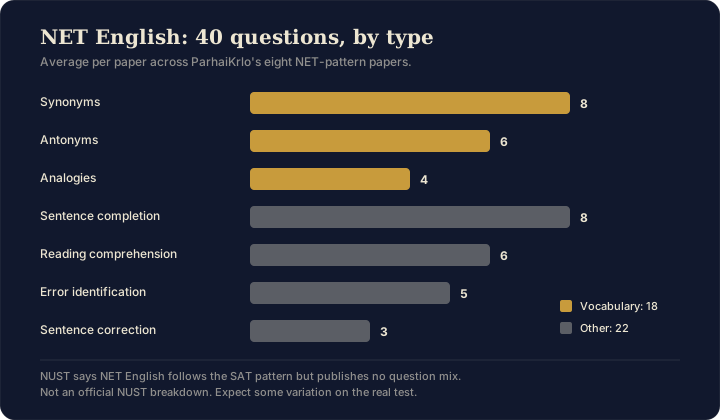
The mix below is how the English section is built in the eight NET-pattern papers ParhaiKrlo has prepared: an average per 40-question paper. NUST doesn't publish its own mix, so expect some variation on the real test.
| Question type | Per paper (our papers) | What it tests |
|---|---|---|
| Synonyms | about 8 | The closest meaning to a word |
| Antonyms | about 6 | The opposite meaning |
| Analogies | about 4 | The relationship between a word pair |
| Sentence completion (one blank) | about 5 | The word that fits the sentence's logic |
| Sentence completion (two blanks) | about 3 | A word pair that fits together |
| Error identification | about 5 | Which underlined part has a mistake |
| Sentence correction | about 3 | The correct version of a sentence |
| Reading comprehension | about 6 | Main idea, details, inference, purpose, word in context |
1. Synonyms and antonyms
Choose the word closest in meaning to METICULOUS: (a) careless (b) thorough (c) quick (d) generous
Answer: (b) thorough. Meticulous means showing great attention to detail.
Antonyms use the same format, but ask for the opposite. Read the question twice. Picking the synonym on an antonym question (here, careless is the trap) is one of the most common English mistakes.
2. Analogies
OASIS : DESERT :: (a) cloud : sky (b) island : sea (c) cave : mountain (d) tree : forest
Answer: (b) island : sea. An oasis is a small area surrounded by a desert, unlike it. An island is land surrounded by sea.
Make a sentence that links the first pair, like "an oasis is a patch of water and green surrounded by desert", then test each option with that sentence. Usually only one fits exactly.
3. Sentence completion
The scientist's claims were at first met with ______, but repeated experiments eventually ______ her theory. (a) enthusiasm, disproved (b) scepticism, confirmed (c) scepticism, rejected (d) indifference, weakened
Answer: (b). "But" signals a contrast. The claims were first doubted, then later supported.
Look for signal words. But, although, however mean a contrast. Because, so, therefore mean the second part follows from the first. And, also mean the same direction. In two-blank questions, check both words. One right word isn't enough.
4. Error identification
The reason he was late (A) / is because (B) / his car (C) / broke down on the motorway (D).
Answer: (B). It should be "the reason… is that". "The reason is because" says the same thing twice.
The same errors come up again and again. Learn to spot these:
- Subject-verb agreement: "The list of items are on the desk" should be is. The subject is list.
- Redundancy: "reason… because", "return back", "repeat again"
- Wrong prepositions: "reached to a decision" (just reached), "discuss about" (just discuss)
- Comparisons: "higher than any mountain" should be "any other mountain"
- Pronouns: who's vs whose, its vs it's, me vs I
- Tense consistency: a sentence that switches tense for no reason
5. Sentence correction
You choose the fully correct version of a sentence. Cross out any option with even one error, then compare what's left. The right answer is the one that's correct and keeps the original meaning.
6. Reading comprehension
You read a short passage (two or three paragraphs) and answer questions on its main idea, details, inferences, the author's purpose, or the meaning of a word as it's used.
- Read the questions first, then the passage, so you know what to look for.
- Answer from the passage, not from what you know. An option can be true in real life and still be wrong.
- For "word in context", put each option into the sentence. The everyday meaning of the word is often a trap.
How to prepare: a 4-week English plan
| Week | Focus | Daily work (about 30 min) |
|---|---|---|
| 1 | Synonyms and antonyms | 20 new words, review yesterday's, 10 synonym/antonym MCQs |
| 2 | Sentence completion and analogies | 20 new words, 10 completion and 5 analogy MCQs |
| 3 | Grammar: errors and correction | 20 new words, 15 error questions, note every rule you got wrong |
| 4 | Reading comprehension and mixed sets | 20 new words, one passage a day, a 40-question timed English set twice a week |
Building vocabulary that sticks:
- Learn words in sentences, not as one-word lists. The NET tests meaning in context.
- Learn common roots: bene- (good), mal- (bad), -cred- (believe), -voc- (call). One root helps you guess dozens of words you've never seen.
- Review on a schedule. Look at each word again after 1 day, 3 days and a week. A shared word list is no use if you only see each word once.
- Use an SAT word list. NUST names the SAT pattern, so a standard SAT vocabulary list is a sensible source.
Timing on test day
You have 54 seconds a question on average across the whole NET. English shouldn't use all of its share.
- Vocabulary and analogies: 15 to 30 seconds. You either know the word or you can narrow it down.
- Completion and grammar: 30 to 45 seconds.
- Passages: about a minute a question, including reading time.
Finishing English in about 25 minutes gives you extra time for Maths. There's no negative marking, so never leave an English question blank. If two options remain, pick one and move on.
Frequently Asked Questions
How many English MCQs are in the NUST NET?
English is 20% of NET-Engineering, about 40 of its 200 MCQs. It is also 20% of NET-Applied Sciences and NET-Architecture, and 50% of the Business Studies & Social Sciences and Natural Sciences NETs.
What type of English questions come in NUST NET?
NUST says its English paper follows the SAT pattern. Expect synonyms, antonyms, analogies, sentence completion, error identification, sentence correction and reading comprehension. In ParhaiKrlo's NET-pattern papers, vocabulary makes up about half of the English questions.
How can I improve my vocabulary for NUST NET?
Learn about 20 words a day in sentences, not as isolated lists, and review each word after one day, three days and a week. Learn common roots so you can work out unfamiliar words. Since NUST names the SAT pattern, a standard SAT word list is a sensible source.
How much time should I spend on NET English?
Aim for 30 to 40 seconds a question, about 25 minutes for the whole section, so it takes less than its share of the 180 minutes and leaves extra time for Mathematics. Vocabulary questions can take 15 to 30 seconds; passages about a minute each.
Is there negative marking in NET English?
No. NUST says there is no negative marking in the NET, so never leave an English question blank. If you can narrow it to two options, pick one and move on.
Practise English on the NET pattern
- NUST NET papers: eight full NUST NET past papers, prepared by ParhaiKrlo on the NET-Engineering pattern, each with 40 English MCQs and a full explanation for every answer. NUST doesn't publish its own papers.
- NUST NET preparation hub: practise English by question type: vocabulary, sentence completion, grammar and reading.
- 6-week NET-1 study plan: how English fits alongside Maths and Physics before Series 1.
- NET 2027 pattern and syllabus: the weightage of every NET type.
NUST's statements about the English section are from its undergraduate admission FAQ, checked on 2 October 2026. The question mix describes ParhaiKrlo's own NET-pattern papers, not an official NUST breakdown.