
NUST NET-1 Preparation: A 6-Week Study Plan for November 2026
NET-2027 Series 1 tests start on 17 November 2026, about six weeks away. This week-by-week plan covers every NET-Engineering topic in Maths, Physics and English, split by weightage, with full timed papers built in and the final week kept for practice, not new chapters.
By ParhaiKrlo Team · Published 2 Oct 2026 · Updated 3 Oct 2026 · 7 min read
Updated: 2 October 2026
NUST's NET-2027 Series 1 tests start on 17 November 2026 in Islamabad, and registration runs from 4 October to 14 November. If you start on Monday 5 October, you have six weeks.
Six weeks isn't long enough to learn FSc from scratch. It is enough to cover every NET-Engineering topic once, close your biggest gaps, and practise the test's speed. This plan does that, week by week, while you're still going to college.
Quick answer
- Time: about 3 hours on college days and 5 to 6 on weekends, roughly 25 hours a week
- Split: about half on Mathematics, a third on Physics, the rest on English, matching NET-Engineering's 50 / 30 / 20 weightage
- Weeks 1 to 5: cover every topic once, with a full timed paper in weeks 1, 3 and 5
- Week 6: full papers and revision only, no new chapters
- 16 November: rest
Before you start: two things to do this week
- Register as soon as Series 1 opens on 4 October. Computer-based candidates pick their own test date and session, so early registration gets you the widest choice. You pay Rs. 5,000 through 1Link or by credit card. Our registration guide has every step.
- Sit one full paper under test conditions: 200 MCQs in 180 minutes, no breaks, no notes. Use one of our NET-pattern papers. Note your score in each subject. That's your baseline, and it tells you which of the weeks below need extra time.
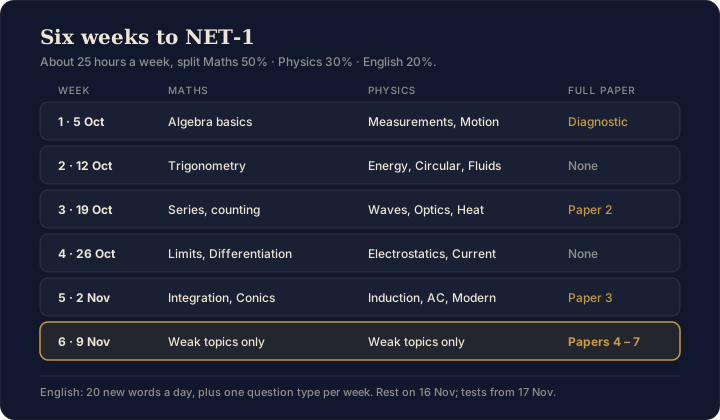
The six weeks at a glance
| Week | Dates | Mathematics | Physics | English | Full paper |
|---|---|---|---|---|---|
| 1 | 5 to 11 Oct | Sets, Functions and Groups; Quadratic Equations; Complex Numbers; Matrices and Determinants | Measurements; Vectors and Equilibrium; Motion and Force | Synonyms and antonyms, daily vocabulary | Diagnostic paper |
| 2 | 12 to 18 Oct | Trigonometry (all of it) | Work and Energy; Circular Motion; Fluid Dynamics; Oscillations | Sentence completion | No |
| 3 | 19 to 25 Oct | Sequences and Series; Permutations, Combinations and Probability; Induction and Binomial Theorem; Partial Fractions | Waves; Physical Optics; Optical Instruments; Heat and Thermodynamics | Error identification, sentence correction | Paper 2 |
| 4 | 26 Oct to 1 Nov | Functions and Limits; Differentiation; Vectors | Electrostatics; Current Electricity; Electromagnetism | Reading comprehension | No |
| 5 | 2 to 8 Nov | Integration; Analytic Geometry; Conic Sections; Linear Programming | Electromagnetic Induction; Alternating Current; Physics of Solids; Electronics; Modern, Atomic and Nuclear Physics | Analogies, mixed vocabulary | Paper 3 |
| 6 | 9 to 15 Nov | Revision of weak topics | Revision of weak topics | Timed mixed sets | Papers 4 to 7 |
The order is deliberate. Part I topics come first because you've already studied them in college. The Part II topics (calculus, conics, electricity and modern physics) come in weeks 4 and 5. By then your college has covered more of them, and they'll still be fresh on test day.
Week by week
Week 1: algebra basics and a baseline
Start with your diagnostic paper on day one. Then work through the algebra chapters, which you studied in first year and can revise quickly. In Physics, Motion and Force carries the most questions of any Physics topic in our papers. Make sure your equations of motion and projectile formulas are automatic.
Start the English habit now: 20 new words a day, with a quick review of yesterday's 20. It costs 15 minutes and builds up to about 800 words by test day.
Week 2: trigonometry
Trigonometry gets a full week because it carries more questions than any other Mathematics topic in our papers. It also turns up inside calculus and conic questions. Learn the identities until you don't have to think about them, and practise the graphs and inverse functions too. The Physics topics this week are formula-heavy but short, so make a one-page formula sheet as you go.
Week 3: counting and series
Sequences and Series and Permutations, Combinations and Probability are both high-yield, and their questions are short once you know the formulas. On the weekend, sit Paper 2 under full test conditions. Compare it to your diagnostic, subject by subject.
Week 4: the start of calculus and electricity
Differentiation is the second-biggest Maths topic in our papers. Spend most of the week on it, after a quick pass through Functions and Limits. In Physics, Current Electricity is one of the most-tested topics. Practise circuit questions (series and parallel, Kirchhoff's rules) until they're quick.
If your college hasn't covered these chapters yet, use the FSc Part II textbook directly. NUST builds the NET from the HSSC textbooks.
Week 5: integration, conics and modern physics
This is the heaviest week. Integration and Conic Sections are both big topics. Modern and Nuclear Physics are short chapters, but their questions are usually direct recall, so they're easy marks if you've read them. Sit Paper 3 at the weekend.
Week 6: practice, not new chapters
Don't start anything new this week. Sit four full papers across the week, and review each one the same day:
- Review every wrong answer and every guess. Read the explanation, then note the topic.
- Spend the rest of the day on the weakest topic that paper showed up.
- Check your timing. If you finish with no time left, see which subject is eating it.
Keep 16 November for rest. Check your admit card, test centre and travel, and sleep early.
Daily routine on a college day
| Block | Time | What to do |
|---|---|---|
| Maths | 90 minutes | One topic from the week's list: concepts, then 25 to 30 MCQs |
| Physics | 60 minutes | One topic: formulas, then 15 to 20 MCQs, mostly numericals |
| English | 30 minutes | 20 new words plus 10 to 15 questions of the week's type |
On weekends, either sit a full paper (weeks 1, 3 and 5) or do two extra topic blocks to catch up.
Rules that make six weeks enough
- Use timed MCQs, not just notes. NET-Engineering gives you 54 seconds a question on average. If you've only read the chapter, you won't be fast enough on the day.
- Don't skip any topic completely. There's no negative marking, and every chapter you know a little about is a set of questions you can at least make a good guess on.
- Use your best score. NUST counts only your best NET score. If Series 1 doesn't go to plan, it shows you what to fix before Series 2 to 4. See which NET series to take.
Topic priorities if you fall behind
If you lose a week, protect the topics that carry the most questions in our papers:
- Mathematics: Trigonometry, Differentiation, Integration, Sequences and Series, Conic Sections, Permutations, Combinations and Probability
- Physics: Motion and Force, Current Electricity, Waves, Circular Motion
- English: Vocabulary (synonyms, antonyms, analogies) is the biggest English area
These priorities describe the eight NET-pattern papers ParhaiKrlo prepared from the FSc textbooks. NUST doesn't publish chapter weightage, so don't drop any chapter entirely.
Frequently Asked Questions
Can I prepare for NUST NET in 6 weeks?
Six weeks is enough to cover every NET-Engineering topic once, close your biggest gaps and practise the timing, if you study about 25 hours a week. It is not enough to learn FSc from scratch. Since NUST counts your best score, NET-1 also shows you what to fix before a later series.
How many hours a day should I study for NET?
This plan uses about 3 hours on college days (90 minutes Maths, 60 Physics, 30 English) and 5 to 6 hours on weekends, roughly 25 hours a week, split to match NET-Engineering's 50/30/20 weightage.
When is NUST NET-1 2026?
NET-2027 Series 1 registration runs from 4 October to 14 November 2026, and the computer-based test starts in Islamabad on 17 November 2026, under NUST's tentative schedule.
How many full NET papers should I solve before the test?
This plan uses seven: a diagnostic paper in week 1, one each in weeks 3 and 5, and four in the final week, each sat in 180 minutes and reviewed the same day. Reviewing every wrong answer and guess matters as much as the number of papers.
Which topics should I prioritise for NET Mathematics?
In ParhaiKrlo's eight NET-pattern papers, Trigonometry, Differentiation and Integration carry the most Mathematics questions, followed by Sequences and Series, Conic Sections, and Permutations, Combinations and Probability. NUST does not publish chapter weightage, so do not drop any chapter entirely.
Resources for the plan
- NUST NET papers: eight full 200-MCQ NUST NET past papers, prepared by ParhaiKrlo on the NET-Engineering pattern, with every answer explained. NUST doesn't publish its own papers. Enough for the diagnostic, weeks 3 and 5, and week 6.
- NUST NET preparation hub: topic-wise MCQs for each day's block.
- NET 2027 pattern and syllabus: the full topic list and weightage.
- NUST NET English guide: every English question type, with practice tips.
The test dates in this plan are from NUST's tentative NET-2027 schedule, checked on 2 October 2026. Confirm them at ugadmissions.nust.edu.pk before you register.