
NUST NET 2027 Pattern & Syllabus: Subjects, Weightage and Topics
NET-Engineering is 200 MCQs in three hours: Mathematics 50%, Physics 30% and English 20%, with no negative marking. NUST runs five different NETs depending on your programme. Here is each one's weightage, the topics to cover, and what changed from the old pattern.
By ParhaiKrlo Team · Published 2 Oct 2026 · Updated 3 Oct 2026 · 6 min read
Updated: 1 October 2026
There isn't one NUST Entry Test. NUST runs five different NETs, and which one you take depends on your intermediate group and the programme you want. Most students want engineering or computing, so they take NET-Engineering: 200 MCQs in three hours, mostly Mathematics.
This guide covers the pattern of every NET type, the topics behind each subject, and what's no longer tested. The pattern and weightage come from NUST's admissions pages, checked on 1 October 2026.
Quick answer: NUST NET pattern
- Format: 200 MCQs, four options each, in 180 minutes
- Negative marking: none
- NET-Engineering weightage: Mathematics 50%, Physics 30%, English 20%. That's about 100 Maths, 60 Physics and 40 English MCQs
- Syllabus: SSC and HSSC level, Part I and Part II, drawn from the textbooks of the different education boards
- English: NUST says it follows the SAT pattern
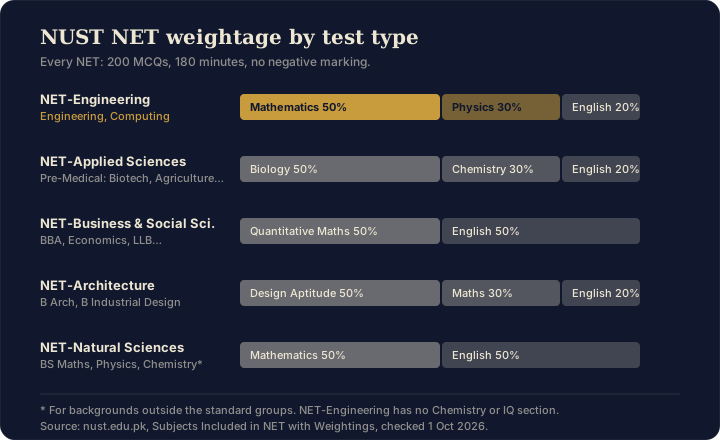
The five NET types and their weightage
| NET type | Who takes it | Weightage |
|---|---|---|
| NET-Engineering | Pre-Engineering, ICS, Pre-Medical (with or without additional Maths), or any HSSC with Maths, applying for Engineering, Computing or BS Robotics & AI | Mathematics 50%, Physics 30%, English 20% |
| NET-Applied Sciences | Pre-Medical, applying for BS Biotechnology, Environmental Science, Agriculture, Food Science & Technology, Bioinformatics, Chemistry or Physics | Biology 50%, Chemistry 30%, English 20% |
| NET-Business Studies & Social Sciences | Any HSSC group, applying for BBA, Economics, Accounting & Finance, Psychology, Mass Communication, Public Administration, LLB, Tourism, Liberal Arts or International Relations | Quantitative Mathematics 50%, English 50% |
| NET-Architecture | HSSC with Maths and Physics, applying for B Architecture or B Industrial Design | Design Aptitude 50%, Mathematics 30%, English 20% |
| NET-Natural Sciences | A background outside the standard groups, applying for BS Mathematics, Physics or Chemistry | Mathematics 50%, English 50% |
NET-Engineering also lets you apply to BS Mathematics, BS Physics, BS Chemistry, BS Bioinformatics, BS Food Science & Technology and BS Robotics & AI without paying a second fee or taking another NET.
For BS Bioinformatics, Food Science & Technology and Chemistry, NUST takes your best score even if you sat both NET-Engineering and NET-Applied Sciences.
What changed from the old NET pattern
Older guides and some academy material still describe a NET-Engineering paper with Chemistry, a Computer section and an Intelligence (IQ) section. That's out of date. NUST's current page lists only Mathematics, Physics and English for NET-Engineering.
If you're a Pre-Engineering student, you don't need to revise FSc Chemistry for NET at all. Chemistry only appears in NET-Applied Sciences, alongside Biology.
NET-Engineering syllabus: topics to cover
NUST doesn't publish a chapter-by-chapter syllabus or chapter weightage. It says the NET is "compiled from text books prescribed for HSSC courses" and tells students to consult the relevant textbooks of the different boards. In practice that means the FSc Part I and Part II course for each subject.
The topic lists below are how we've organised the eight NET papers on ParhaiKrlo, built from those textbooks. They're a complete map of the FSc course, not an official NUST list.
Mathematics (about 100 MCQs)
Mathematics is half the paper, so it decides your score more than anything else.
- Algebra: Sets, Functions and Groups; Complex Numbers; Matrices and Determinants; Quadratic Equations; Partial Fractions; Sequences and Series; Permutations, Combinations and Probability; Mathematical Induction and Binomial Theorem
- Trigonometry: identities, graphs, solving triangles, inverse trigonometric functions
- Calculus: Functions and Limits, Differentiation, Integration
- Geometry: Vectors, Analytic Geometry (straight lines), Conic Sections (circle, parabola, ellipse, hyperbola)
- Linear Inequalities and Linear Programming
Across our eight papers, Trigonometry, Differentiation and Integration carry the most questions, followed by Sequences and Series, Conic Sections, and Permutations, Combinations and Probability. Calculus and trigonometry come up everywhere, so make them strong first.
Physics (about 60 MCQs)
- Part I: Measurements, Vectors and Equilibrium, Motion and Force, Work and Energy, Circular Motion, Fluid Dynamics, Oscillations, Waves, Physical Optics, Optical Instruments, Heat and Thermodynamics
- Part II: Electrostatics, Current Electricity, Electromagnetism, Electromagnetic Induction, Alternating Current, Physics of Solids, Electronics, Dawn of Modern Physics, Atomic Spectra, Nuclear Physics
Most questions are short numericals or one-step concept checks. Motion and Force, Current Electricity and Waves carry the most questions in our papers, but every chapter turns up.
English (about 40 MCQs)
- Vocabulary: synonyms, antonyms and words in context. This is the biggest English area in our papers
- Sentence completion: choosing the word or phrase that fits
- Grammar and usage: finding errors, tenses, prepositions, subject-verb agreement
- Reading comprehension: short passages with questions
NUST says its English paper follows the SAT pattern. That means meaning in context and careful reading matter more than memorising grammar rules. Our NET English guide works through every question type with examples.
How long you get per question
180 minutes for 200 MCQs is 54 seconds a question on average. It's tight, and the subjects don't take equal time:
- English can usually go in 30 to 40 seconds a question. Finishing it quickly frees up time.
- Physics numericals take longer. Aim for about a minute each.
- Mathematics is where the time goes. Some calculus and conic questions need well over a minute.
Since there's no negative marking, never leave a question blank. If a question is eating your time, mark your best guess, flag it, and come back to it if time allows.
Computer-based vs paper-based
In Islamabad and Quetta the NET is computer-based. In Karachi and Gilgit it's on paper. NUST says both use the same pattern and standard.
NUST also has a free sample test on ugadmissions.nust.edu.pk that shows the computer-based interface. Try it once before test day so the screen isn't new to you.
How to use the pattern in your preparation
- Split your time by weightage. Roughly half your prep time on Maths, a third on Physics, the rest on English.
- Use your FSc textbooks first. NUST builds its questions from them, so the textbook exercises are your base. Extra books come after.
- Practise full papers under time. Knowing the content isn't enough when you have 54 seconds a question. Full 200-MCQ papers in three hours build that speed. Our 6-week NET-1 study plan builds them in week by week, and our subject-wise strategy covers how to approach each subject.
Frequently Asked Questions
How many MCQs are in the NUST NET?
The NET has 200 MCQs, each with four options, to be attempted in 180 minutes, and there is no negative marking. In NET-Engineering that works out to about 100 Mathematics, 60 Physics and 40 English MCQs.
Is Chemistry included in NUST NET-Engineering?
No. NUST's current NET-Engineering weightage is Mathematics 50%, Physics 30% and English 20%. Chemistry appears only in NET-Applied Sciences (Biology 50%, Chemistry 30%, English 20%), which is for Pre-Medical candidates applying to programmes such as Biotechnology and Agriculture.
What is the NUST NET syllabus?
NUST does not publish a chapter-wise syllabus. It says the NET is compiled from the textbooks prescribed for HSSC courses and is based on SSC and HSSC Part I and Part II studies, so the FSc course of each subject is the syllabus. NUST says its English paper follows the SAT pattern.
Which NET do business and social sciences students take?
NET-Business Studies & Social Sciences, which is Quantitative Mathematics 50% and English 50%. It is open to any HSSC group and covers BBA, Economics, Accounting & Finance, Psychology, Mass Communication, Public Administration, LLB, Tourism, Liberal Arts and International Relations.
Is there negative marking in the NUST NET?
No. NUST's admission FAQ says there is no negative marking, so you should answer every question, with your best guess where you are unsure.
Practise on the NET-Engineering pattern
- NUST NET papers: eight full NUST NET past papers, 200 MCQs each, on the NET-Engineering pattern. ParhaiKrlo prepared them because NUST doesn't publish its own, and every answer comes with an expert explanation.
- NUST NET preparation hub: practise topic by topic in Maths, Physics and English.
- NET-2027 registration and dates: when each series opens and how to apply.
- NUST aggregate calculation: how much your NET score counts and what to aim for.
The pattern above is from NUST's "Subjects included in NET with weightings" page and its admission FAQs, checked on 1 October 2026. Confirm on nust.edu.pk before your test.