
How Many Times Can You Attempt an Entry Test, and Is a Retake Worth It?
Every big entry test in Pakistan has its own attempt rules. Some count your best score, some are once a year, and an MDCAT result now stays valid for three years. Here are the official rules and a simple way to decide whether a retake is worth it.
By ParhaiKrlo Team · Published 3 Oct 2026 · 7 min read
Updated: 3 October 2026
"Can I give it again?" is the first question most students ask after a disappointing entry test. The answer depends on the test. Some let you sit several times in one admission cycle and keep your best score. Others are held once a year, so a retake means waiting twelve months.
This guide puts the official attempt rules for Pakistan's main entry tests in one place, then gives you a simple way to decide whether a retake is worth your time and money.
Quick answer
- MDCAT is held once a year. PMDC says a result stays valid for three years, so a retake is next year's paper, not a second sitting this year.
- ECAT (UET) ran two phases for Fall 2026, and UET counted the best score of the two.
- NUST NET runs four series a cycle and counts your best score. One attempt per NET type per series.
- LUMS LCAT is held once for each admission cycle, so a first-year applicant gets one sitting a year.
- A retake is worth it only if something changes in between: more prep, a fixed weak subject, or better timing. A retake on the same preparation usually gives you the same score.
The attempt rules, test by test
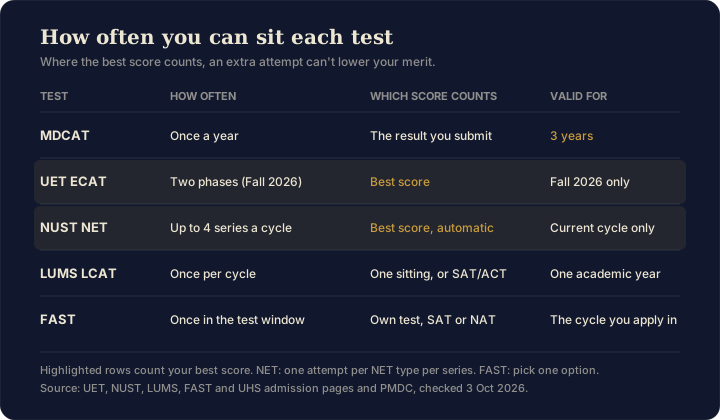
| Test | How often you can sit it | Which score counts | How long it stays valid |
|---|---|---|---|
| MDCAT (PMDC) | Once a year | The result you submit, from a valid year | 3 years, under the PMDC Act |
| ECAT (UET Lahore) | Two phases for Fall 2026 | Best of the two phases | The Fall 2026 admissions only |
| NUST NET | Up to four series a cycle, once per NET type per series | Best score, picked automatically | The current admission cycle only |
| LUMS LCAT | Once per admission cycle | Your one sitting (or a SAT/ACT score instead) | One academic year |
| FAST admission test | Once in the Fall test window (29 Jun to 10 Jul 2026) | Your chosen test: FAST test, SAT or NTS NAT | The cycle you apply in |
A few notes on that table:
MDCAT. In November 2025 PMDC said it could not "legally disadvantage" earlier test-takers, because under the PMDC Act an MDCAT result stays valid for three years. UHS's 2025-26 Punjab admission notices accepted MDCAT 2023, 2024 or 2025. If you hold more than one valid result, read that year's admission notice to see which one you may submit. The 2025-26 Punjab notices don't spell this out.
ECAT. UET's ECAT page says applicants "will be allowed multiple attempts, and their best score will be considered" in line with Pakistan Engineering Council instructions. For Fall 2026, Phase 2 (16 to 21 June) was labelled the final attempt. ECAT has no negative marking.
NUST NET. You can't sit NET-Engineering twice in Series 1, but you can sit it again in Series 2. Each series needs its own registration and fee. Our guide to which NET series to take covers the details.
LCAT. LUMS says the LCAT is held only once for Fall and Spring admissions, and freshmen join in Fall only. If one sitting worries you, LUMS also accepts SAT or ACT scores, which you can take more than once. See our LCAT dates guide.
FAST. FAST asks you to pick one of three test options (its own test, SAT or NTS NAT) on the form. Its own test has negative marking. Choose the option you are strongest in before you apply.
How much is one more mark worth?
Before you decide, work out what a better score would actually do to your merit. Entry tests carry different weights:
| Test | Weight in merit | What one extra mark adds |
|---|---|---|
| MDCAT (Punjab, 180 MCQs) | 50% | about 0.28 aggregate points per MCQ |
| NUST NET (200 marks) | 75% | 0.375 aggregate points per mark |
So 10 more correct MCQs in MDCAT add about 2.8 aggregate points. In NUST, 10 more NET marks add 3.75 points. On a crowded merit list, that can move you thousands of places. See what decides your MDCAT seat and how NUST aggregate is calculated for full worked examples.
Your Matric and FSc marks are mostly fixed by the time you retake. The entry test is usually the only part of your merit you can still move.
Is a retake worth it? Five questions to ask
1. Do you know why you lost marks? Go through your result, or a past paper under exam conditions, and list where the marks went. If you can't name the weak areas, a retake won't fix them.
2. Is there real time to improve? NUST series are weeks apart, and an ECAT second phase is a few weeks after the first. MDCAT and LCAT are a year apart. A gap of a few weeks is enough to fix one or two weak topics, not to rebuild a whole subject.
3. How far are you from the closing merit? If you need two or three more aggregate points, a retake is often worth it. If you need fifteen, think about a different programme or university too, not just a retake. Our backup plan guide covers this.
4. What does it cost you? Count the fee, travel, and the study time it takes away from board exams. For MDCAT, a retake usually means a gap year. Ask yourself honestly whether you'll stay motivated for twelve more months.
5. Can it hurt you? For NET and ECAT, where the best score counts, an extra attempt can't lower your merit. For MDCAT, your earlier result is still valid, but check the admission notice for the year you apply in before you assume you can submit whichever score you like.
When a retake usually makes sense
- You were sick, or something went wrong on the day. Your score doesn't show what you know.
- You started preparing late and still had big topics untouched.
- You were close to the merit you need, and your mistakes were in a few fixable topics.
- The test lets you keep your best score (NET, ECAT), so the attempt is low-risk.
When it usually doesn't
- You'd take it on the same preparation, with no new plan in between.
- The gap you need to close is very large compared with past closing merits.
- A retake clashes with your board exams, which carry their own weight in merit.
- You'd skip applying anywhere else while you wait. Always apply to backups in the same cycle.
How to make a retake count
- Sit a full past paper under timed conditions within a week of your result. This gives you an honest baseline.
- Make a mistake log. Write down every wrong question by topic. Your weak topics will show up within two or three papers.
- Fix the biggest gaps first. For MDCAT, Biology carries 45% of the paper, so a weak Biology chapter costs more than a weak English topic.
- Practise under the real format. NET is computer-based, MDCAT is paper-based, and FAST has negative marking. Practise the way you'll be tested.
- Take one more full paper a week before the test to check you've actually improved.
Frequently Asked Questions
How many times can you take MDCAT?
MDCAT is held once a year, so a retake means sitting next year's paper. Under the PMDC Act an MDCAT result stays valid for three years, and UHS's 2025-26 Punjab admission notices accepted MDCAT 2023, 2024 or 2025. If you hold more than one valid result, read that year's admission notice to see which one you may submit.
Does UET count the best ECAT score?
Yes. UET says applicants are allowed multiple attempts in line with Pakistan Engineering Council instructions, and the best score counts for merit. For Fall 2026 there were two ECAT phases, and the scores were valid for the Fall 2026 admissions only. ECAT has no negative marking.
How many times can you take the NUST NET?
NUST runs four NET series in a cycle and counts your best score automatically. You can take each NET type only once per series, and each series needs its own registration and fee. A NET score is valid for the current admission cycle only.
Can you take the LUMS LCAT twice?
LUMS says the LCAT is held only once for Fall and Spring admissions, and freshmen join in Fall only, so a first-year applicant gets one LCAT sitting a year. LUMS also accepts SAT or ACT scores, which you can take more than once.
Is it worth retaking an entry test?
Only if something changes in between: more preparation, a fixed weak subject, or a better day. A retake on the same preparation usually gives a similar score. It makes most sense when you were close to the merit you need, when you lost marks in a few fixable topics, or when the test counts your best score, as NET and ECAT do.
Next steps
- MDCAT past papers: every year from 2008 to 2025, with explained answers, to find your weak topics.
- NUST NET papers: eight full NET-pattern papers if you're planning another series.
- LUMS LCAT mocks: full timed mocks for the one sitting you get.
- Backup plan guide: which universities to apply to while you retake.
The attempt rules above are from UET's ECAT page, FAST's admission pages, NUST's admission rules, LUMS's programme pages, UHS's 2025-26 admission notices and PMDC's public statement on MDCAT validity, checked on 3 October 2026. Rules can change each cycle, so confirm on each university's official website before you register.