
FAST Entry Test Tips for Success: Preparation and Test-Day Strategy
The FAST-NU entry test gives you one attempt, deducts marks for wrong answers and times each section separately. Those three rules change how you should prepare and how you should behave in the test. Here is what works, from your first week to your last minute.
By ParhaiKrlo Team · Published 9 Oct 2026 · 5 min read
A lot of entry-test advice says "attempt every question". For the FAST-NU entry test, that advice can cost you marks. FAST deducts marks for wrong answers, gives you one attempt per cycle, and times each section separately. Good FAST preparation is built around those three rules.
This guide covers preparation, the last week, test day and strategy inside the test for the BS Computer Science / Engineering test. The rules are from FAST's own admission pages and 2025 prospectus, checked on 9 October 2026.
Quick answer: the five things that matter most
- Put half your effort into Advanced Mathematics. It's 50% of the test.
- Practise skipping. With negative marking, a blind guess has a real cost.
- Treat every attempt before test day as practice. FAST's prospectus says each type of admission test can be taken only once.
- Use each section's full time. Time you save in one section doesn't carry over to the next.
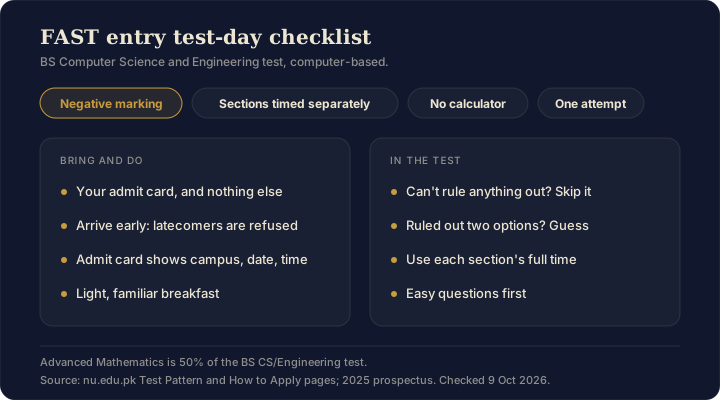
- Bring your admit card and nothing else. FAST says latecomers aren't allowed in.
Know the rules of your test
| FAST admission test (BS CS / Engineering) | |
|---|---|
| Sections | Advanced Math 50%, Basic Math 20%, Analytical Skills & IQ 20%, English 10% |
| Length | Not published by FAST; prep sites report 120 MCQs in 120 minutes |
| Negative marking | Yes; FAST doesn't publish the deduction |
| Calculator | Not allowed |
| Format | Computer-based, at every FAST campus |
| Attempts | One per cycle |
| Weight in merit | 50% for Computing and Business, 33% for Engineering |
The full topic list is in our FAST test pattern and syllabus guide.
How to prepare
Make FSc maths your foundation
Advanced Mathematics is FSc Part I and II: calculus, trigonometry, algebra, geometry and vectors. Your board preparation and your FAST preparation overlap here, so use that. Learn each chapter properly from the textbook, then do topic MCQs until they're quick.
Don't neglect Basic Math and IQ
Together they're 40% of the test, and they're the sections where practice pays off fastest. Basic Math is matric-level arithmetic done quickly without a calculator. IQ questions (series, coding, analogies, puzzles) repeat their patterns, so once you've seen enough of them you'll recognise the type in seconds. Ten minutes a day on each adds up.
Keep English light but regular
English is only 10%. A little vocabulary and one short reading passage a day is enough. Don't let it take time from maths.
Practise without a calculator
Every practice question, from the first week. Mental arithmetic, clean working and checking against the options are skills you'll use on every maths question in the test.
Keep a mistakes notebook
Write down why you got each question wrong. With negative marking, you also want to track your guesses: how often a guess after ruling out two options was right, and how often a blind guess was. That tells you how much risk to take on the day.
Sit full timed papers
In the last month, sit a full-length paper at least once a week, with the sections timed separately. That's the only way to learn the pace before your one real attempt. Our FAST past papers and mock tests follow the BS CS/Engineering pattern.
The last week
- No new topics. Revise formulas, IQ patterns and your mistakes notebook.
- One or two full timed papers, with your skipping rule in practice.
- Keep regular sleep.
The day before
- Put the books away by the evening.
- Print your admit card. It shows your roll number, date, time and campus.
- Plan your journey with a margin. FAST says latecomers won't be allowed to take the test.
- Eat normally and sleep early.
On test day
- Have a light, familiar breakfast.
- Arrive early. There's no second chance if you're late.
- Bring your admit card. FAST says to bring nothing to the test centre except the admit card, and no one sits the test without an endorsed one.
Strategy inside the test
Use the skipping rule
FAST deducts marks for wrong answers, so:
- If you can't rule out any option, skip it.
- If you can rule out two of the four options, take the guess.
Decide this rule before test day and stick to it. Changing your approach in the middle of the test is how good students lose marks.
Use each section's full time
FAST's online test gives each section its own timer, and saved time doesn't carry forward. So there's no point rushing English to save time for maths. Within a section you can move back and forth, so after one pass, use any spare minutes to check your answers and revisit the questions you skipped.
Easy questions first
In each section, answer what you can solve quickly, then return to the longer ones. In Advanced Math especially, one stubborn integral shouldn't take the time of three easier questions.
Read carefully
Watch for "not", "except" and "which of these is false", and check which quantity the question actually asks for. With negative marking, a misread costs more than just a lost mark.
After the test
Selected candidates are informed by SMS and email, and you can check your status on the admissions portal with your application reference number. Merit lists are made separately for each campus. See how the FAST aggregate is calculated, or try your own numbers in the FAST aggregate calculator.
Frequently Asked Questions
Should I attempt every question in the FAST entry test?
No. FAST deducts marks for wrong answers. Skip a question if you can't rule out any option, and take the guess if you can rule out two of the four.
Which section of the FAST test matters most?
Advanced Mathematics, which is 50% of the BS CS/Engineering test. Basic Mathematics and Analytical Skills & IQ are 20% each, and English 10%.
Can I save time in one FAST section for another?
No. FAST's online test times each section separately, and time saved in one section doesn't carry forward. Use any spare minutes to review that section.
What should I bring to the FAST test centre?
Your admit card. FAST says applicants should bring nothing except the admit card, no one sits the test without an endorsed one, and latecomers aren't allowed in.
Can I retake the FAST entry test in the same year?
No. FAST's prospectus says each type of admission test can be taken only once, so practise on full timed papers before test day.
Practise now
- FAST-NU past papers: seven full-length papers on the BS CS/Engineering pattern, every answer explained. FAST doesn't release its own papers; ours are prepared by ParhaiKrlo.
- FAST-NU mock tests: timed, full-length practice.
- FAST entry test 2027 dates and registration: when to apply and the fees.
- FAST-NU preparation hub: everything for FAST in one place.
The rules here are from FAST's admission pages and 2025 prospectus, checked on 9 October 2026. Always follow the instructions on your own admit card.