
LUMS LCAT Tips for Success: How to Prepare and What to Do on Test Day
The LCAT is held once per cycle, on paper, with no calculator and no published question count. Here is how to prepare for that format, what to do the day before and on test day, and how to pace two Verbal and two Math sections of 40 minutes each.
By ParhaiKrlo Team · Published 9 Oct 2026 · 5 min read
The LCAT is a different kind of test from the FSc-based entry tests most Pakistani students know. It's closer to the SAT: reading, writing and reasoning-heavy maths, on paper, with no calculator. Students who prepare for it like a board exam, by memorising, often find the real paper doesn't ask what they learned.
This guide covers how to prepare for that style, the last week, test day and pacing inside the four sections. The facts are from LUMS's programme pages and its own LCAT sample guide, as covered in our earlier LCAT posts.
Quick answer: the five things that matter most
- Prepare SAT-style. LUMS calls the LCAT "similar to the SAT" and its sample guide points to SAT practice material.
- Do all your maths practice without a calculator. Calculators aren't allowed in any part of the test.
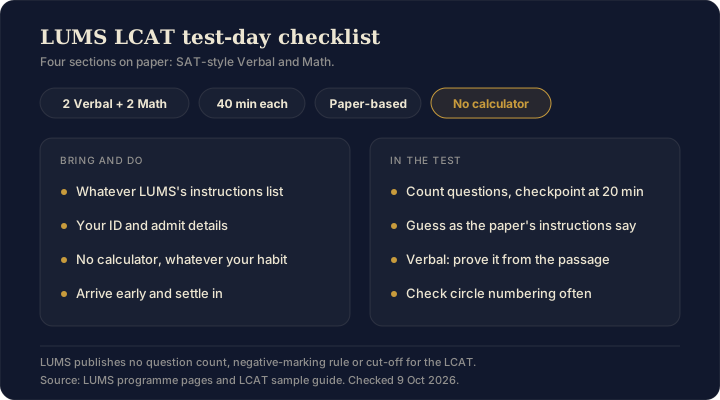
- Pace each 40-minute section on its own. There are two Verbal and two Math sections.
- Be careful with the answer sheet. It's paper-based, and you fill in circles.
- Read the instructions on the paper about guessing. LUMS doesn't publish whether there's negative marking.
Know the rules of your test
| LUMS LCAT | |
|---|---|
| Sections | 2 Verbal and 2 Math |
| Time | 40 minutes per section, about 3 hours in total |
| Format | Paper-based multiple choice, answers marked on an answer sheet |
| Calculator | Not allowed |
| Questions per section | Not published by LUMS |
| Negative marking | Not published by LUMS |
| Attempts | Held once per admission cycle |
| Score | Valid for one academic year, and not disclosed to applicants |
Our LCAT Math and Verbal sections guide explains what each section tests, with worked examples.
How to prepare
Build skills, not memory
The LCAT tests how you read and reason, not how many facts you remember. The Verbal sections ask about meaning, structure, grammar and word choice in passages. The Math sections cover algebra, advanced maths, data analysis, geometry and trigonometry, and they reward method over long calculation.
Read every day
Verbal skill builds slowly, so start early. Read a serious article or essay every day, such as a newspaper opinion piece or a long magazine feature, and ask yourself what the writer's main point is and how they support it. That's most of what the reading questions ask.
Learn grammar rules properly
Questions on Standard English conventions have right and wrong answers: subject-verb agreement, punctuation, pronouns, modifiers. Learn the rules once, then practise spotting them.
Practise maths by hand
Since there's no calculator, keep numbers as fractions, simplify early and use properties instead of brute force. A student who practised with a calculator for months will be slow on test day.
Use the right practice material
LUMS's own sample guide recommends SAT practice material, and our LUMS sample papers and LCAT mock tests follow the LCAT's Verbal and Math format. Sit full sections under a 40-minute timer, not just loose questions.
Keep a mistakes notebook
For every wrong answer, write down why. In Verbal, the cause is often reading what you expected rather than what the passage says. In Math, it's often a careless step. Patterns show up within a couple of weeks.
The last week
- Revise, don't cram. Go through your grammar rules, maths formulas and mistakes notebook.
- Sit one or two full practice tests with all four sections back to back, to build stamina for three hours.
- Keep your sleep regular.
The day before
- Stop studying by the evening. A tired brain reads slowly, and the LCAT is a reading test.
- Check your test-day instructions from LUMS for the venue, reporting time, ID and what you may bring.
- Plan your journey with time to spare.
- Eat normally and sleep early.
On test day
- Have a proper breakfast. Three hours of focused reading is tiring.
- Arrive early and settle in before the first section.
- Bring only what's allowed. No calculator, whatever your habits.
Strategy inside the test
Pace by section
Each section has its own 40 minutes. LUMS doesn't publish how many questions a section has, so count them when the section starts and set yourself a checkpoint at 20 minutes. If you're behind, speed up on the questions you find easy rather than rushing the hard ones.
Don't get stuck
If a question isn't working after a minute, mark your best answer, note it, and move on. Come back at the end of the section if time allows.
Guessing: follow the paper's instructions
LUMS doesn't say whether wrong answers are penalised, so read the instructions printed on your paper. If wrong answers cost nothing, answer every question. If they're penalised, guess only when you've ruled out at least one or two options.
In Verbal, go back to the text
The right answer is supported by the passage, not by your opinion or outside knowledge. Before choosing, find the line that proves it.
Guard your answer sheet
Every few questions, check that the circle you're filling is on the right question number. One skipped line can shift a whole run of answers, and a correct answer in the wrong circle scores nothing.
Keep the LCAT in perspective
The LCAT matters, but LUMS doesn't admit on the test alone. It uses a holistic assessment of your academic record, test score and application, and some candidates are called for interviews. See how LUMS decides admission and the LUMS eligibility criteria. If you already have a strong SAT score, read LUMS: SAT vs LCAT first.
Frequently Asked Questions
How should I prepare for the LUMS LCAT?
Prepare SAT-style. LUMS calls the LCAT similar to the SAT, and its sample guide recommends SAT practice material. Read every day, learn grammar rules properly, and practise maths by hand under a 40-minute timer per section.
Can I use a calculator in the LCAT?
No. LUMS says calculators are not allowed in any part of the test, so do all your maths practice without one.
Does the LCAT have negative marking?
LUMS doesn't say on its public pages. Read the instructions printed on your paper: if wrong answers cost nothing, answer every question; if they are penalised, guess only after ruling out options.
How should I pace the LCAT sections?
Each of the four sections has its own 40 minutes. LUMS doesn't publish the question count, so count the questions when a section starts and set a checkpoint at 20 minutes.
Is the LCAT the only thing LUMS looks at?
No. LUMS uses a holistic assessment of your academic record, test score and application, and some candidates are called for interviews.
Practise now
- LUMS LCAT sample papers: full papers in the LCAT format, every answer explained.
- LCAT mock tests: timed, full-length practice.
- LCAT 2027 dates and deadlines: when the test is expected.
- LUMS LCAT preparation hub: everything for LCAT in one place.
The rules here are from LUMS's programme pages and LCAT sample guide, as covered in our LCAT posts. Always follow the instructions LUMS sends you for test day.