
MBBS Admission 2026-27 After MDCAT: How the Process Works in Every Province
Passing MDCAT makes you eligible. The admission process decides where you land. Here's how the preference form, merit lists and upgradation work, province by province, with the dates already announced for 2026-27.
By ParhaiKrlo Team · Published 7 Oct 2026 · 11 min read
Updated: 7 October 2026
MDCAT 2026 results are out in every province. If you passed, you're now eligible to apply for MBBS or BDS. The next few months decide which college you actually join, and most of that comes down to one form and a few deadlines.
This guide explains how the admission process works: the online application, the college preference list, merit lists, upgradation and the fee deadlines. It covers Punjab, Khyber Pakhtunkhwa, Sindh, Balochistan and the federal colleges. If you want to know how merit itself is calculated, read our guide to what decides your seat after MDCAT first.
Quick answer
- Each province has an "admitting university" that runs one central admission for its public colleges: UHS in Punjab, KMU in KP, a Sindh admission run through DUHS, BUMHS in Balochistan, and SZABMU for the federal colleges.
- KP is open now. KMU's online application for 2026-27 opened on 1 October 2026 and closes on 21 October 2026 at 5 pm.
- Punjab hasn't announced 2026-27 dates yet. Last session, UHS opened applications on 7 November and closed them on 21 November.
- Your college preference list is the most important thing you submit. In Punjab, the order of preferences becomes final and can't be changed after the deadline.
- Merit lists come in rounds. After the first selection list, empty seats are filled through upgradation: students move up to a college higher on their list.
- Miss a fee deadline and you lose the seat. In Punjab's private colleges last year, selected students had to deposit Rs 600,000 within three working days.
Who runs admission in your province
| Region | Admitting university | MDCAT results accepted (latest notice) | Official portal |
|---|---|---|---|
| Punjab | UHS Lahore | 2023, 2024 or 2025 (for 2025-26) | uhs.edu.pk |
| Khyber Pakhtunkhwa | Khyber Medical University (KMU) | 2024, 2025 or 2026 | cas.kmu.edu.pk |
| Sindh | Joint admission for Sindh's public medical universities, applications through DUHS | As per the Sindh prospectus | admissions.duhs.edu.pk |
| Balochistan | BUMHS Quetta | As per the BUMHS notice | bumhs.edu.pk |
| Federal colleges (Islamabad and others) | SZABMU Islamabad | As per the SZABMU notice | szabmu.edu.pk |
| Armed Forces colleges | NUMS | NUMS's own test | numspak.edu.pk |
Every row follows the same PMDC base rules: you need at least 55% in MDCAT for MBBS and 50% for BDS, and merit is 50% MDCAT, 40% FSc and 10% Matric. The provinces differ in domicile rules, FSc minimums, seat quotas and dates.
The process, step by step
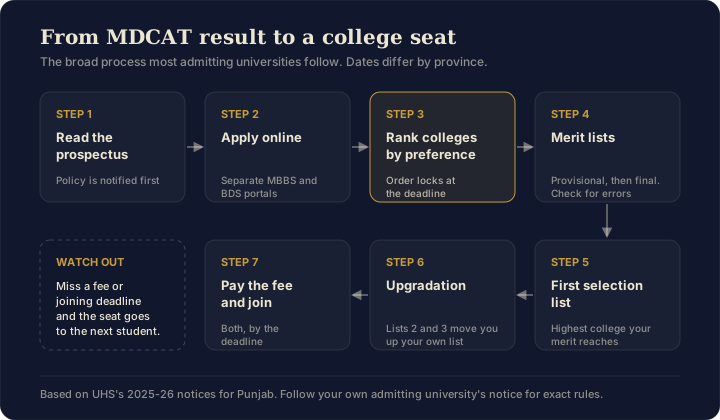
The steps below are from UHS's official notice for Punjab's public colleges in 2025-26. Other provinces follow the same broad pattern.
1. Read the prospectus and admission policy
Admissions start only after the provincial government notifies its admission policy. In Punjab last year, the policy was notified on 22 October 2025, and UHS opened applications about two weeks later. The prospectus lists every college, every seat category and every document you need. Read it before you start the form.
2. Create your account and fill the form
You register on the admitting university's portal with your name, father's or guardian's name, email, CNIC or B-Form number and a password. Then you enter:
- your personal details and domicile
- your Matric and FSc marks, subjects and year of passing
- your MDCAT score
- the seat categories you're eligible for (open merit, plus any quota you qualify for)
In Punjab, MBBS and BDS have separate portals. If you want to be considered for both, apply on both.
3. Choose your colleges in order of preference
This is the step students get wrong most often. Your preference list tells the system which college to give you when your merit is high enough for more than one.
- List colleges in the order you'd genuinely choose them, not the order you think you'll get in.
- In Punjab's public sector, you must select all colleges for your seat category.
- In Punjab's private sector, a college you leave off your list will never be offered to you, not even through upgradation.
- After the deadline, the number and order of your preferences are final. You can edit your application until the closing date, but not after.
UHS's private-sector notice also advises students to check each college's fee, location and facilities, by visiting or through its official website, before finalising preferences.
4. Upload documents and pay the processing fee
Uploads must be clear scans. UHS allowed up to 1 MB per file last year, and SZABMU allows up to 512 KB. The processing fee was Rs 2,000 at UHS (paid at Bank of Punjab or National Bank, or through a 1Bill invoice) and is Rs 3,000 per programme at KMU (paid at any Bank of Khyber branch). In both cases, you upload or verify the paid challan on the portal.
5. Provisional and final merit lists
After applications close, the university publishes a provisional merit list. This is your chance to spot mistakes: wrong marks, a missing quota or a wrong category. Each university has a short window for objections before it publishes the final merit list. Check your entry the day the provisional list comes out.
6. Selection lists and upgradation
The final merit list ranks everyone. Seats are then allocated college by college in selection lists:
- First selection list: you're placed in the highest college on your preference list that your merit reaches.
- You pay the fee and join by the deadline. If you don't, you lose the seat.
- Second and third lists (upgradation): when students above you don't join, seats open up. If a seat opens at a college higher on your list, you're moved up automatically.
In Punjab's public sector, upgradation is mandatory. If you're moved, you must report to the new college, and UHS transfers your fee. In Punjab's private sector, you choose at the time of joining whether to keep your seat or stay in the running for upgradation. That choice is final.
7. Pay the fee and join
Admission is confirmed only when you've done both: paid the fee and joined the college in writing by the due date. Miss either one and the seat goes to the next student on merit.
Punjab 2025-26 timeline (for reference)
Punjab's 2026-27 schedule isn't out yet. Last session's schedule shows how long the process takes:
| Step | MBBS (public) | BDS (public) |
|---|---|---|
| Applications open | 7 November 2025 | 7 November 2025 |
| Applications close | 21 November 2025, 5 pm | 21 November 2025, 5 pm |
| Provisional merit list | 26 November 2025 | 26 December 2025 |
| Final merit list | 28 November 2025 | 29 December 2025 |
| First selection list | 1 December 2025 | 2 January 2026 |
| Second selection / upgradation | 5 December 2025 | 8 January 2026 |
| Third selection / upgradation | 11 December 2025 | 14 January 2026 |
| Classes begin | 2 February 2026 | 2 March 2026 |
Private-sector MBBS ran a little later: its first selection list came on 18 December 2025 and its third on 31 December 2025. Expect this year's dates to be different. Use the table only to plan roughly, and follow UHS's official notice.
How each province differs
Punjab (UHS)
- Public colleges: Punjab domicile is mandatory, and FSc Pre-Medical needs at least 60%.
- Private colleges: students with a domicile from any district of Pakistan can apply, through UHS's separate private portals.
- Seat categories: open merit, plus reserved seats for disabled students, Cholistan, under-developed districts, reciprocal seats in other provinces, and overseas Pakistanis.
- Private deposit: last year, selected private-sector students paid Rs 600,000 to UHS within three working days of the merit list. UHS later passed it on to the college. The rest of the fee went directly to the college.
Khyber Pakhtunkhwa (KMU)
- Open now: 1 to 21 October 2026, at cas.kmu.edu.pk.
- Higher FSc minimum: at least 65% in FSc Pre-Medical or equivalent.
- MDCAT 2024, 2025 or 2026 is accepted.
- Domicile: KP or the newly merged districts.
- Quotas include: open merit, self-finance, reciprocal, disabled, backward areas, newly merged districts, Overseas Pakistanis Foundation, minorities, Army Public School victims, Afghan nationals and foreign self-finance.
- Once you submit, you can't change your application, so preview it carefully first.
Sindh
- Seats are split by district. Each public college is "tagged" to a group of districts, and its general merit seats are divided among them by population. Khairpur Medical College, for example, divides its 100 seats among 10 tagged districts. You compete mainly with students from your own district.
- Domicile and PRC both matter. For Karachi seats, the prospectus asks for a Karachi domicile, a PRC and a NADRA CNIC with a permanent Karachi address.
- Self-finance seats (called CEAP, UEAP or UDP depending on the university) sit alongside general merit seats at much higher fees. At Khairpur Medical College last year, the yearly tuition was Rs 48,000 on general merit and Rs 600,000 on CEAP merit.
- Fees are due fast. Several colleges in the 2025-26 prospectus gave selected students three working days to pay.
Balochistan (BUMHS)
BUMHS conducts MDCAT for Balochistan and runs admission to its public medical colleges. Its MDCAT 2026 result and grievance notice are on bumhs.edu.pk. Watch the same page for the 2026-27 admission notice. Balochistan domicile is required for provincial seats.
Federal colleges (SZABMU)
SZABMU runs admission to federal public colleges such as Federal Medical College, Islamabad. Every Pakistani citizen, including students from AJK and Gilgit-Baltistan, can compete for open merit seats and is also considered for their own domicile quota. Of Federal Medical College's 100 seats, only 6 are open merit. The rest are split by region (25 Islamabad, 29 Punjab and so on), plus 9 for children of federal government employees and 2 for disabled students. If you use a domicile quota, you also need proof that you actually lived or studied in that region.
Documents to keep ready
Most universities ask for the same core set:
- Matric and FSc certificates or result cards (attested if the prospectus asks)
- Your domicile certificate (and a PRC in Sindh)
- Your CNIC or B-Form, and your father's, mother's or guardian's CNIC
- Your MDCAT 2026 result card
- A recent passport-size photo (SZABMU asks for a blue background)
- Any quota proof: disability certificate, federal employee certificate, or proof of residence in an under-developed district
Getting a domicile, PRC or attested certificate can take a week or more, so start now.
Mistakes that cost students their seats
- Ordering preferences by "what I'll get" instead of "what I want". Upgradation only moves you up your list. If you put a college you'd prefer lower down, you can be stuck below it.
- Leaving colleges off the list. In Punjab's private sector, a college that isn't on your list can't be offered to you at any stage.
- Missing the fee deadline. Three working days goes quickly. Arrange the money before the first list comes out.
- Not joining in writing. Paying the fee isn't enough. You also have to mark your joining by the deadline.
- Not checking the provisional list. Wrong marks or a missing quota can usually be fixed only during the objection window.
- Applying for MBBS but not BDS. If you'd genuinely be happy as a dentist, apply on both portals. They're separate applications.
What to do this week
- If you're from KP, apply on cas.kmu.edu.pk before 21 October 2026.
- Calculate your aggregate with our MDCAT merit calculator, so you know roughly where you'll stand.
- Shortlist colleges and decide your real order of preference. Look at fees, location and hostel facilities.
- Collect your documents, especially anything that needs attestation or a government office visit.
- Check your admitting university's site every few days for the admission notice. Don't rely on WhatsApp forwards.
If your score wasn't what you hoped and you're thinking about MDCAT 2027, start with our MDCAT past papers and full-length mocks.
Frequently Asked Questions
When will MBBS admissions 2026-27 open?
It depends on your province. In KP, KMU's online application opened on 1 October 2026 and closes on 21 October 2026 at 5 pm. Punjab hasn't announced its 2026-27 dates yet. Last session, UHS opened applications on 7 November 2025 and closed them on 21 November 2025, after the Punjab government notified its admission policy on 22 October 2025.
Can I change my college preferences after applying?
You can edit your application until the closing date, but not after. In Punjab, the number and order of your preferences become final after the deadline. In Punjab's private sector, a college you leave off your list will never be offered to you, not even through upgradation. In KP, KMU says an application can't be changed once it's submitted.
What is upgradation in MBBS admission?
After the first selection list, some students don't pay or don't join, so seats open up. In the second and third lists, if a seat opens at a college higher on your preference list, you're moved up to it. In Punjab's public sector upgradation is mandatory and UHS transfers your fee. In Punjab's private sector you choose at the time of joining whether to keep your seat or stay in the running for upgradation, and that choice is final.
How much do I have to pay when I'm selected for a private medical college in Punjab?
Last session, students selected for a private medical or dental college in Punjab had to deposit Rs 600,000 to UHS within three working days of the merit list. UHS later passed it on to the college, and the rest of the fee went directly to the college. Missing the deadline cancels the admission offer.
Can I apply for both MBBS and BDS?
Yes. In Punjab, MBBS and BDS have separate portals, so you must apply on both to be considered for both. You need at least 55% in MDCAT for MBBS and 50% for BDS. Apply for BDS only if you'd genuinely be happy as a dentist.
Next steps
- Passed MDCAT 2026? What decides your seat: how merit works and your options if your score is low.
- MDCAT merit calculator guide: the formula and the score each target aggregate needs.
- Public vs private university admissions: how the two routes differ.
The Punjab process, dates, fees and documents are from UHS's official MBBS and BDS admission notices for public and private colleges, session 2025-26. The KP dates, eligibility and quotas are from KMU's Centralized Admission System page. The Sindh details are from the Government of Sindh MBBS and BDS prospectus for 2025-26. The federal seat split and documents are from SZABMU's MBBS admission page. All were checked on 7 October 2026. Rules and dates change every session, so follow your admitting university's current notice.