
MDCAT Merit Calculator 2026: Find Your Aggregate and the Score You Need
Your MDCAT merit is 50% MDCAT, 40% FSc and 10% Matric. Here's how to use our free MDCAT merit calculator, the MDCAT score each target aggregate needs, and the input mistakes that give students the wrong number.
By ParhaiKrlo Team · Published 5 Oct 2026 · 6 min read
Updated: 5 October 2026
MDCAT 2026 results are out, and every medical college will now rank applicants by one number: your aggregate, also called your merit. You can work it out yourself in under a minute with our free MDCAT merit calculator.
This guide shows how to use the calculator, the formula behind it, the MDCAT score each target aggregate needs, and the input mistakes that give students the wrong number.
Quick answer: the MDCAT merit formula
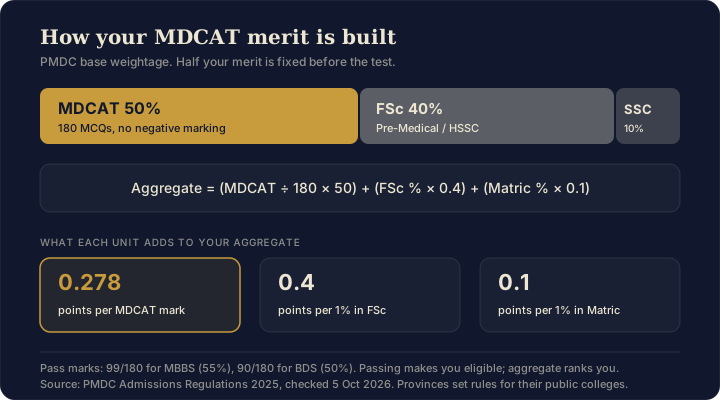
Under PMDC's Admissions Regulations, your merit is made of three parts:
- MDCAT: 50%
- FSc (Pre-Medical) / HSSC or equivalent: 40%
- Matric / SSC or equivalent: 10%
Aggregate = (MDCAT marks ÷ 180 × 50) + (FSc % × 0.4) + (Matric % × 0.1)
MDCAT 2026 had 180 MCQs and no negative marking, so your MDCAT score is simply the number of questions you got right.
How to use the MDCAT merit calculator
Open the MDCAT aggregate calculator. It has two tabs.
Tab 1: "My aggregate"
Use this once you have your result.
- Matric / SSC: type your marks obtained and your board's total. The total box starts at 1100, but change it if your board uses 1200 or another total.
- FSc Pre-Medical / HSSC: the same, marks obtained and total.
- MDCAT score: enter your total out of 180. If you only know your score for each subject, for example from a mock, switch to Correct by subject and type your correct answers in Biology (81), Chemistry (45), Physics (36), English (9) and Logical Reasoning (9).
The calculator shows your aggregate, how many points each part added, and whether your MDCAT score clears the PMDC pass marks: 99 for MBBS (55%) and 90 for BDS (50%).
Tab 2: "MDCAT score I need"
Use this before the test, or with a mock score, to set a goal. Enter your Matric and FSc marks and a target aggregate. The calculator gives you the whole number of MDCAT marks needed. If the target can't be reached even with 180/180, it says so and tells you the highest aggregate you can reach.
Your inputs are saved in your browser, so you can come back and try other targets without typing everything again.
Worked example
Here's the example from the calculator page, with made-up numbers: Matric 1000/1100, FSc 950/1100, MDCAT 150/180.
| Part | Calculation | Points |
|---|---|---|
| MDCAT | 150 ÷ 180 × 50 | 41.667 |
| FSc | 86.36% × 0.4 | 34.545 |
| Matric | 90.91% × 0.1 | 9.091 |
| Aggregate | 85.303% |
Run the same numbers through the calculator and you get the same answer, because the page and the tool use the same code.
What each mark is worth
- 1 MDCAT mark = 0.278 aggregate points (50 ÷ 180)
- 1% in FSc = 0.4 points
- 1% in Matric = 0.1 points
So one MDCAT mark is worth about 0.7% of FSc marks, and 10 extra correct MCQs add 2.78 points. That's a lot when thousands of candidates sit within a few points of each other.
Unlike NUST, MDCAT gives your FSc a big share. Half your merit is fixed before you sit the test. That's why the same MDCAT score can lead to very different aggregates.
What MDCAT score do you need?
Rearranging the formula:
MDCAT needed = (target − Matric % × 0.1 − FSc % × 0.4) ÷ 50 × 180
| Your academics | For 80% | For 85% | For 88% | For 90% | For 92% |
|---|---|---|---|---|---|
| Matric 80%, FSc 75% | 152 | 170 | 180 | Out of reach | Out of reach |
| Matric 85%, FSc 80% | 143 | 161 | 171 | 179 | Out of reach |
| Matric 90%, FSc 88% | 129 | 147 | 158 | 165 | 173 |
| Matric 95%, FSc 93% | 120 | 138 | 149 | 156 | 164 |
MDCAT marks are out of 180, rounded up to the next whole mark. "Out of reach" means even a perfect 180 doesn't get there.
Look at the 85% column. A student with 95% and 93% needs 138, and a student with 80% and 75% needs 170 for the same aggregate. That gap of 32 MDCAT marks comes from academics alone. Your exact figure depends on your own marks, so put them into the calculator instead of reading off the nearest row.
Mistakes that give you the wrong aggregate
1. Using the wrong board total. If your FSc is 1000 out of 1200 but you leave the total at 1100, the calculator reads 90.91% instead of 83.33%. That adds about 3 aggregate points that don't exist. Always type the total printed on your result card.
2. Using your expected marks instead of your actual result. Use the figures on your result cards. Admitting universities check documents, and a merit worked out from guessed marks is just a guess.
3. Treating passing as admission. Clearing 99 makes you eligible for MBBS. It doesn't rank you. Colleges rank eligible candidates by aggregate, which is why you need the aggregate, not just the pass check. Our guide to what decides your seat after passing MDCAT explains the rest of the process.
4. Assuming every college uses this exact formula. PMDC sets the base weightage. Each province's admitting university (UHS in Punjab, for example) makes the merit rules for its public colleges, including reserved seats. Private colleges may also count their own tests or interviews. The calculator gives you the PMDC aggregate. Your province's prospectus has the final word.
What aggregate is "good enough"?
We don't publish expected closing merits. Any figure published before this year's merit lists is a guess, because closing merit depends on how this year's candidates scored and how many seats each college has.
What you can do:
- Compare against last year's closing merit for the colleges you want, from your admitting university's own published lists, and leave a margin.
- Apply to both government and private colleges. PMDC's regulations allow it, and private merit usually closes lower.
- Recheck your aggregate when the prospectus comes out. If your province changes anything, the weights in the prospectus are the ones that count.
Frequently Asked Questions
How is MDCAT merit calculated?
Under PMDC's Admissions Regulations, merit is 50% MDCAT, 40% FSc (Pre-Medical) or HSSC, and 10% Matric or SSC. As a formula: MDCAT marks divided by 180 times 50, plus FSc percentage times 0.4, plus Matric percentage times 0.1.
What MDCAT score do I need for an 85% aggregate?
It depends on your academics. With 95% in Matric and 93% in FSc you need 138 out of 180. With 90% and 88% you need 147, and with 80% and 75% you need 170. Enter your own marks in the calculator's 'MDCAT score I need' tab for an exact figure.
How much is one MDCAT mark worth?
About 0.278 aggregate points (50 divided by 180). One percent in FSc is worth 0.4 points, so one MDCAT mark is worth about 0.7% of FSc marks.
Is passing MDCAT enough to get admission?
No. Clearing 99 (55%) makes you eligible for MBBS and 90 (50%) for BDS. Colleges then rank eligible candidates by aggregate, so your aggregate decides where you get a seat.
Does every province use the same MDCAT merit formula?
PMDC sets the base weightage. Each province's admitting university, such as UHS in Punjab, makes the merit rules for its public colleges, including reserved seats, and private colleges may count their own tests or interviews. Your province's prospectus has the final word.
Retaking MDCAT in 2027?
Open the "MDCAT score I need" tab, enter your marks and a realistic target, and you have your 2027 goal in MDCAT marks. Then work towards it:
- MDCAT past papers: practise real papers topic by topic.
- MDCAT mock tests: sit full-length timed mocks, then enter your score in Correct by subject to see where it would put you.
- MDCAT 2026 syllabus and weightage: where your 180 marks come from.
- MDCAT prep hub: everything for MDCAT in one place.
Preparing for engineering too? The NUST merit calculator works the same way for NET.
The 50/40/10 weightage is from PMDC's Admissions Regulations 2025, checked on 5 October 2026. The pass marks are PMDC's MDCAT 2026 bars of 55% for MBBS and 50% for BDS. PMDC and provincial universities can change the rules for any session, so confirm against your current prospectus before relying on a number.