
Public vs Private University Admissions: How the Process Differs
Public and private admissions in Pakistan run on different rules. Who runs the process, how merit works, whether your domicile matters, how preferences lock and when you pay all change. Here's how the two compare, using the official 2025-26 notices.
By ParhaiKrlo Team · Published 3 Oct 2026 · 6 min read
Updated: 3 October 2026
Most students apply to a mix of public and private universities. The two look similar from the outside: an online form, a test, a merit list. But the rules underneath are different. Who runs the process, whether your domicile matters, how your preferences lock and when you have to pay all change.
Getting these differences wrong is how good students lose seats. This guide explains how the two systems differ, first for medical colleges and then for other universities.
Quick answer
- Medical colleges in Punjab: UHS runs both public and private MBBS and BDS admissions, with the same merit formula (10% Matric, 40% FSc, 50% MDCAT). The differences are domicile, preferences, fees and upgrading.
- Other public universities usually rank you on a published formula of entry test and academic marks, with fixed deadlines and one main admission round.
- Private universities usually run their own tests or accept SAT or NTS scores, often have several test dates, and charge much higher fees.
- Both must be recognised: check the HEC list of recognised campuses, and the right council (PMDC, PEC and so on) for professional degrees.
Medical colleges: public vs private in Punjab
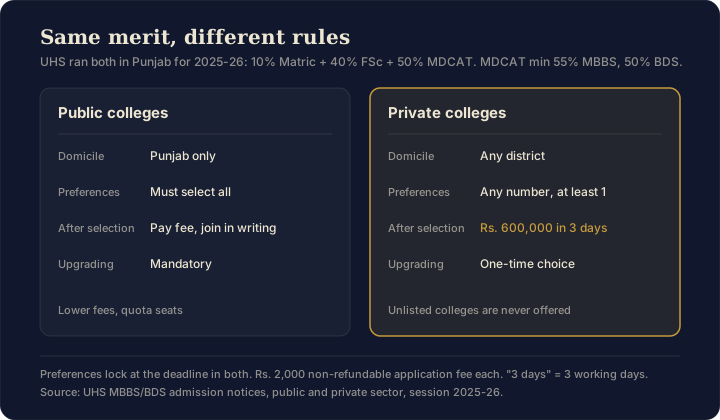
For the 2025-26 session, UHS Lahore ran admissions for both public and private medical and dental colleges in Punjab. It published separate notices and separate portals for each. Here's how they compared:
| Public colleges | Private colleges | |
|---|---|---|
| Who runs admission | UHS (public portal) | UHS (private portal) |
| Merit formula | 10% Matric, 40% FSc, 50% MDCAT | Same |
| Minimum MDCAT | 55% MBBS, 50% BDS | Same |
| Domicile | Punjab domicile mandatory | Any district of Pakistan |
| College preferences | Must select all colleges for your seat category | Any number, at least one. A college you leave out is never offered |
| Application fee | Rs. 2,000, non-refundable | Rs. 2,000, non-refundable |
| After selection | Pay the college fee by the due date and join in writing | Deposit Rs. 600,000 with UHS within 3 working days, then pay the rest to the college |
| Upgrading | Mandatory: if a better preference opens, you move | You can choose once to keep your seat or stay in upgrading. The choice is final |
| Quotas | Open merit plus reserved seats (disabled, Cholistan, under-developed districts, overseas and others) | Open merit plus overseas and foreign self-finance seats |
Two rules matter most.
Your preference list locks at the deadline. Both notices say you can edit the form until the closing date, but after that "the number and order of preferences shall become final and immutable." Order your colleges carefully before the deadline.
Private admission moves fast on money. If you're on a private merit list and miss the 3-working-day deposit, the offer is cancelled and goes to the next candidate. Arrange the funds before the lists come out, not after.
Other provinces run their own processes. In KP, for example, the health department publishes a separate admission policy. Always read the notice for your province and session.
Other universities: how public and private usually differ
Outside medicine there's no single admitting body. Each university runs its own admission. The patterns below hold for most universities, but always check the specific university's own page.
| Public universities | Private universities | |
|---|---|---|
| How you're ranked | A published formula of test and academic marks | Often a published formula too, sometimes with an interview |
| Entry test | Shared tests (ECAT, NET) or the university's own test | Own test, or SAT or NTS NAT scores |
| Test dates | Usually fixed dates each year | Often several rounds or rolling dates |
| Quotas and domicile | Often regional quotas or reserved seats | Usually open merit only |
| Fees | Lower, government-supported | Much higher. Scholarships and need-based aid are common |
| Seats | Very competitive merit for popular programmes | Merit varies more by programme and campus |
Some real examples from the 2026 cycle:
- UET (ECAT): ECAT is the common entrance test for engineering in Punjab, used by both public and private engineering institutions. Fall 2026 had two ECAT phases, and the best score counted.
- NUST: a public university with four NET series a cycle. Merit is 75% NET, 15% FSc and 10% Matric. See our NUST aggregate guide.
- FAST: a private university that lets you choose its own test, SAT or NTS NAT, and publishes its weights. For BS Computer Science it's 50% test, 40% HSSC and 10% SSC.
- GIKI: a private institute whose admission policy says there are "no special quotas, reserved seats or admission by donations."
- LUMS: a private university that uses a holistic review with no published formula. See how LUMS decides admission.
Fees and financial aid
Public universities usually cost much less because the government supports them. Private universities charge more, but many offer scholarships and need-based aid. The aid deadline is often separate from, and earlier than, the admission deadline.
If cost matters, look up the fee page before you apply, not after you get in. UHS's private-sector notice tells applicants to check "the fee structure, location, and facilities" of every college before listing it as a preference.
Recognition: check this first
Private or public, a degree is only useful if it's recognised.
- HEC keeps a list of recognised campuses of public and private universities. HEC warns that a sub-campus not on its list is unrecognised, and its degree won't be recognised either.
- Professional degrees also need their council: PMDC for MBBS and BDS, PEC for engineering, and so on.
Check both before you pay any fee. Our degree choice guide lists the councils for each field.
Which should you apply to?
Usually both. Public seats are cheaper but very competitive. Private seats give you more test dates and more chances, at a higher cost. A sensible list has a few of each, at different levels of merit. Our backup plan guide shows how to build one.
Frequently Asked Questions
Is the merit formula different for public and private medical colleges?
Not in Punjab. For the 2025-26 session, UHS used the same formula for public and private MBBS and BDS admissions: 10% Matric, 40% FSc and 50% MDCAT, with the same minimum MDCAT marks of 55% for MBBS and 50% for BDS.
Do I need a Punjab domicile for private medical colleges in Punjab?
No. UHS's 2025-26 notices made a Punjab domicile mandatory for public medical and dental colleges, but accepted a domicile from any district of Pakistan for private colleges.
Can I change my college preferences after applying?
Only until the deadline. UHS's 2025-26 notices let applicants edit the form until the closing date, after which the number and order of preferences became final. For private colleges, a college left off the list is never offered at any stage.
How much do I have to pay when selected for a private medical college?
In Punjab's 2025-26 private-sector admissions, selected candidates had to deposit Rs. 600,000 with UHS within 3 working days of the merit list, and then pay the rest of the fee to the college. Missing the deposit deadline cancelled the offer.
How do I know if a university is recognised?
Check HEC's list of recognised campuses of public and private universities. HEC warns that a sub-campus not on its list is unrecognised and its degrees won't be recognised. Professional degrees also need their council, such as PMDC for MBBS and BDS or PEC for engineering.
Next steps
- Passed MDCAT? What decides your seat: how medical merit works.
- Common admission form mistakes: the errors that cost students seats.
- MDCAT past papers and NUST NET papers: practise for the test that carries the most weight.
The medical college rules above are from UHS's 2025-26 admission notices for public and private colleges in Punjab. University examples are from UET, NUST, FAST, GIKI and LUMS admission pages, and recognition rules from HEC, all checked on 3 October 2026. Rules change each session, so read the current notice before you apply.