
NUST NET Preparation in 1 Month: A Plan for Late Starters
A month isn't enough to cover the whole FSc course in depth, but it's enough to raise your NET score a lot if you spend it in the right places. Here's a 4-week plan for late starters: which topics to protect, when to sit full papers, and what to skip.
By ParhaiKrlo Team · Published 3 Oct 2026 · 5 min read
Updated: 3 October 2026
If your NET is a month away and you've barely started, don't panic. A month isn't enough to learn the whole FSc course in depth. It is enough to raise your score a lot, if you spend the time on the topics that carry the most marks and practise under real test conditions.
This plan is for late starters aiming at any NET series, whether that's Series 1 (tests from 17 November 2026) or a later one. It assumes you can give about 4 hours a day, more on weekends.
Quick answer
- Week 1: a baseline paper, then the highest-weight Maths and Physics topics
- Week 2: calculus and the rest of the high-weight topics
- Week 3: quick-win topics and two full timed papers
- Week 4: full papers, error review and rest. No new chapters in the last few days
- Every day: 20 minutes of vocabulary. English is the fastest subject to improve
- Never leave a question blank. NUST says there's no negative marking
The rule for one month: weight first
With four weeks you can't give every chapter equal time. So put your time where the marks are. NET-Engineering is 50% Maths, 30% Physics and 20% English, and some topics carry far more questions than others.
In the eight NET-pattern papers ParhaiKrlo prepared from the FSc textbooks, these topics carry the most questions:
| Subject | Highest-weight topics in our papers | Questions per paper |
|---|---|---|
| Mathematics | Trigonometry, Differentiation, Integration | about 30 together |
| Mathematics | Sequences and Series; Conic Sections; Permutations, Combinations and Probability; Vectors | about 30 together |
| Physics | Motion and Force, Current Electricity, Waves, Circular Motion | about 16 together |
| English | Vocabulary (synonyms, antonyms, analogies) | about 18 |
That's roughly half the paper from about a dozen topics. NUST doesn't publish chapter weightage, so this is our papers' mix, not an official breakdown. Every chapter can appear, so don't drop any completely. Just give the big ones your best hours.
The four weeks
| Week | Mathematics | Physics | English | Full paper |
|---|---|---|---|---|
| 1 | Trigonometry; Sequences and Series | Motion and Force; Circular Motion | Vocabulary daily; synonyms and antonyms | Day 1 baseline |
| 2 | Differentiation; Integration | Current Electricity; Electrostatics; Waves | Sentence completion; analogies | End of week |
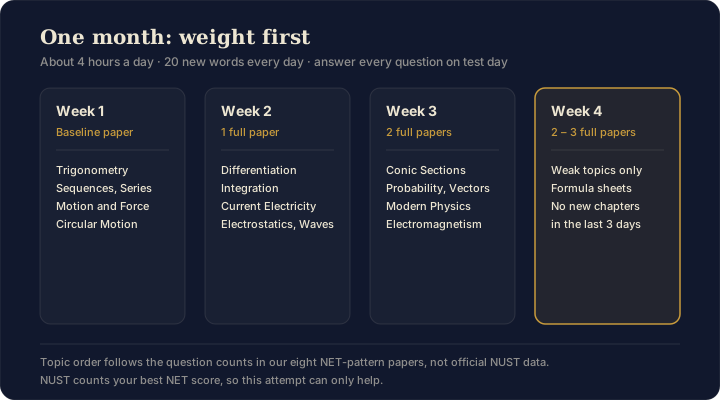
| 3 | Conic Sections; Permutations, Combinations and Probability; Vectors | Modern, Atomic and Nuclear Physics; Electromagnetism | Error identification; reading comprehension | Two papers |
| 4 | Weak topics from your papers | Weak topics from your papers | Timed English sections | Two or three papers |
Week 1: baseline and the biggest topics
Sit a full timed paper on day one: 200 MCQs in 180 minutes. Note your score in each subject. Then start on Trigonometry, the biggest Maths topic in our papers, and Motion and Force, the biggest Physics one. Both feed into later topics.
Week 2: calculus
Differentiation and Integration together carry about 18 questions per paper in our papers. Learn the standard results and practise many short questions rather than a few long ones. In Physics, Current Electricity is high-weight and quick once you've practised circuits.
Week 3: quick wins and full papers
Some topics give fast marks for little time:
- Modern, Atomic and Nuclear Physics are short chapters, and their questions are usually direct recall.
- Permutations, Combinations and Probability questions are quick once you know the formulas.
- English sentence completion and error identification improve quickly with practice.
Sit two full timed papers this week, and review each one the same day.
Week 4: practise, repair, rest
Sit two or three full papers. After each one, review every wrong answer and every guess, and spend the next session on the weakest topic it showed. Stop new chapters three days before the test. Revise your formula sheet and vocabulary list instead, and rest the day before.
A daily routine
| Block | Time | What to do |
|---|---|---|
| Maths | 2 hours | The day's topic: key results, then 30 to 40 timed MCQs |
| Physics | 1 hour 15 minutes | Formulas, then 20 MCQs, mostly numericals |
| English | 45 minutes | 20 new words, review of older words, 15 questions |
What to skip, and what not to
You can go lighter on: Partial Fractions and Linear Programming in Maths, and Optical Instruments and Physics of Solids in Physics. These carry the fewest questions in our papers. Read the key results once, so you can make a good guess.
Don't skip: Trigonometry and calculus. They appear inside other Maths topics too, so weakness there costs marks across the paper.
Test-day strategy
- Do English first, or at least fast. At 30 to 40 seconds a question, it frees time for Maths.
- Don't get stuck. If a question takes more than about a minute and a half, pick your best answer, flag it and move on.
- Answer every question. With no negative marking, a guess can only help.
If the month isn't enough
That's fine. NUST counts your best NET score from all the series you take, so this attempt can only help. Use your result to plan a longer run at a later series with our 3-month plan, and see which series to take.
Frequently Asked Questions
Can I prepare for NUST NET in 1 month?
You can raise your score a lot in a month, though not cover the whole course in depth. Put your time on the highest-weight topics, sit full timed papers every week, and build vocabulary daily.
Which topics are most important for NET in one month?
In our eight NET-pattern papers, Trigonometry, Differentiation and Integration carry about 30 Maths questions per paper, and Motion and Force, Current Electricity, Waves and Circular Motion about 16 Physics questions. Vocabulary is about 18 of 40 English questions. This is our papers' mix, not official NUST data.
How many hours a day should I study in the last month?
About 4 hours a day: around 2 hours of Maths, 1 hour 15 minutes of Physics and 45 minutes of English, with more on weekends for full papers.
What can I skip with only a month left?
You can go lighter on Partial Fractions, Linear Programming, Optical Instruments and Physics of Solids, which carry the fewest questions in our papers. Read their key results once. Don't skip Trigonometry or calculus.
What if one month of preparation is not enough?
NUST counts your best NET score from all the series you take, so this attempt can only help. Use your result to plan a longer run at a later series.
Next steps
- NUST NET papers: eight full NET-pattern papers prepared by ParhaiKrlo, with every answer explained, for your weekly full papers. NUST doesn't publish its own papers.
- 6-week plan for Series 1: if you have a little longer.
- NUST NET English guide: quick wins in every English question type.
Topic weights describe the eight NET-pattern papers ParhaiKrlo prepared, not official NUST data. The test pattern and attempt rules are from NUST's admission pages, checked on 3 October 2026.