
Computer Engineering in Pakistan: Scope, Career Paths and the Skills That Matter
Computer engineering sits between electronics and software, so its graduates can work on chips, embedded devices, networks or code. Here's what the field actually leads to in Pakistan, how it differs from CS, and the skills to build in four years.
By ParhaiKrlo Team · Published 6 Oct 2026 · 8 min read
Updated: 6 October 2026
Many students choose between Computer Science and Computer Engineering without really knowing how the two differ. Both deal with computers, and both lead to good jobs. But computer engineering is an engineering degree: you study the hardware as well as the software, and you graduate as an engineer registered with the Pakistan Engineering Council.
This guide covers where computer engineers work in Pakistan, how the degree compares with CS and Electrical Engineering, who is eligible, and the skills that actually get you hired.
Quick answer
- Computer engineering is the hardware-software degree. You learn circuits, digital logic, microprocessors and computer architecture, plus programming, data structures and operating systems.
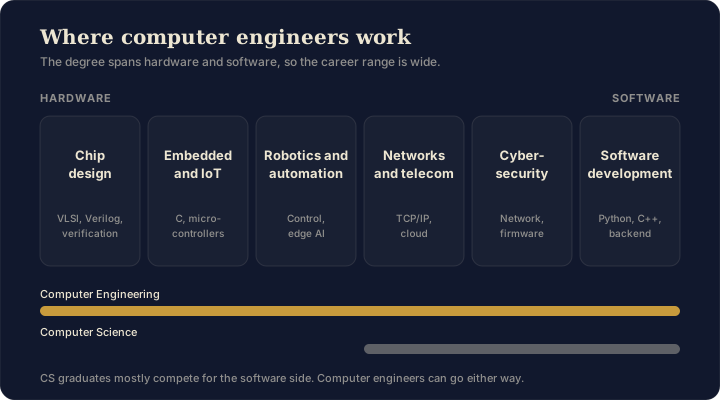
- The scope is wide because you can go either way. Graduates work in embedded systems, IoT, networks, chip design, robotics and AI hardware, and many also work as software developers.
- Pakistan's tech sector is growing. IT and IT-enabled services exports reached a record $4.6 billion in FY2025-26, up 20% on the year before (State Bank of Pakistan figures).
- Chip design is a new opening. The government's INSPIRE programme, launched in October 2025, aims to train 7,200 semiconductor professionals over five years.
- You need FSc Pre-Engineering or ICS (with Physics and Maths) at most universities. Pre-medical students need extra Maths, and many engineering programmes don't accept them at all.
- Your skills matter more than your transcript. Build projects with microcontrollers, learn C and Python well, and do at least one serious internship.
What computer engineers actually study
A computer engineering degree takes four years. FAST's BS (Computer Engineering), for example, needs at least 140 credit hours. The first two years build the base:
- Maths: calculus, differential equations, linear algebra, probability.
- Electronics: circuit analysis, electronic devices, digital logic design, signals and systems.
- Programming: programming fundamentals, object-oriented programming, data structures and algorithms.
The last two years are where it becomes computer engineering:
- Microprocessors and interfacing
- Computer organization and architecture
- Operating systems and computer networks
- Digital signal processing
- Embedded systems, VLSI (chip) design, and electives in AI, robotics or IoT
- A final-year design project, and usually a summer internship
If you enjoy both physics and programming, this mix is the main reason to choose it.
Computer Engineering vs CS vs EE
| Computer Engineering | Computer Science | Electrical Engineering | |
|---|---|---|---|
| Focus | Hardware and software together | Software, algorithms, theory | Power, electronics, communication |
| Degree type | Engineering (PEC-accredited) | Computing (NCEAC-accredited) | Engineering (PEC-accredited) |
| Usual eligibility | FSc Pre-Engineering or ICS | FSc with Maths, often ICS. Some accept pre-medical with extra Maths | FSc Pre-Engineering |
| Typical first jobs | Embedded, networks, chip design, software | Software, data, AI | Power sector, electronics, telecom |
| PEC registration | Yes | No | Yes |
The overlap with CS is real. Many computer engineering graduates end up writing software, and that's fine. The difference is that you also have the option of jobs that need hardware knowledge. A CS graduate usually doesn't.
Career paths in Pakistan
Embedded systems and IoT
Embedded engineers write the code that runs inside devices: smart meters, medical equipment, car electronics, home appliances and industrial controllers. It's the most direct use of a computer engineering degree, and it needs both C programming and an understanding of circuits.
Chip design and verification (VLSI)
This is a small field in Pakistan, but it's growing. Most local chip work is design and verification for foreign clients, and the government is now funding training:
- INSPIRE, launched in October 2025, aims to train 7,200 professionals in semiconductor design, verification and research over five years. It involves nine public universities and six new IC design labs, with Rs 4.5 billion in development funding.
- Ignite, the Ministry of IT's technology fund, also funded an IC design and verification training programme at FAST-NUCES in 2025.
If you want this path, take VLSI and digital design electives seriously and learn a hardware description language like Verilog.
Networks, telecom and cloud
Telecom operators, internet providers, banks and large companies all need engineers to run their networks. Computer engineers study networking and data communication in the degree, and industry certifications (like Cisco's or a cloud provider's) help a lot here.
Software development
Pakistan's IT export earnings include software services, consultancy and freelance work, and that's where many graduates land. A computer engineer who programs well can compete for the same jobs as a CS graduate, especially in systems programming, backend work and performance-heavy code.
Robotics, automation and AI hardware
Factories, the power sector and defence organisations use automation, control systems and robotics. AI is also moving onto small devices ("edge AI"), which needs people who understand both models and hardware.
Cybersecurity
Hardware knowledge is useful in security work like network security, firmware analysis and securing IoT devices.
Research, teaching and study abroad
Many graduates do an MS in Pakistan or abroad, then go into research, teaching or specialised industry jobs. Pakistan has been a full signatory of the Washington Accord since June 2017, so PEC-accredited engineering degrees are recognised as substantially equivalent by the accord's other member countries. That helps with study and professional registration abroad.
PEC registration: why it matters
Under Section 27 of the PEC Act, anyone who does professional engineering work in Pakistan must be registered with the Pakistan Engineering Council, and employers must hire registered engineers for that work. In practice:
- Check your programme is PEC-accredited before you apply. PEC accredits each programme batch by batch, and only graduates of accredited programmes can register. PEC publishes the list on its website.
- Register as a Registered Engineer (RE) after you graduate.
- Become a Professional Engineer (PE) later, after years of experience, through PEC's assessment. PEs get more authority, like signing off on designs.
A CS degree doesn't lead to PEC registration. This matters most for government engineering posts and engineering firms. It matters much less for pure software jobs.
Where to study and who is eligible
Computer engineering is offered at many public and private universities. Some examples:
| University | Programme | How you get in |
|---|---|---|
| NUST | BE Computer Engineering at the College of E&ME (Rawalpindi) and SEECS (Islamabad) | NUST NET, or SAT/ACT on international seats |
| FAST-NUCES | BS (Computer Engineering) | FAST's own test, SAT or NTS NAT-IE |
| UET Taxila | BSc Computer Engineering (running since 2001) | ECAT |
| Other Punjab engineering universities | Computer engineering at many campuses | ECAT |
| COMSATS, UMT, BZU and others | Computer engineering | Each university's own test or NTS |
Eligibility example: FAST asks for at least 60% in Matric and 60% in FSc, and you must have studied either Pre-Engineering (Physics, Chemistry, Maths) or ICS (Computer Science, Maths, Physics). Its merit is 33% test, 50% FSc and 17% Matric. Note that FAST's CS-type programmes accept pre-medical students with extra Maths, but its engineering programmes don't list pre-medical at all. NUST is an exception: pre-medical students who didn't take additional Maths can apply for engineering after passing NUST's online Mathematics course with at least 60%.
Rules change every year, so check each university's eligibility page before you apply. If you're aiming for NUST, our NET-2027 pattern and syllabus guide and aggregate guide will help.
Skills that get computer engineers hired
Your degree gets you an interview. Your skills get you the job. Build these over four years:
Technical skills
- C and C++ for embedded and systems work, and Python for scripting, testing and AI.
- Microcontrollers: start with Arduino, then move to STM32 or ESP32 and learn to read datasheets.
- Digital design: Verilog or VHDL, and an FPGA board if your department has one.
- Linux and the command line, plus Git for version control.
- Networking basics: TCP/IP, routing, and how the internet actually moves data.
- Data structures and algorithms, if you want software jobs. Interviews test them.
Other skills
- Clear English writing, for reports, documentation and emails to foreign clients.
- Teamwork on real projects. Your final-year project is the best thing on your CV, so pick it carefully.
- Self-learning. Tools change fast. Online courses and open-source projects show employers you can keep up.
A four-year roadmap
| Year | Focus |
|---|---|
| Year 1 | Get strong in programming and maths. Build a small Arduino project for fun |
| Year 2 | Digital logic, data structures, electronics. Start a GitHub profile and post your projects |
| Year 3 | Pick a direction: embedded, VLSI, networks or software. Do a summer internship |
| Year 4 | A final-year project in your chosen direction. Apply for jobs or MS programmes early |
The honest downsides
- Pakistan's hardware industry is small. There are fewer embedded and chip-design jobs than software jobs, and most are in the big cities.
- It's a heavier degree than CS. You'll do labs in circuits and electronics as well as programming.
- Many graduates still end up in software. That's a good outcome, but if you know you only want software, CS or Software Engineering may suit you better.
If you like knowing how things work all the way down, from the transistor to the app, computer engineering gives you more options than almost any other degree.
Frequently Asked Questions
What is the scope of computer engineering in Pakistan?
Computer engineers can work in embedded systems and IoT, chip design and verification, networks and telecom, robotics and automation, cybersecurity and software development. Pakistan's IT and IT-enabled services exports reached a record $4.6 billion in FY2025-26, and the government's INSPIRE programme aims to train 7,200 semiconductor professionals over five years.
What is the difference between computer engineering and computer science?
Computer engineering is an engineering degree that covers hardware and software together: circuits, digital logic, microprocessors and computer architecture as well as programming. Computer science focuses on software, algorithms and theory. Computer engineering graduates can register with the Pakistan Engineering Council; CS graduates don't.
Can a pre-medical student study computer engineering?
At many universities, no. Engineering programmes generally need FSc Pre-Engineering or ICS with Physics and Maths. FAST, for example, lists only Pre-Engineering or ICS for its engineering programmes. NUST is an exception: pre-medical students without additional Maths can apply for engineering after passing NUST's online Mathematics course with at least 60%.
Is PEC registration necessary for computer engineers?
For engineering work, yes. Section 27 of the PEC Act requires anyone doing professional engineering work to be registered with the Pakistan Engineering Council. Only graduates of PEC-accredited programmes can register, so check a programme's accreditation before you apply.
Which skills should a computer engineering student learn?
C and C++ for embedded work, Python, microcontrollers like Arduino, STM32 or ESP32, a hardware description language like Verilog, Linux, Git and networking basics. Add data structures and algorithms if you want software jobs, and do at least one serious internship.
Next steps
- How to choose a degree after intermediate: if you're still comparing fields.
- Backup plan strategy: build a balanced list of universities.
- NUST NET past papers: start practising for the test.
The export figures are from the State Bank of Pakistan for FY2025-26, as reported in July 2026. The INSPIRE details are from government announcements in October and November 2025. Programme, eligibility and PEC details are from the official NUST, FAST-NUCES, UET Taxila and Pakistan Engineering Council websites. The Washington Accord date is from Engineers Canada's report on the June 2017 International Engineering Alliance meeting. All were checked on 6 October 2026.