
How to Choose a Degree Program When You're Confused After Intermediate
Feeling confused after intermediate is normal. Instead of picking what everyone else picks, work through five steps: what your stream allows, what you actually enjoy, what the work looks like, what you can afford, and whether the degree is recognised.
By ParhaiKrlo Team · Published 3 Oct 2026 · Updated 6 Oct 2026 · 6 min read
Updated: 3 October 2026
After intermediate, everyone seems to have an opinion about your future. Parents want medicine or engineering, friends are applying to Computer Science, and a cousin says Business is the safe choice. If you feel confused, that's normal. Most students do.
The good news is that you don't need to know your whole career right now. You need to choose a degree that fits what you can do, what you enjoy, and what you can realistically get into. This guide gives you a simple way to decide.
Quick answer
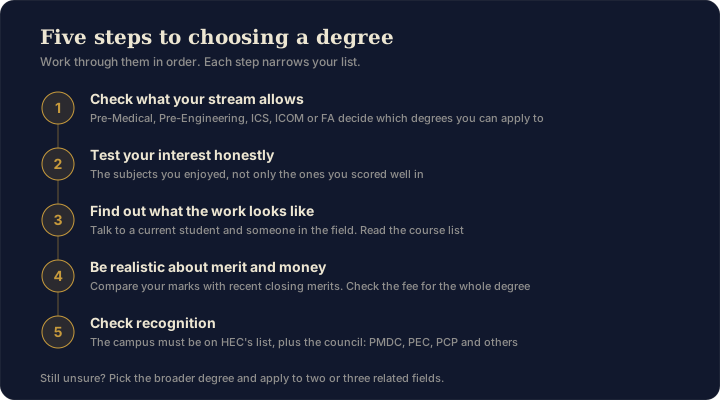
Work through five steps in order:
- Check what your stream allows. Your intermediate subjects decide which degrees you're eligible for.
- Test your interest honestly. Look at the subjects you enjoyed, not just the ones you scored well in.
- Find out what the job actually looks like. Talk to someone who studies or works in that field.
- Be realistic about merit and money. Compare your marks with past closing merits, and check the fees.
- Check recognition. The university must be on HEC's list, and professional degrees need their council.
Step 1: What your stream allows
Your intermediate group is the first filter. Here's a rough guide to what each stream usually opens up:
| Your stream | Degrees it usually leads to | Watch out for |
|---|---|---|
| FSc Pre-Medical | MBBS, BDS, Pharm-D, Doctor of Physiotherapy, Nursing, Biotechnology, other life sciences | MBBS and BDS need MDCAT (55% for MBBS, 50% for BDS) |
| FSc Pre-Engineering | Engineering, Computer Science, Physics, Mathematics, Architecture, Business | Engineering needs a test like ECAT or NET |
| ICS | Computer Science, Software Engineering, AI, Data Science, Business, Mathematics | Engineering eligibility for ICS varies by programme. Check each one |
| ICOM | BBA, Accounting and Finance, Economics, Commerce | Some programmes need Mathematics. Check each one |
| FA / Humanities | Law, Psychology, Mass Communication, English, Social Sciences, Education | LLB needs HEC's Law Admission Test (LAT) |
Your stream doesn't close every door, but some doors need an extra step:
- Pre-medical students can often switch to computing. FAST, for example, says pre-medical students who have passed additional mathematics are eligible for its computing programmes.
- Pre-medical students who want engineering at NUST must complete NUST's online Mathematics course with at least 60% if they didn't take additional Maths. See our NUST series guide.
Torn between Computer Science and Computer Engineering? Our computer engineering guide compares them side by side.
Each university sets its own eligibility, so always read the programme page.
Step 2: Test your interest honestly
Marks and interest are not the same thing. You might have scored well in Chemistry because you memorised hard, but felt bored the whole time. Ask yourself:
- Which subject did I study even when I didn't have to?
- Which kind of problem do I enjoy? Fixing things, helping people, building software, arguing a case, working with numbers?
- Do I prefer working with people, data, machines or ideas?
Write your answers down. Patterns show up quickly. If you enjoy logic puzzles and building things on a computer, Computer Science may suit you better than medicine, even with Pre-Medical marks.
Step 3: Find out what the work looks like
Students often choose a degree from its name, not its daily reality. Before you commit:
- Talk to a current student in that programme. Ask what a normal week looks like and what they wish they had known.
- Talk to someone working in the field, if you can. A doctor's long hospital shifts, an engineer's site work and a software developer's desk job are very different lives.
- Read the course list on the university's website. Four or five years of those subjects is what you're signing up for.
A degree is a long commitment. MBBS is five years of study before house job, and most engineering and BS degrees take four. Make sure the daily work suits you, not just the job title.
Step 4: Be realistic about merit and money
Merit. Look at your Matric and FSc marks and how your entry test is likely to go. Then compare them with recent closing merits for the programmes you're considering. If your dream programme is far out of reach this year, consider a related programme or a retake. Our retake guide helps with that decision.
Money. Check the fee for the whole degree, not just the first semester, and add hostel and living costs if you'll move cities. Public universities usually cost much less. Private universities often offer scholarships and need-based aid, but the aid deadline can come before the admission deadline. Our public vs private guide explains how the two systems differ.
Step 5: Check recognition
This step protects your degree.
- HEC recognition. HEC keeps a list of recognised campuses of public and private universities. It warns that a sub-campus not on its list is unrecognised, and its degrees won't be recognised.
- Professional councils. For professional degrees, the programme also needs the relevant council's approval:
| Degree | Council to check |
|---|---|
| MBBS, BDS | Pakistan Medical and Dental Council (PMDC) |
| Engineering (BE, BSc Engineering) | Pakistan Engineering Council (PEC) |
| Pharm-D | Pharmacy Council of Pakistan |
| Nursing | Pakistan Nursing and Midwifery Council |
| Computing (BS CS and related) | National Computing Education Accreditation Council (NCEAC) |
| Business (BBA and related) | National Business Education Accreditation Council (NBEAC) |
| Law (LLB) | Pakistan Bar Council |
Check the council's own website for the programme and campus you're applying to. A degree without the right approval can stop you from getting registered or licensed later.
If you're still unsure
- Choose the broader option. A BS in Computer Science, Mathematics or Economics keeps more doors open than a very narrow programme.
- Apply to two or three related fields, not one. You can decide between offers later.
- Remember you can change course. Many students move into a different field for their master's degree. Your first degree is a big decision, but not a final one.
- Avoid choosing only because a friend is. Your friend's strengths and interests are not yours.
Frequently Asked Questions
Can a pre-medical student study Computer Science?
Often, yes, with an extra step. FAST, for example, says pre-medical students who have passed additional mathematics are eligible for its computing programmes. Each university sets its own rules, so check the programme page.
Can a pre-medical student apply for engineering at NUST?
Yes, but if you didn't take additional Maths, NUST requires its online Mathematics course with at least 60% before you can be admitted to engineering.
How do I choose between degrees I like?
Work through five steps: check what your stream allows, test your interest honestly, find out what the daily work looks like, compare your marks and budget with recent merits and fees, and check recognition. If you're still unsure, choose the broader degree and apply to two or three related fields.
Which councils accredit professional degrees in Pakistan?
PMDC for MBBS and BDS, the Pakistan Engineering Council for engineering, the Pharmacy Council of Pakistan for Pharm-D, the Pakistan Nursing and Midwifery Council for nursing, NCEAC for computing, NBEAC for business and the Pakistan Bar Council for law. The university itself must also be on HEC's list of recognised campuses.
Is it a problem if I pick the wrong degree?
It's a big decision, but not a final one. Many students move into a different field for their master's degree. To reduce the risk, talk to current students, read the course list, and avoid choosing only because a friend is.
Next steps
- Backup plan guide: build a list of universities at different merit levels.
- Public vs private admissions: how the two systems differ.
- MDCAT 2026 syllabus, NUST NET pattern and LCAT sections: see what each entry test asks before you choose.
The eligibility examples above are from FAST's and NUST's admission pages, the MDCAT pass marks from UHS's MDCAT 2025 information guide, and the recognition rules from HEC, all checked on 3 October 2026. Eligibility differs by university and programme, so always read the programme page before you apply.