
MDCAT Passing Marks and Validity: What 99/180 Means and How Long Your Result Lasts
You need 99 out of 180 to pass MDCAT for MBBS and 90 for BDS, and your result stays valid for three years across Pakistan. Here's what those rules mean, the times they've been relaxed, and why passing isn't the same as getting in.
By ParhaiKrlo Team · Published 7 Oct 2026 · 5 min read
Updated: 7 October 2026
Two questions come up every year after MDCAT results: "Did I pass?" and "How long can I use this score?" Both have clear answers, set by PMDC and the PMDC Act. But passing is only the first step, and the validity rule has some details that matter when you plan.
Quick answer
- MBBS: 55%, which is 99 out of 180.
- BDS: 50%, which is 90 out of 180.
- Your MDCAT result is valid for three years, under Section 17(4) of the PMDC Act 2022, and it's valid across the whole country, not just your own province.
- Passing makes you eligible. It doesn't get you a seat. Colleges rank eligible students by aggregate: 50% MDCAT, 40% FSc and 10% Matric.
- The pass mark has been relaxed late in the cycle before, to fill vacant seats, but each time it was called a one-time measure.
MDCAT passing marks in numbers
The current MDCAT has 180 MCQs, one mark each, with no negative marking.
| Programme | Pass percentage | Marks needed out of 180 |
|---|---|---|
| MBBS | 55% | 99 |
| BDS | 50% | 90 |
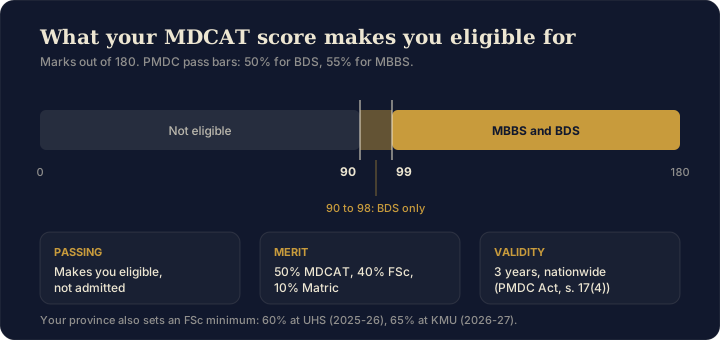
Scoring 98 means you're not eligible for MBBS, but you can apply for BDS. Scoring 89 means you can't apply for either in the normal admission rounds.
What passing gets you, and what it doesn't
Clearing 99 or 90 means you can apply. That's all. It doesn't reserve a seat or rank you.
In Punjab, 37,708 of the 47,475 candidates who sat MDCAT 2026 reached the 55% bar for MBBS. That's about 8 in 10. With that many students eligible, the real competition is on merit:
Aggregate = 50% MDCAT + 40% FSc + 10% Matric
So a student with 100/180 and a student with 170/180 have both "passed", but they'll land in very different places on a merit list. Use our MDCAT merit calculator to work out your own aggregate, and read what decides your seat after passing MDCAT for how merit lists work.
You also need the FSc minimum for your province. UHS asked for at least 60% in FSc Pre-Medical or equivalent for 2025-26, and KMU asks for at least 65% for 2026-27.
Have the passing marks ever been lowered?
Yes, twice in recent years, and both times late in the admission cycle to fill seats that were left empty:
- 2024-25: the passing percentage for private colleges was cut to 50% for MBBS and 45% for BDS.
- 2025-26: PMDC allowed up to 3% lower, 52% for MBBS and 47% for BDS, for vacant seats.
Both were called one-time measures. There's no promise it will happen in 2026-27. If you're just under the bar, watch PMDC's notices, but plan as if the bar stays at 55% and 50%.
How long is an MDCAT result valid?
Section 17(4) of the PMDC Act 2022 says:
"The MDCAT result of one province shall be valid for the entire country and shall be valid for a period of three years."
Here's what that means in practice:
| Rule | What it means for you |
|---|---|
| Valid for three years | A 2026 result can be used for admissions in 2026-27, 2027-28 and 2028-29 |
| Valid across the country | A result from one province's MDCAT is valid nationwide |
| Domicile preference | Each province must give preference to its own domicile holders, so a valid result doesn't guarantee you can compete for another province's seats |
You can see the three-year rule in the latest admission notices:
- UHS (Punjab) accepted MDCAT 2023, 2024 or 2025 for 2025-26 admissions.
- KMU (KP) is accepting MDCAT 2024, 2025 or 2026 for 2026-27 admissions.
The rule has been debated. In November 2025, some students argued that older results make the competition harder for new candidates. But the three-year period is written into the Act, so changing it would need Parliament to amend the law.
If you take MDCAT more than once
If you sit MDCAT again in 2027, you'll have two valid results. Before you count on using either one, check your admitting university's prospectus to see which result it lets you use.
Common mistakes about passing marks
- Thinking 99 is "enough". It's enough to apply. Government college merit closes far higher.
- Ignoring the FSc minimum. Passing MDCAT doesn't help if your FSc is below your province's minimum.
- Counting on a relaxation. Past cuts came late and were described as one-time measures.
- Assuming an old result is automatically accepted. Check the years listed in your province's admission notice.
- Forgetting BDS. If you scored between 90 and 98, you can still apply for BDS, if you'd genuinely want to be a dentist.
Frequently Asked Questions
What are the passing marks for MDCAT?
55% for MBBS, which is 99 out of 180, and 50% for BDS, which is 90 out of 180. Scoring 98 means you're not eligible for MBBS but can apply for BDS. Scoring 89 means you can't apply for either in the normal admission rounds.
How long is an MDCAT result valid?
Three years. Section 17(4) of the PMDC Act 2022 says the MDCAT result of one province is valid for the entire country and for a period of three years. So a 2026 result can be used for admissions in 2026-27, 2027-28 and 2028-29.
Does passing MDCAT guarantee admission?
No. Passing makes you eligible to apply. Colleges then rank eligible students by aggregate, which is 50% MDCAT, 40% FSc and 10% Matric. In Punjab, about 8 in 10 candidates reached the MBBS bar in MDCAT 2026, so the real competition is on merit.
Will PMDC lower the MDCAT passing marks in 2026?
There's no promise it will. The bar was cut to 50% for MBBS and 45% for BDS for private colleges in 2024-25, and PMDC allowed up to 3% lower (52% and 47%) for vacant seats in 2025-26. Both came late in the cycle and were called one-time measures, so plan as if the bar stays at 55% and 50%.
Can I use my MDCAT result in another province?
The PMDC Act says an MDCAT result is valid for the entire country. But it also says each province must give preference to students with its own domicile, so a valid result doesn't guarantee you can compete for another province's seats. Check that province's admission notice.
What to do next
- If you passed: read our MBBS admission process guide and get your documents ready.
- If you're considering private colleges: read our guide to private medical college fees.
- If you're retaking: follow our MDCAT 2027 plan for repeaters, and start with past papers and full-length mocks.
The pass marks are PMDC's bars for MDCAT 2026. The validity rule is quoted from Section 17(4) of the PMDC Act 2022, as published in the Gazette of Pakistan on 16 January 2023. Accepted MDCAT years are from UHS's 2025-26 notice and KMU's 2026-27 admission page. All were checked on 7 October 2026.