
Private Medical College Fees in Pakistan 2026-27: The PMDC Cap and How Admission Works
PMDC caps private MBBS and BDS tuition, but the cap has moved twice and some colleges are allowed to charge more. Here's what you'll actually pay, how private admission works, and what to check before you pick a college.
By ParhaiKrlo Team · Published 7 Oct 2026 · 8 min read
Updated: 7 October 2026
If your MDCAT score won't reach a government college, a private medical college is the most common next step. The biggest question is cost. Until 2025, every private college set its own fee. Now PMDC caps it, but the cap has changed twice, some colleges are allowed to charge more, and the 2026-27 figure hasn't been announced yet.
This guide explains what the cap is, what five years will roughly cost, how private admission works after MDCAT 2026, and what to check before you put a college on your preference list.
Quick answer
- PMDC capped private MBBS and BDS tuition at Rs 1.8 million a year for 2024-25, including all ancillary charges.
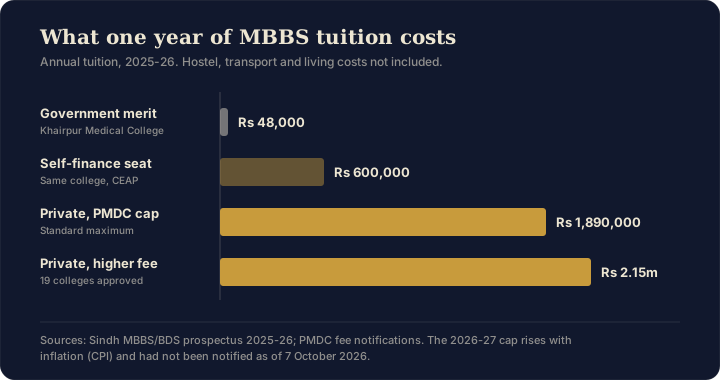
- For 2025-26 the cap is Rs 1.89 million, a 5% rise, and it applies to students in every year, first to final.
- From 2026-27, increases are tied to inflation (CPI). PMDC said the new figure would be "notified separately". We couldn't find that notification as of 7 October 2026.
- 19 colleges were allowed to charge up to Rs 2,147,483 a year after justifying higher costs to PMDC in March 2026.
- Government colleges cost a small fraction of this. At Khairpur Medical College, for example, open-merit tuition was Rs 48,000 a year in 2025-26.
- In Punjab, private admission runs centrally through UHS, and last year selected students had to deposit Rs 600,000 within three working days.
How the PMDC fee cap works
Where the cap came from
In March 2025, the Prime Minister's Committee on Medical Education Reforms agreed to cap private MBBS and BDS tuition at Rs 1.8 million a year. Before that, fees had been rising every year, and PMDC's council had discussed the problem in several meetings since 2022.
The committee also allowed a route to charge more. A college that believed it needed a higher fee, up to Rs 2.5 million, could submit a detailed financial justification to PMDC. That had to show its costs and the extra facilities it offered students.
The cap year by year
| Session | Annual cap | What changed |
|---|---|---|
| 2024-25 | Rs 1,800,000 | Cap fixed for all students, first to final year |
| 2025-26 | Rs 1,890,000 | 5% increase |
| 2026-27 | Not yet notified | Increase to be based on CPI inflation |
Three details matter here:
- The cap includes all ancillary charges. A college can't add separate "lab", "library" or "exam" charges on top of tuition to get round it.
- It applies to every year of study, not just first year.
- Colleges must publicly display their approved fee structure at least three months before admissions begin. If a college's fee isn't on its website, ask for it in writing.
Colleges allowed to charge more
In March 2026, PMDC approved higher fees for 19 private colleges, up to Rs 2,147,483 a year, after reviewing their financial justifications. These included, among others, Akhtar Saeed Medical and Dental College, Central Park Medical College, FMH College of Medicine and Dentistry, University College of Medicine and Dentistry and Azra Naheed Medical and Dental College in Lahore, Islamabad Medical and Dental College, and Rehman Medical and Dental College in Peshawar. Another 20 applications were deferred for missing documents.
So two private colleges on your list may legally charge different fees. Check each one.
What five years of MBBS might cost
Here's a rough tuition-only estimate at the 2025-26 cap, before any CPI increases:
| Fee level | Per year | Five years (MBBS) | Four years (BDS) |
|---|---|---|---|
| Standard cap | Rs 1,890,000 | Rs 9,450,000 | Rs 7,560,000 |
| Approved higher fee | Rs 2,147,483 | Rs 10,737,415 | Rs 8,589,932 |
These are simple multiplications, not quotes. Real totals will be higher because the fee is expected to rise with inflation each year. Hostel, transport and living costs also add up, so ask each college exactly what its fee includes.
Private vs government: the cost gap
The difference is large. In Sindh's 2025-26 prospectus, Khairpur Medical College charged:
- Rs 48,000 a year in tuition for general merit seats
- Rs 600,000 a year for its self-finance (CEAP) seats
A standard-cap private college charges about 39 times the government merit tuition. That's why government seats fill first and their merit closes highest.
Many public colleges also have self-finance seats, which sit between the two. They're cheaper than private colleges but cost far more than open merit. KMU lists self-finance as a separate seat category for KP's public colleges, and Sindh's universities run their own schemes (CEAP, UEAP or UDP). If you're just below government merit, check whether you can apply for these.
How private admission works after MDCAT
Punjab: one central UHS application
In Punjab, you don't apply to each private college separately. UHS runs a single central admission for private medical and dental colleges, with separate portals for MBBS and BDS. Last session (2025-26):
- Any Pakistani domicile was accepted. Unlike Punjab's public colleges, you don't need a Punjab domicile.
- The same eligibility applied: at least 55% in MDCAT for MBBS (50% for BDS), and at least 60% in FSc Pre-Medical or equivalent.
- Merit used the same formula: 50% MDCAT, 40% FSc, 10% Matric.
- You could list as many colleges as you wanted, but at least one. A college not on your list was never offered to you, even through upgradation.
- The processing fee was Rs 2,000.
- Selected students deposited Rs 600,000 with UHS within three working days of the merit list. UHS later transferred it to the college, and you paid the rest of the fee directly to the college. Under PMDC's 2023 regulations, tuition can be paid quarterly, half-yearly or annually.
- When you joined, you chose either to keep your seat or to stay in line for upgradation, and that choice was final.
UHS also told students to check each college's fee, location and facilities, in person or on its official website, before finalising preferences. Do that. Once the deadline passes, you can't change your list.
Last session's private MBBS lists came out on 18, 25 and 31 December 2025, and classes began on 2 February 2026. This year's dates aren't out yet.
Other provinces
Rules for private colleges outside Punjab vary. PMDC's admission rules allow private colleges to consider their own tests and interviews when building merit lists. Some run their own admissions, while others go through the provincial admitting university. Check the college's own admission page and your province's notice.
For a step-by-step guide to preference lists, merit lists and upgradation, read our MBBS admission process guide.
Foreign and overseas seats
Both public and private colleges keep some seats for foreign nationals and overseas Pakistanis. These are charged in dollars. In Punjab's public colleges, the overseas quota fee was US$10,000 a year under a PMDC notification of March 2025. In Punjab's private sector last year, any foreign self-finance seat left empty was moved to open merit and charged the normal open-merit fee.
Before you put a private college on your list
- Confirm PMDC recognition for the current session. UHS's 2025-26 list marked colleges whose admission was "subject to the approval of PM&DC". Avoid a college with any doubt over its status.
- Get the full fee in writing, and compare it with the cap. Ask whether hostel and transport are extra.
- Check whether it's one of the colleges approved to charge more.
- Look at its teaching hospital. Clinical training happens there, so its size and patient load matter.
- Visit if you can, or at least read the official website carefully.
- Plan the first payment early. Rs 600,000 in three working days is hard to arrange at short notice.
- Keep every receipt and challan. You'll need them if anything goes wrong with a transfer or refund.
Is private MBBS worth it?
It depends on your family's finances and on how close you are to government merit. A private college gives you the same MBBS degree and the same PMDC registration route. But at Rs 9 million or more in tuition alone, it's a big commitment.
If you're only a few marks short of government merit, compare the cost of a private seat with the cost of a year spent retaking MDCAT. Our guide on whether a retake is worth it can help you decide. If you do retake, start with real exam practice: our MDCAT past papers and full-length mocks are free.
Frequently Asked Questions
What is the PMDC fee cap for private medical colleges?
PMDC capped private MBBS and BDS tuition at Rs 1.8 million a year for 2024-25, including all ancillary charges. For 2025-26 the cap is Rs 1.89 million, a 5% rise, and it applies to students in every year. From 2026-27, increases are tied to CPI inflation, and PMDC said the new figure would be notified separately. We couldn't find that notification as of 7 October 2026.
Can a private medical college charge more than the cap?
Only with PMDC's approval. A college could submit a detailed financial justification to charge more, up to Rs 2.5 million. In March 2026, PMDC approved higher fees for 19 private colleges, up to Rs 2,147,483 a year, and deferred another 20 applications for missing documents.
How much does private MBBS cost for five years?
At the 2025-26 cap of Rs 1,890,000 a year, five years of tuition comes to Rs 9,450,000 before any inflation increases. At the approved higher fee of Rs 2,147,483, it's Rs 10,737,415. Real totals will be higher because fees are expected to rise with inflation, and hostel, transport and living costs add more.
How do I apply to private medical colleges in Punjab?
Through one central UHS application, with separate portals for MBBS and BDS. Last session, any Pakistani domicile was accepted, you needed at least 55% in MDCAT for MBBS (50% for BDS) and 60% in FSc, and merit was 50% MDCAT, 40% FSc and 10% Matric. Selected students deposited Rs 600,000 with UHS within three working days of the merit list.
What is a self-finance seat in a government medical college?
Many public colleges keep some seats on self-finance, which cost far more than open merit but less than a private college. At Khairpur Medical College in 2025-26, open-merit tuition was Rs 48,000 a year, while its self-finance (CEAP) seats were Rs 600,000. KMU lists self-finance as a separate category for KP's public colleges, and Sindh's universities run their own schemes.
Next steps
- MBBS admission process 2026-27: preferences, merit lists and upgradation, province by province.
- MDCAT merit calculator: work out your aggregate.
- Public vs private university admissions: how the two routes differ.
The fee cap details are from PMDC's March 2025 press release on the Committee on Medical Education Reforms and from PMDC's fee notifications as reported by Dawn and ProPakistani (October 2025 and 30 January 2026). The higher-fee approvals are from Dawn's report of 13 March 2026. Punjab's private admission rules are from UHS's 2025-26 private-sector notice. Sindh fees are from the Government of Sindh MBBS and BDS prospectus for 2025-26. All were checked on 7 October 2026. Fees and rules change each session, so confirm the current figures with PMDC, your admitting university and the college.