
MDCAT Tips for Success: Preparation, Exam Day and Paper Strategy
MDCAT is one paper, once a year, and it decides your medical admission. Here is what works: studying by weightage, practising the full 180-MCQ paper under time, a calm exam day, and a careful OMR strategy that doesn't throw away marks you earned.
By ParhaiKrlo Team · Published 9 Oct 2026 · 5 min read
MDCAT is unforgiving in one way: you get one paper a year. A bad morning can cost you twelve months. That's why the students who do well usually aren't the ones who studied the most hours. They studied the right things, practised the real paper under time, and walked in calm.
This guide covers preparation, the last week, exam day and strategy inside the hall. The pattern is the one PMDC used for MDCAT 2025 and 2026. PMDC hasn't announced anything for 2027 yet, so we'll update this page if it changes.
Quick answer: the five things that matter most
- Study by weightage. Biology is 45% of the paper and Chemistry 25%. Together that's 126 of 180 marks.
- Practise the full paper under time. 180 MCQs in 3 hours is one minute a question.
- Attempt every question. There was no negative marking in 2025 or 2026, so a blank is a wasted chance.
- Treat the OMR sheet as part of the exam. A right answer in the wrong bubble scores nothing.
- Protect exam day. Sleep, documents and arrival time are as much a part of your score as revision.
Know the rules of your test
| MDCAT (2025 and 2026 pattern) | |
|---|---|
| Questions | 180 MCQs: Biology 81, Chemistry 45, Physics 36, English 9, Logical Reasoning 9 |
| Time | 3 hours |
| Negative marking | None |
| Format | Paper-based, OMR answer sheet |
| Attempts | One sitting per year |
| Passing marks | 55% (99/180) for MBBS, 50% (90/180) for BDS |
| Validity | Three years, across Pakistan |
Full chapter lists are in our MDCAT syllabus guide.
How to prepare
Study by weightage, not by fear
Most students spend too long on Physics because it feels hard, and too little on Biology because it feels easy. That's backwards. Biology is 81 marks; Physics is 36. Roughly match your study hours to the marks:
- Biology (45%): the biggest share of your time. See Biology chapter-wise weightage.
- Chemistry (25%): steady, daily. See Chemistry chapter-wise weightage.
- Physics (20%): concepts and common numericals. See Physics chapter-wise weightage.
- English and Logical Reasoning (5% each): short daily practice, not long sessions. See English and LR preparation.
Read the textbook line by line
MDCAT questions are built on the PMDC curriculum, and many turn on one exact line: a definition, an exception, a number. Read your textbook carefully, not just your notes, and underline the details that could become a question.
Topic MCQs first, then full papers
Learn a chapter, then do MCQs on that chapter until you're getting most of them right. Once your syllabus is covered, move to full past papers and mocks, and go back to the chapters where you lose marks.
Keep a mistakes notebook
For every wrong answer, note why: didn't know it, misread it, mixed up two similar facts, or rushed. Re-read the notebook every week. Repeated mistakes are the cheapest marks you'll ever gain.
Practise in exam conditions
At least once a week in the last two months, sit a full 180-MCQ paper in one 3-hour block, with no phone and an OMR-style answer sheet. Our MDCAT past papers and mock tests are built for this.
The last week
- No new chapters. Revise high-weightage topics and your mistakes notebook.
- One or two full timed papers, at the same time of day as the real exam.
- Keep your sleep regular. Three hours of focus needs a rested brain.
The day before
- Put the books away by the evening. A short look at your notes in the morning is enough.
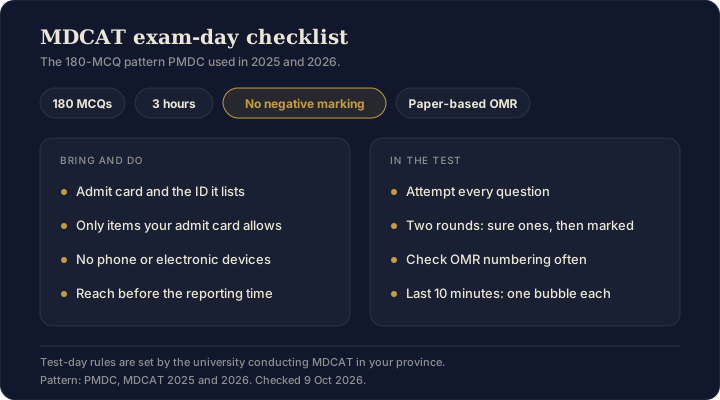
- Check your admit card for the centre, reporting time and what you may bring, and keep it with the ID it asks for.
- Plan the journey to the centre, with a margin for traffic.
- Eat normally and sleep early.
On exam day
- Eat a light, familiar breakfast and carry water if your admit card allows it.
- Reach the centre well before the reporting time. Finding your hall and seat while rushed adds stress you don't need.
- Carry only what's allowed. The rules come from the university conducting MDCAT in your province and are printed on the admit card. Phones and electronic devices are not something to risk.
Strategy inside the hall
One minute a question, used wisely
Many Biology questions take 20 to 30 seconds if you know the fact. Bank that time for Physics numericals and tricky Chemistry. Don't let one question take three minutes.
Do two rounds
- Round one: answer everything you're sure of, and mark the ones you're not.
- Round two: come back to the marked questions with the time you saved.
Attempt every question
With no negative marking in the current pattern, never leave a bubble empty. Rule out what you can, then pick the best remaining option.
Protect your OMR sheet
- Check the question number every few answers, so one skipped line doesn't shift a whole column.
- Fill each bubble completely, the way the instructions say.
- Keep the last ten minutes to make sure every question has exactly one answer marked.
Read the full question
Watch for "not", "except", "incorrect", and "all of the following". They flip the answer, and they're easy to miss when you're moving fast.
After the exam
Once results are out, the MDCAT merit calculator shows where your score puts your aggregate. If you're thinking about trying again, our MDCAT 2027 plan for repeaters starts by finding exactly where your marks went, and MDCAT passing marks and validity explains how long your result counts.
Frequently Asked Questions
How should I divide my time between MDCAT subjects?
By weightage. Biology is 81 of 180 marks, Chemistry 45, Physics 36, and English and Logical Reasoning 9 each. Biology should get the biggest share of your study time, and English and LR short daily practice.
Should I attempt every MCQ in MDCAT?
Yes, under the current pattern. MDCAT 2025 and 2026 had no negative marking, so rule out what you can and pick the best remaining option rather than leaving a bubble empty.
How much time do I get per MCQ in MDCAT?
180 MCQs in 3 hours is one minute a question. Many Biology questions take 20 to 30 seconds if you know the fact, which leaves extra time for Physics numericals and harder Chemistry.
How do I avoid mistakes on the MDCAT OMR sheet?
Check the question number every few answers so one skipped line doesn't shift a column, fill each bubble completely as instructed, and keep the last ten minutes to confirm every question has exactly one answer.
What should I take to the MDCAT exam centre?
Whatever your admit card lists. The rules are set by the university conducting MDCAT in your province and printed on the admit card. Keep it with the ID it asks for, and leave phones and electronic devices behind.
Practise now
- MDCAT past papers: real papers from past years, with every answer explained.
- MDCAT mock tests: full-length, timed, on the current 180-MCQ pattern.
- MDCAT preparation hub: everything for MDCAT in one place.
The pattern here is PMDC's for MDCAT 2025 and 2026, checked on 9 October 2026. Always follow the instructions on your own admit card.