
NUST NET Subject-Wise Preparation Strategy: Maths, Physics and English
NET-Engineering is 100 Maths, 60 Physics and 40 English questions, and each subject needs a different approach. Here's where the marks come from in each subject, how to split your study time, how to pace each section on test day, and what score targets look like.
By ParhaiKrlo Team · Published 3 Oct 2026 · 5 min read
Updated: 3 October 2026
Most students prepare for NET by studying whatever chapter comes next. That wastes time. Maths, Physics and English carry different weights, take different amounts of time to improve, and need different approaches on test day.
This guide covers NET-Engineering, the test for engineering and computing programmes. It explains where each subject's marks come from, how to split your study time, and what score targets look like.
Quick answer
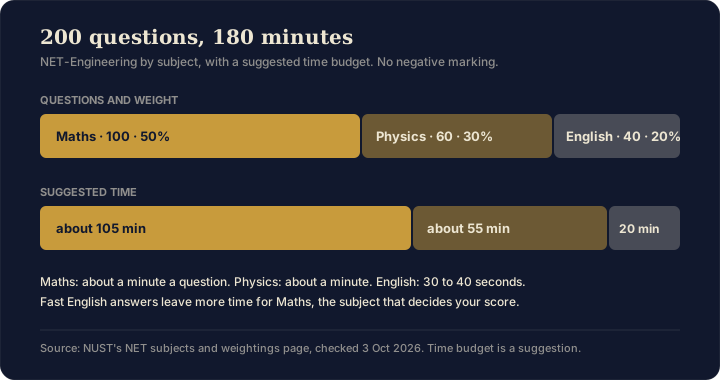
- NET-Engineering is 200 MCQs in 180 minutes: 100 Maths (50%), 60 Physics (30%) and 40 English (20%).
- Split your study time the same way: about half on Maths, a third on Physics, the rest on English.
- Maths decides your score. It's half the paper and the slowest to improve, so start it first and practise it most.
- Physics rewards formulas and short numericals. Every chapter appears, so cover them all.
- English is the quickest to improve. A daily vocabulary habit and fast answering free up time for Maths.
- There's no negative marking, so answer every question.
How the paper is split
| Subject | Questions | Weight | Roughly how long on test day |
|---|---|---|---|
| Mathematics | 100 | 50% | about 105 minutes |
| Physics | 60 | 30% | about 55 minutes |
| English | 40 | 20% | about 20 minutes |
On average you get 54 seconds a question, but not every question needs the same time. English questions are usually quick, so finishing them fast leaves more time for Maths.
Mathematics: half the paper
Where the marks are. In the eight NET-pattern papers ParhaiKrlo prepared from the FSc textbooks, seven topics carry about 60% of the Maths questions: Trigonometry, Differentiation, Integration, Sequences and Series, Conic Sections, Permutations, Combinations and Probability, and Vectors. NUST doesn't publish chapter weightage, so cover every chapter, but make these strong first.
How to prepare:
- Learn results until they're automatic. Trigonometric identities, standard derivatives and integrals, and series formulas should come without thinking.
- Do many short questions, not a few long ones. NET Maths questions are mostly one or two steps. Speed comes from volume.
- Build calculus on trigonometry. Many calculus questions use trigonometric functions, so weakness in one costs marks in both.
- Time yourself. Aim for about a minute a question, and learn when to move on.
On test day: don't get stuck on a long question. If one takes more than about a minute and a half, mark your best answer, flag it and come back if time allows.
Physics: formulas and short numericals
Where the marks are. Physics is spread more evenly than Maths. In our papers, Motion and Force, Current Electricity, Waves and Circular Motion carry the most questions, but most chapters carry two to four questions each.
How to prepare:
- Make a one-page formula sheet for each chapter and revise it often.
- Practise numericals with units. Many wrong answers come from unit and power-of-ten slips.
- Read the short Part II chapters. Modern, Atomic and Nuclear Physics questions are often direct recall, so they're easy marks once read.
- Learn the concepts behind formulas. Some questions test understanding, not calculation.
On test day: aim for about a minute a question. Use estimation to rule out options quickly.
English: quick to improve
Where the marks are. In our papers, vocabulary (synonyms, antonyms and analogies) is the biggest area, about 18 of 40 questions. Sentence completion and grammar make up most of the rest, plus a reading passage. NUST says its English paper follows the SAT pattern.
How to prepare:
- Learn 20 words a day, in sentences. Review older words regularly so they stick.
- Learn common roots and prefixes to work out unfamiliar words.
- Practise sentence completion and error spotting in timed sets.
On test day: aim for 30 to 40 seconds a question. Our NET English guide covers every question type with examples.
How to split your study time
| Weekly hours | Maths | Physics | English |
|---|---|---|---|
| 15 hours | 7.5 | 4.5 | 3 |
| 20 hours | 10 | 6 | 4 |
| 25 hours | 12.5 | 7.5 | 5 |
Adjust after your first full paper. If one subject is far behind the others, give it extra time until it catches up.
What score targets look like
NET counts for 75% of your NUST aggregate, and each NET mark is worth 0.375 aggregate points. Here are two example targets, split by subject:
| Target NET score | Maths (of 100) | Physics (of 60) | English (of 40) |
|---|---|---|---|
| 140 of 200 | 65 | 42 | 33 |
| 160 of 200 | 76 | 48 | 36 |
These splits are examples, not rules. Many students score higher in English and make up the rest in Maths. Use our aggregate guide to find the NET score your target aggregate needs.
Frequently Asked Questions
How many questions are there in each NET-Engineering subject?
NET-Engineering has 200 MCQs in 180 minutes: 100 Mathematics (50%), 60 Physics (30%) and 40 English (20%). There's no negative marking.
How should I divide my NET study time?
Match the weightage: about half on Maths, a third on Physics and the rest on English. On 20 hours a week that's 10 hours of Maths, 6 of Physics and 4 of English. Adjust after your first full paper.
How much time should I spend on each NET section?
Roughly 105 minutes on Maths, 55 on Physics and 20 on English. English questions take 30 to 40 seconds each, which frees time for Maths.
Which NET subject is easiest to improve quickly?
English. A daily habit of 20 new words, plus timed sentence completion and error-spotting practice, improves scores faster than Maths, which builds slowly through many practice questions.
What subject scores do I need for 160 in NET?
One example split is 76 of 100 in Maths, 48 of 60 in Physics and 36 of 40 in English. It's an example, not a rule. Each NET mark is worth 0.375 aggregate points.
Next steps
- NET 2027 pattern and syllabus: every topic in each subject.
- NUST NET papers: eight full NET-pattern papers prepared by ParhaiKrlo, with every answer explained. NUST doesn't publish its own papers.
- Study plans: 1 month, 6 weeks or 3 months.
The NET-Engineering pattern and weightage are from NUST's admission pages, checked on 3 October 2026. Topic counts are from ParhaiKrlo's own eight NET-pattern papers, not from NUST.