
NUST NET Tips for Success: Preparation, Test Day and Exam Strategy
Most students who struggle in NUST NET don't lack ability. They start late, practise without a clock, or walk in unsure of the rules. Here is what works for NET-Engineering, from your first week of preparation to your last minute in the test centre.
By ParhaiKrlo Team · Published 9 Oct 2026 · 6 min read
Every year, the same pattern repeats. Students start NET preparation a few weeks before the test, try to cover everything at once, get anxious, and walk into the test centre tired. Then they lose marks on questions they actually knew.
NET rewards something simpler: steady preparation, practice under time, and a calm test day. This guide covers all three for NET-Engineering, the NET most engineering and computing applicants take. The test rules are from NUST's admission pages, checked on 9 October 2026.
Quick answer: the five things that matter most
- Start early and follow the weightage. Mathematics is 50% of NET-Engineering, so it gets the most time.
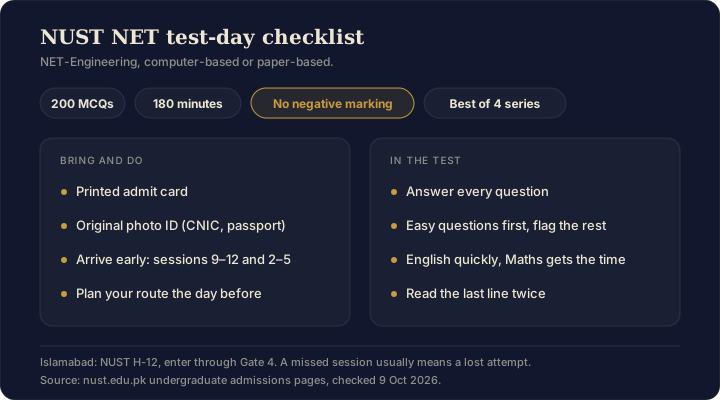
- Practise full papers under a clock. 200 MCQs in 180 minutes is 54 seconds a question. Speed is a skill you build, not one you have.
- Never leave a blank. NET has no negative marking, so a guess can only help.
- Bring your printed admit card and an original photo ID. Without them you won't sit the test.
- Remember the safety net. NUST runs up to four NET series and counts your best score, so one bad day isn't the end.
Know the rules of your test
| NET-Engineering | |
|---|---|
| Questions | 200 MCQs: Mathematics 100, Physics 60, English 40 |
| Time | 180 minutes |
| Negative marking | None |
| Format | Computer-based in Islamabad and Quetta; paper-based in Karachi and Gilgit |
| Attempts | One per series, up to four series; your best score counts |
| Weight in merit | 75% of your aggregate |
Notice what's missing: there's no Chemistry, no Computer section and no IQ section in the current NET-Engineering. Older guides still list them. Don't spend weeks on topics that aren't in the paper. Our NET 2027 pattern and syllabus guide has the full topic list.
How to prepare
Start well in advance
Starting early gives you time to cover the course once, find your weak spots and fix them, with no last-minute panic. If you're aiming for NET-1, six weeks of steady work is the minimum we'd suggest. Our 6-week NET-1 study plan and 3-month plan lay it out week by week.
Syllabus first, then papers
Go through each topic from your FSc books before you start full papers. Papers show you what you don't know, but they can't teach it. A good order:
- Cover the topic from the textbook.
- Do topic-wise MCQs until you're getting most of them right.
- Then sit full papers, and go back to the topics where you lose marks.
Spend time where the marks are
Half the paper is Mathematics, so give it about half your time. Within Maths, calculus and trigonometry come up everywhere. Physics is 30%: practise numericals by hand, and check NUST's computer-based test instructions for what you can use on the day. English is 20%, and a little daily vocabulary and reading goes a long way. Our subject-wise strategy goes deeper.
Keep a mistakes notebook
Every time you get an MCQ wrong, write down why: didn't know it, misread it, made a calculation slip, or ran out of time. After two weeks you'll see your real problem. It's often not the one you expected.
Practise in the real format
If you're sitting the computer-based NET, try NUST's free sample test on ugadmissions.nust.edu.pk so the screen isn't new to you on the day. Then sit full 200-MCQ papers in one go, with a timer, at least once a week in the last month.
The last week
- Stop learning new topics. Revise what you know and fix small gaps.
- Do one or two full papers at the same time of day as your test session.
- Sleep at normal times. Late nights in the last week cost more than they gain.
The day before
- Put the books away. A light look at your formula sheet is fine; a new chapter isn't.
- Print your admit card and put it with your original photo ID.
- Plan your route to the test centre and how long it takes. In Islamabad the test is at NUST H-12, entry through Gate 4.
- Eat normally and sleep early.
On test day
- Have a proper breakfast, but nothing heavy or unfamiliar.
- Reach early. Computer-based sessions run 9:00 am to 12:00 pm and 2:00 pm to 5:00 pm. Arriving rushed is the worst way to start.
- Bring your printed admit card and an original document with your photo: CNIC, passport, Family Registration Certificate, or your Matric or FSc certificate. NUST keeps the admit card at the centre for verification.
- Don't miss your session. NUST considers rescheduling only in extreme emergencies, so a missed slot usually means a lost attempt.
Strategy inside the test
Manage your time by subject
The average is 54 seconds a question, but the subjects don't take equal time:
- English: about 30 to 40 seconds a question. Finishing it quickly frees time for Maths.
- Physics: about a minute for numericals.
- Mathematics: this is where the time goes. Some calculus and conic questions need well over a minute.
Do the easy questions first
Go through each part and answer what you can solve quickly. Flag the long ones and come back. Early correct answers settle your nerves and protect your score if time runs short.
Answer every question
With no negative marking, a blank is always worth zero and a guess might be worth a mark. Before time runs out, make sure every question has an answer, even if it's your best guess.
Read carefully
Many lost marks are misreads: "not", "except", units, or which quantity the question actually asks for. Read the last line of the question twice before you look at the options.
After the test
Computer-based results are usually uploaded within 24 hours. If your score isn't what you wanted, use it: your mistakes notebook and your section scores tell you exactly what to fix before the next series. Our guide on which NET series to take helps you plan the next attempt, and the NUST aggregate calculator shows what your score means for merit.
Frequently Asked Questions
How should I start preparing for NUST NET?
Cover the syllabus topic by topic from your FSc books, practise topic-wise MCQs, then move to full 200-MCQ papers under a three-hour timer. Give Mathematics about half your time, since it is half of NET-Engineering.
Should I attempt every question in NUST NET?
Yes. NET has no negative marking, so a blank always scores zero while a guess might score a mark. Before time runs out, make sure every question has an answer.
What should I bring to the NUST NET test centre?
Your printed admit card and one original document with your photograph: CNIC, passport, Family Registration Certificate, or your Matric or FSc certificate. NUST keeps the admit card at the centre for verification.
How much time do I get per question in NET?
180 minutes for 200 MCQs is 54 seconds a question on average. English usually takes 30 to 40 seconds a question, Physics numericals about a minute, and some Mathematics questions well over a minute.
What if my first NET goes badly?
NUST runs up to four NET series in a cycle and uses your best score for merit, so a weak attempt doesn't pull your aggregate down. Use the result to find what to fix before the next series.
Practise now
- NUST NET past papers: eight full-length papers on the NET-Engineering pattern, every answer explained. NUST doesn't publish its own papers; ours are prepared by ParhaiKrlo.
- NUST NET mock tests: timed, full-length practice.
- NET-2027 registration and test dates: when each series runs.
- NUST NET preparation hub: everything for NET in one place.
Test-day rules here are from NUST's admission pages, checked on 9 October 2026. Always follow the instructions on your own admit card.