
Didn't Get MBBS? Options After MDCAT: BDS, Pharm-D, DPT, Nursing and Allied Health
Missing MBBS merit doesn't end a career in healthcare. Here's how BDS, Pharm-D, DPT, BS Nursing and allied health degrees compare on length, eligibility and entry tests, and how to choose between them and a retake.
By ParhaiKrlo Team · Published 7 Oct 2026 · 6 min read
Updated: 7 October 2026
Every year, tens of thousands of students pass MDCAT but don't get an MBBS seat. If that's you, it can feel like the end of the road. It isn't. Pakistan's healthcare system needs dentists, pharmacists, physiotherapists, nurses and lab specialists, and each of those is a real profession with its own degree, council registration and career path.
This guide compares the main options for pre-medical students, explains how admission works for each, and helps you decide between starting one of them now and retaking MDCAT.
Quick answer
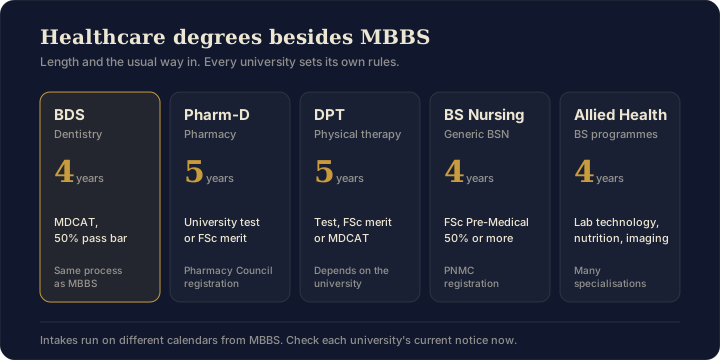
- BDS (dentistry) uses the same MDCAT, with a lower pass bar of 50% (90 out of 180). It's a four-year degree.
- Pharm-D (pharmacy) and DPT (physical therapy) are five-year degrees. Most universities use their own entry test or your FSc marks, not MDCAT.
- BS Nursing is a four-year degree. Recognised programmes ask for at least 50% in FSc Pre-Medical.
- Allied health degrees (medical lab technology, nutrition, radiology and others) are four years, with many specialisations.
- Many of these admissions run on different calendars from MBBS, and some Fall 2026 intakes have already closed. Check now, not after MBBS merit lists end.
Your options at a glance
| Degree | Length | Usual entry route | Recognition |
|---|---|---|---|
| BDS (Dentistry) | 4 years | MDCAT, 50% pass bar | PMDC |
| Pharm-D (Pharmacy) | 5 years | University test or FSc merit | Pharmacy Council of Pakistan |
| DPT (Physical Therapy) | 5 years | University test, FSc merit or MDCAT, depending on the university | Degree from an HEC-recognised university |
| BS Nursing (Generic) | 4 years | Provincial or university admission, FSc Pre-Medical 50%+ | Pakistan Nursing and Midwifery Council |
| BS Allied Health Sciences | 4 years | University test, FSc merit or MDCAT, depending on the university | Degree from an HEC-recognised university |
BDS: the closest option to MBBS
BDS uses the same MDCAT and the same admission process as MBBS, through your province's admitting university. The pass bar is lower: 50% instead of 55%. Merit usually closes lower than MBBS too.
Dentists register with PMDC, and can work in hospitals, start a private practice or specialise later.
Choose BDS only if you'd genuinely want to be a dentist. It's a different profession, not "MBBS minus one year". In Punjab, MBBS and BDS have separate application portals, so you must apply for BDS separately. Our MBBS admission process guide covers the steps.
Pharm-D: medicines and the pharmaceutical industry
Pharm-D (Doctor of Pharmacy) is a five-year, 10-semester degree. Graduates work as hospital and clinical pharmacists, in the pharmaceutical industry (manufacturing, quality control, research and sales), in regulation, or run their own pharmacy. To practise, you register with the Pharmacy Council of Pakistan, so check that a programme is accredited before you apply.
Admission example: at UHS's own campus, Pharm-D needed at least 60% in FSc Pre-Medical and at least 50% in UHS's Undergraduate Admission Test (UGAT), for Fall 2025. Many private universities admit on FSc marks plus their own test.
DPT: physical therapy and rehabilitation
DPT (Doctor of Physical Therapy) is also five years. Physical therapists treat injuries, disabilities and long-term conditions through exercise and movement. They work in hospitals, sports teams, rehabilitation centres and private clinics, and many go abroad for further study.
Admission varies widely:
- At UHS's own campus, DPT used the same UGAT route as Pharm-D for Fall 2025.
- In 2023, UHS decided that its affiliated institutions would admit DPT and allied health students on MDCAT merit (50% MDCAT, 40% FSc, 10% Matric), with admissions opening after MDCAT results.
- SZABMU in Islamabad runs its own entry test for DPT, BS Allied Health Sciences and BS Nursing. It published its first Fall 2026 merit lists on 5 October 2026.
So read each university's notice. Some will count your MDCAT score, and others won't.
BS Nursing: high demand at home and abroad
The four-year generic BS Nursing degree leads to registration with the Pakistan Nursing and Midwifery Council (PNMC). Recognised programmes ask for HSSC Pre-Medical with at least 50%, and Matric in science with Biology.
Nurses are needed in every hospital in Pakistan and are in demand abroad. In Punjab, UHS runs the central admission for public-sector nursing colleges. For 2025-26, it went through nine selection lists, so seats kept opening well into the session.
BS Allied Health Sciences: many specialisations
Allied health degrees are four years and train you for the technical side of healthcare. At UHS's own campus, the options for Fall 2025 included:
- BS Medical Laboratory Technology
- BS Speech and Language Pathology
- BS Human Genetics and Molecular Biology
- BS Transfusion Medicine and Blood Bank Technology
- BS Human Nutrition and Dietetics
Other universities offer radiology and imaging, anaesthesia technology, cardiac perfusion, optometry, operation theatre technology, dialysis and more. Sindh's Khairpur Medical College alone listed 19 BS technology programmes in its 2025-26 prospectus.
Option or retake?
This is the big decision. Starting another degree now and retaking MDCAT next year are both reasonable choices. The table below can help.
| Start another degree now if... | Retake MDCAT if... |
|---|---|
| You'd be genuinely happy in that profession | You only want to be a doctor |
| You were far from MBBS merit | You were close, and know why you fell short |
| A year's delay would be hard for your family | You can study full time for a year |
| You've found a programme you're excited about | You're ready to follow a serious plan |
If you retake, our MDCAT 2027 plan for repeaters lays out a month-by-month approach. Our guide on whether a retake is worth it covers the trade-offs. Remember that your MDCAT 2026 result stays valid for three years.
Other options for pre-medical students
Healthcare isn't the only route. Pre-medical students also go into biotechnology, biochemistry, microbiology, psychology and other sciences. Some move into computing or engineering with extra Maths: NUST, for example, lets pre-medical students apply for engineering after passing its online Mathematics course. Our guide on how to choose a degree after intermediate can help you think it through.
Before you apply anywhere
- Check the programme's recognition with its council (PMDC, the Pharmacy Council of Pakistan or PNMC) or with HEC.
- Check the intake calendar. Some universities admit in summer, some after MDCAT results, and some have spring intakes.
- Find out which test counts: MDCAT, the university's own test, or FSc marks only.
- Compare fees. Private-university fees for these degrees vary a lot.
- Talk to someone in the profession before you commit five years to it.
Frequently Asked Questions
What can I do if I don't get MBBS after MDCAT?
The main healthcare options for pre-medical students are BDS (4 years, through MDCAT with a 50% pass bar), Pharm-D (5 years), DPT (5 years), BS Nursing (4 years) and BS Allied Health Sciences (4 years). You can also retake MDCAT, since your result stays valid for three years.
Is MDCAT required for Pharm-D and DPT?
It depends on the university. At UHS's own campus, Pharm-D and DPT used UHS's Undergraduate Admission Test (UGAT) for Fall 2025. In 2023, UHS decided its affiliated institutions would admit DPT and allied health students on MDCAT merit. SZABMU runs its own entry test. Read each university's notice.
Which is better, Pharm-D or DPT?
Both are five-year degrees with good careers, so choose by interest. Pharm-D leads to hospital and clinical pharmacy, the pharmaceutical industry, regulation or your own pharmacy, with registration through the Pharmacy Council of Pakistan. DPT leads to treating injuries and disabilities in hospitals, sports teams, rehabilitation centres and clinics.
What is the eligibility for BS Nursing in Pakistan?
Recognised four-year generic BS Nursing programmes ask for HSSC Pre-Medical with at least 50%, and Matric in science with Biology. Graduates register with the Pakistan Nursing and Midwifery Council. In Punjab, UHS runs the central admission for public-sector nursing colleges.
Should I take another degree or retake MDCAT?
Start another degree now if you'd be genuinely happy in that profession, you were far from MBBS merit, or a year's delay would be hard for your family. Retake MDCAT if you only want to be a doctor, you were close and know why you fell short, and you can study full time for a year.
Next steps
- MBBS admission process 2026-27: if you're applying for MBBS or BDS.
- Private medical college fees: what private MBBS really costs.
- Backup plan strategy: build a balanced list of options.
Programme lengths and the UHS UGAT route are from UHS's Fall 2025 on-campus undergraduate admission notice. The 2023 MDCAT decision for UHS-affiliated allied health and DPT admissions is from UHS's Board of Studies, as reported by Eduvision on 21 July 2023. SZABMU details are from its Fall 2026 admission notices. Nursing eligibility is the PNMC-recognised BSN requirement that universities publish. The Khairpur programmes are from the Government of Sindh MBBS and BDS prospectus 2025-26. All were checked on 7 October 2026. Requirements differ by university and change each year, so read the current notice before you apply.