
NUST Merit Calculator 2027: Calculate Your Aggregate and NET Target
Our free NUST merit calculator works out your aggregate on NUST's 75/15/10 formula, handles the A Level route, and tells you the NET score a target aggregate needs. Here's how to use it and turn the result into a subject-wise NET target.
By ParhaiKrlo Team · Published 5 Oct 2026 · 6 min read
Updated: 5 October 2026
NUST ranks every NET candidate by one number, the aggregate, and three quarters of it comes from NET. Our free NUST merit calculator works it out in seconds, for FSc and A Level students, and works backwards from the aggregate you want to the NET score it takes.
This guide shows how to use it, how to read the result, and how to turn a NET target into marks in Maths, Physics and English.
Quick answer: the NUST merit formula
From NUST's Merit Generation Criteria:
- NET: 75%
- FSc / HSSC: 15% (FSc Part-I if you're still in second year)
- Matric / SSC: 10%
Aggregate = (NET marks ÷ 200 × 75) + (FSc % × 0.15) + (Matric % × 0.10)
A Level students in their final year: your O Level equivalence (from your IBCC certificate) gets 25%, in place of the separate 10% and 15%. NET is still 75%.
For the full rules (best-of-series scoring, gap years, ACT/SAT basis), see our guide to how the NUST aggregate is calculated.
How to use the NUST merit calculator
Open the NUST aggregate calculator. First pick your school system, then one of two tabs.
Step 1: choose Matric & FSc or A Level
- Matric & FSc: enter marks obtained and total for each. The FSc total starts at 550, because most second-year students apply on Part-I marks. If you've finished FSc, change it to your full total (usually 1100).
- A Level (final year): enter one figure, your O Level equivalence % from the IBCC certificate. Don't work it out yourself. NUST warns that self-calculated marks can affect your merit.
Step 2: "My aggregate"
Enter your NET score out of 200. If you've just finished a mock and only know your score per subject, switch to Correct by subject and type your correct answers in Mathematics (out of 100), Physics (60) and English (40). NET has no negative marking, so correct answers are your score.
You get your aggregate and how many points NET, FSc and Matric each added.
Step 3: "NET score I need"
Enter your academics and a target aggregate. The calculator gives you the whole number of NET marks needed. If the target is above what even 200/200 would give you, it tells you so and shows the highest aggregate you can reach.
Your inputs are saved in your browser, so you can try a few targets without retyping.
Worked example
The calculator page uses this example: Matric 1000/1100, FSc Part-I 470/550, NET 140/200.
| Part | Calculation | Points |
|---|---|---|
| NET | 140 ÷ 200 × 75 | 52.500 |
| FSc Part-I | 85.45% × 0.15 | 12.818 |
| Matric | 90.91% × 0.10 | 9.091 |
| Aggregate | 74.409% |
Each NET mark is worth 0.375 aggregate points. One percent in FSc is worth 0.15, so one NET mark counts for as much as 2.5% of your FSc marks.
The NET score you need
These come from the calculator's "NET score I need" tab, rounded up to whole marks:
| Your academics | For 70% | For 75% | For 78% | For 80% | For 82% |
|---|---|---|---|---|---|
| Matric 80%, FSc 75% | 136 | 149 | 157 | 162 | 168 |
| Matric 90%, FSc 85% | 129 | 142 | 150 | 156 | 161 |
| Matric 95%, FSc 92% | 125 | 138 | 146 | 152 | 157 |
A Level route (O Level equivalence × 0.25):
| O Level equivalence | For 70% | For 75% | For 80% |
|---|---|---|---|
| 80% | 134 | 147 | 160 |
| 88% | 128 | 142 | 155 |
| 95% | 124 | 137 | 150 |
Compare the top and bottom rows. Strong academics save you about 11 NET marks for the same aggregate. That helps, but NET still decides most of it. Put in your own marks for an exact figure.
Turn your NET target into subject targets
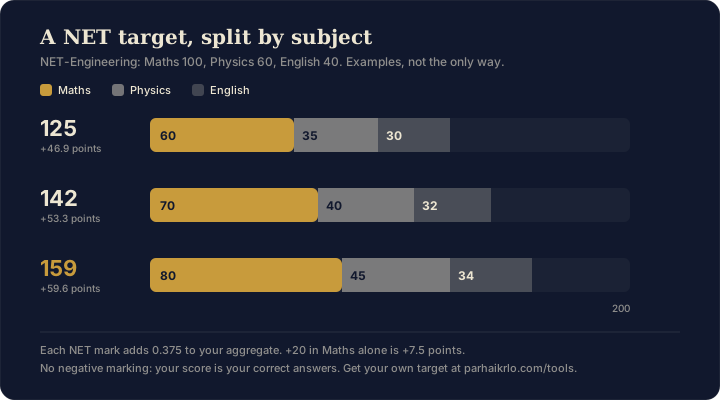
A target like "150" is hard to prepare for. A target per subject is easier. On the NET-Engineering paper (Maths 100, Physics 60, English 40), here are three ways a score can break down:
| NET total | Maths /100 | Physics /60 | English /40 | Adds to aggregate |
|---|---|---|---|---|
| 125 | 60 | 35 | 30 | 46.875 |
| 142 | 70 | 40 | 32 | 53.250 |
| 159 | 80 | 45 | 34 | 59.625 |
These are examples, not the only way to get there. Two patterns are worth knowing:
- Maths is half the paper. Moving from 60 to 80 in Maths adds 20 NET marks, or 7.5 aggregate points, on its own.
- English is the steadiest 30+. It's 40 MCQs of vocabulary, grammar and reading that reward regular practice. Our NET English guide shows how to score 35+.
Set your subject targets, sit a full mock, and enter your marks in Correct by subject to see where it puts you. Then compare with your target and work on the subject with the biggest gap.
Common mistakes with NUST merit calculators
1. Using full FSc marks with a Part-I total, or the other way round. 470/550 and 960/1100 give different percentages (85.45% vs 87.27%). Enter the marks and total that NUST will actually use. If you're in second year, that's Part-I.
2. Converting O Levels yourself. Use the IBCC equivalence figure, not your own grade-to-percentage conversion.
3. Thinking a weak attempt pulls you down. NUST uses your best NET score from the current cycle. Use the calculator with your best score, not your latest.
4. Treating any calculator's "closing merit" as official. NUST doesn't announce a cutoff in advance. Third-party estimates are guesses. Use NUST's own published closing merit for last session, and our guide on how to read NUST closing merit and merit positions, to choose a realistic target. Then add a 5 to 10 mark buffer.
Frequently Asked Questions
How does the NUST merit calculator work?
It uses NUST's formula: 75% NET, 15% FSc (Part-I if you are still in second year) and 10% Matric. Enter your marks to get your aggregate, or enter a target aggregate to get the NET score you need, rounded up to a whole mark.
How do A Level students calculate their NUST aggregate?
A Level students in their final year get 25% weight on their O Level equivalence from the IBCC certificate, in place of the separate 10% and 15%. NET is still 75%. Choose 'A Level (final year)' in the calculator and use the IBCC figure, not your own conversion.
What NET score do I need for an 80% aggregate at NUST?
With 90% in Matric and 85% in FSc you need 156 out of 200. With 80% and 75% you need 162, and with 95% and 92% you need 152. On the A Level route with 88% O Level equivalence you need 155.
Should I enter FSc Part-I or full FSc marks?
If you apply while still in second year, NUST uses your FSc Part-I marks, so enter them with the Part-I total (usually 550). If you have finished FSc, enter your full marks and total.
Can I enter my NET marks subject by subject?
Yes. Switch to 'Correct by subject' and enter your correct answers in Mathematics (out of 100), Physics (60) and English (40). This is the NET-Engineering split, and NET has no negative marking, so correct answers are your score.
Make your NET score move
- NUST NET past papers: eight full NET-Engineering papers prepared by ParhaiKrlo, 200 MCQs each with explained answers. NUST doesn't publish its own papers.
- NET 2027 pattern and syllabus: where your 200 marks come from.
- NUST NET subject-wise strategy: how to raise Maths, Physics and English.
- Which NET series to take: plan more than one attempt, since only your best counts.
- NUST NET prep hub: topic-wise practice in one place.
Applying for medicine as well? The MDCAT merit calculator works the same way on PMDC's formula.
The formula above is from NUST's Merit Generation Criteria and undergraduate admission FAQs, checked on 5 October 2026. NUST can change its policy for any cycle, so confirm there before you rely on these numbers.